
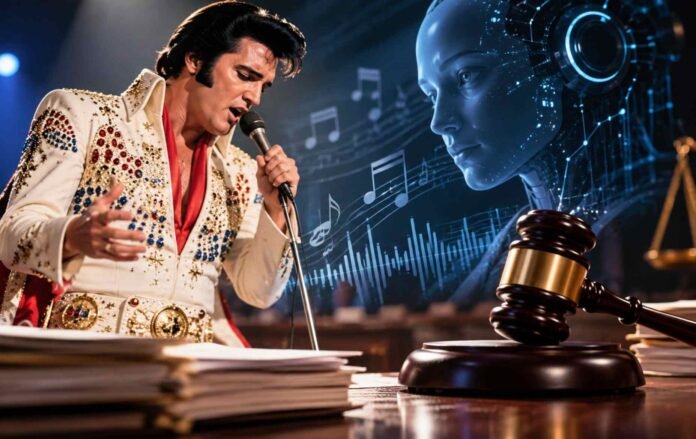
Artificial intelligence companies have spent years building increasingly powerful tools using enormous collections of online content. From books and photographs to music and journalism, human creativity has played a major role in shaping the technology we use today. However, the question of who owns that material, and whether companies should pay to use it, remains one of the biggest unresolved issues in the AI industry.
Now, the debate has reached the music of Elvis Presley.
The rights holders behind 274 songs associated with the legendary singer have filed a lawsuit against Anthropic, the company responsible for developing Claude. They allege that the AI company used copyrighted music without permission to train its models and are seeking tens of millions of dollars in damages.
Anthropic has disputed the allegations and says it intends to defend itself against the claims.
The case is another important development in the growing legal battle between creative industries and AI developers. It also raises a straightforward question: should technology companies be allowed to build commercial products using copyrighted work without obtaining permission or compensating the people who own it?
AI developers have repeatedly argued that training models on copyrighted material can qualify as fair use. That argument is now being tested in courts across several industries. But even if learning from existing material is legally different from directly reproducing it, companies should not assume that every use of copyrighted content is automatically acceptable.
Building impressive technology does not mean copyright rules should stop applying.
The Elvis lawsuit raises bigger questions about AI generated music
The allegations against Anthropic go beyond the simple question of whether copyrighted songs appeared in its training material.
According to the complaint, Claude was allegedly capable of generating material that closely resembled existing Elvis Presley songs, even after Anthropic introduced measures intended to prevent copyright infringement.
The rights holders claim that certain requests to recreate songs for modern audiences resulted in outputs that retained recognisable elements of the original recordings.
These allegations will need to be examined through the legal process. However, they highlight an important distinction in the AI copyright debate.
There is a difference between a model learning general musical characteristics and producing something that closely reproduces protected creative expression.
Copyright law does not give musicians ownership over an entire genre, musical style or artistic influence. A company should be free to develop technology that understands the characteristics of rock and roll, for example. But that freedom should not automatically extend to reproducing protected lyrics, melodies or other identifiable elements of copyrighted songs.
The same principle applies beyond music.
An AI system should not receive special treatment simply because its copying process involves complicated algorithms rather than a person manually reproducing someone else’s work.
Claude may be an impressive AI assistant, but its capabilities do not make the rights of songwriters and music publishers any less important.
The music industry has already had enough copyright battles
The Elvis Presley lawsuit is not an isolated incident. Major music publishers have previously taken legal action against Anthropic over allegations involving copyrighted song lyrics. Meanwhile, AI music generator Suno has faced legal challenges from major record labels over the use of copyrighted recordings.
These disputes reveal how quickly the music industry is being forced to respond to the growth of generative AI.
AI music tools can now produce songs, imitate broad musical characteristics and generate convincing arrangements from relatively simple instructions. While these developments offer exciting possibilities for musicians and producers, they also create difficult questions about ownership, licensing and commercial exploitation.
The problem becomes particularly serious when an artist’s work is used to develop a product that can generate similar material without a clear agreement with the original rights holders.
Elvis is an especially recognisable name, and the lawsuit could attract considerable attention because of his enormous cultural and commercial legacy. However, the underlying issue affects far more than established music catalogues.
Independent musicians, emerging songwriters and smaller publishers may have considerably fewer resources to investigate potential copyright violations or pursue legal action.
If major rights holders need to take an AI company to court to challenge alleged unauthorised use of their music, smaller creators could face an even more difficult situation.
That is why the debate should not be limited to the financial interests of large music companies. Copyright protection should apply regardless of how famous an artist is or how much money their catalogue generates.
AI innovation should not come at the expense of artists
One of the most common arguments from AI developers is that training advanced models requires access to enormous amounts of information. Restricting that access, they argue, could make innovation more expensive and slow down technological progress.
There is some truth to the argument. Licensing millions of individual creative works would be complicated, time consuming and potentially expensive.
But that is not a convincing reason to ignore copyright obligations.
Film studios, television networks and streaming platforms routinely negotiate music licences when they want to use existing songs in their productions. Businesses that depend on creative material have long understood that access does not automatically mean permission.
AI companies should be expected to follow the same basic principle.
That does not mean every copyrighted work used during AI training must automatically result in an infringement finding. The courts still need to consider questions such as fair use, the purpose of the training, the nature of the material and whether an AI system reproduces protected expression.
However, the industry also needs a more transparent approach to explaining what material goes into its models and how those works are obtained.
Creators should have meaningful ways to understand whether their work has been used, challenge unauthorised exploitation and negotiate compensation where appropriate.
The future of AI should not depend on treating human creativity as an unlimited resource that companies can collect without accountability.
The courts may ultimately rule in Anthropic’s favour. Even so, that would not necessarily settle every question surrounding the use of copyrighted music in AI systems.
The technology industry has made remarkable progress by learning from human creativity. Now it needs to demonstrate that it can respect the people behind that creativity.
Elvis Presley may have been gone for decades, but the controversy surrounding his music shows that copyright questions are far from finished. If AI companies want to turn human creativity into profitable technology, they should be prepared to recognise the rights of the people who created it.
Innovation matters, but so does permission. And the two should not have to be mutually exclusive.
Follow TechBSB For More Updates