
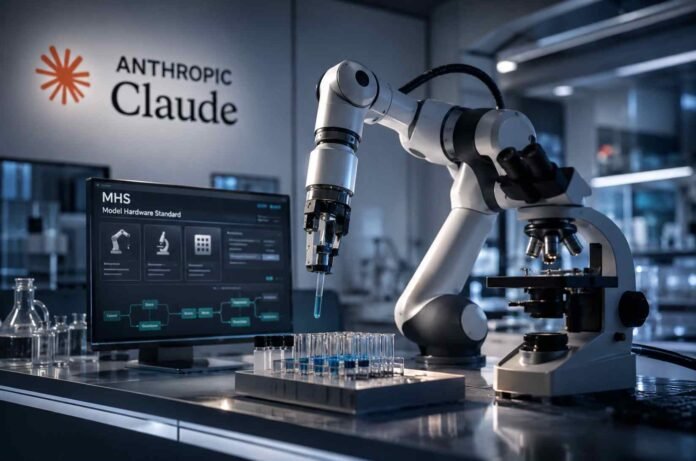
- Anthropic has introduced a preview of the Model Hardware Standard to help AI agents control programmable machines.
- The system could connect equipment such as microscopes, robotic arms and liquid handling devices through common software drivers.
- Claude has already been tested on physical tasks, including adjusting a laser using visual feedback.
- Human supervision and strong safety controls remain essential as AI begins interacting more directly with physical equipment.
Anthropic is taking another step beyond chatbots and software automation, opening a preview of a system designed to help AI agents interact with machines in the physical world.
The company’s proposed Model Hardware Standard, or MHS, aims to create a common software framework through which AI systems can understand and operate programmable equipment. That could include laboratory instruments, robotic arms, microscopes and liquid handling systems.
The idea is straightforward, even if the technical challenge behind it is significant. Instead of building a separate software connection every time an AI agent needs to work with a new piece of equipment, manufacturers could provide standardized drivers that describe what a machine can do and how it should be controlled.
For industries increasingly interested in AI-driven automation, that could remove one of the biggest obstacles to connecting intelligent software with real-world operations.
A common language for machines
Modern laboratories and industrial environments are filled with equipment built by different manufacturers. Each machine may have its own software, commands and interface, making it difficult to coordinate several systems as part of a single automated workflow.
Anthropic’s Model Hardware Standard is designed to address that problem by creating a more consistent way for software agents to interact with programmable hardware.
Under the proposed approach, drivers act as translators between an AI system and a specific machine. These drivers can expose basic capabilities, such as reading measurements, changing settings or performing particular actions.
The system can also capture information that is often buried in technical documentation or held in the experience of trained operators. Users could describe equipment and its capabilities using natural language, allowing the framework to create reference material covering what the machine can do, how it can be adjusted and what safety restrictions need to be considered.
That information could then help an AI agent identify compatible equipment across a network without requiring engineers to build a new software bridge for every device.
Anthropic believes this could dramatically simplify integration work. Processes that previously required weeks or months of custom development could potentially be completed much faster when machines are designed to support the standard.
From microscopes to robotic arms
The potential applications are broad, although MHS is currently focused on equipment with programmable interfaces.
Anthropic says the framework can support devices including microscopes, liquid handlers and robotic arms, giving AI agents a way to coordinate multiple instruments through a common interface.
That matters because the real value may not come from controlling a single machine. It could come from allowing an AI agent to manage an entire sequence of connected tasks.
A laboratory agent, for example, might collect information from one instrument, interpret the results and then instruct another machine to make an adjustment. A robotic system could potentially coordinate several pieces of equipment without an operator having to manually switch between separate control applications.
Anthropic has already tested Claude in physical experiments. One early example involved laser alignment, where the system used camera-based observations to assess the results of adjustments.
The process was iterative. Claude adjusted the laser, checked the resulting image and continued refining its actions based on what it observed.
That kind of feedback loop is important because operating physical equipment is very different from generating text or writing software. Actions have consequences in the real world, and mistakes cannot always be undone with a simple command.
Anthropic has described Claude’s approach during these tests as exploratory, similar in some respects to how a scientist might investigate an experiment while carefully evaluating each result.
Safety and supervision remain essential
The move into physical automation also brings obvious risks.
Language models can be highly capable at interpreting information and planning tasks, but they still have limitations when dealing with complex environments and physical systems. Anthropic acknowledges that expert human supervision remains necessary.
The company is using the research preview to explore safety checks and practical rules before making the technology more widely available.
That is likely to be one of the most important parts of the project. A mistake in a chatbot conversation may be inconvenient, but an incorrect instruction sent to laboratory or industrial equipment could be considerably more serious.
MHS is therefore not intended to remove humans from the process. At least for now, it appears to be aimed at giving experts a more flexible way to automate and coordinate equipment while keeping meaningful safeguards in place.
There are technical limits too. Machines without programmable interfaces cannot currently participate in the system, which means many older laboratory and industrial devices may remain outside its reach.
Anthropic says it plans to work with manufacturers to expand the availability of compatible drivers and bring more equipment into the ecosystem.
A bigger step toward AI in the physical world
The companies involved in the early preview show where Anthropic sees the strongest opportunities.
Participants include organizations working across cloud computing, biotechnology, robotics, laboratory automation and scientific research. The group includes AWS, Automata, Danaher, Doosan Robotics, MBF Bioscience, QIAGEN, Tecan and Universal Robots.
That range reflects the ambition behind the project.
AI agents are already becoming more capable at navigating software environments, using tools and completing multi-step digital tasks. The next frontier is connecting those capabilities to machines that can observe and change the physical world.
Anthropic’s Model Hardware Standard is still experimental, and there is a considerable gap between a research preview and widespread adoption. Hardware manufacturers would need to support the framework, safety practices would need to mature and organizations would have to decide how much autonomy they are willing to give AI systems.
Still, the direction is becoming clearer.
The future of AI agents may not be limited to browsers, business software and computer desktops. Standards such as MHS could eventually give them a more structured way to work with the machines that power laboratories, factories and other physical environments.
For now, Anthropic is presenting MHS as an experiment. But it is also a clear statement of how the company believes AI agents could move from understanding the digital world to operating within the physical one.
Follow TechBSB For More Updates

