
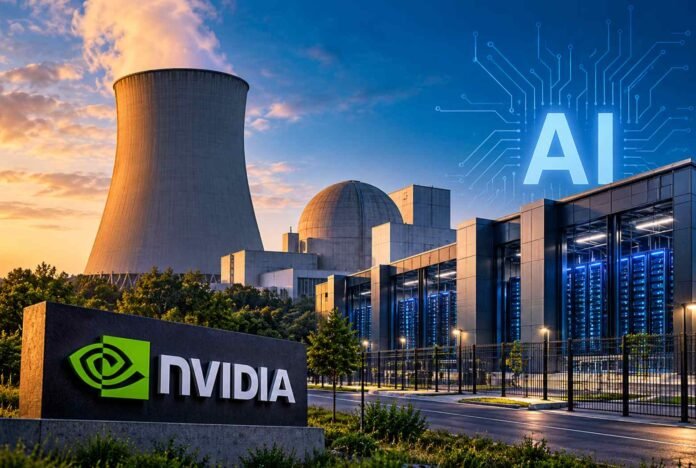
- Nvidia and PreussenElektra have signed a preliminary agreement to assess former German nuclear power plant sites for AI data centers.
- The proposal focuses on reusing existing land, grid connections, water access and industrial infrastructure, not restarting nuclear reactors.
- PreussenElektra manages the decommissioning of eight nuclear power stations, but no specific sites have been confirmed for conversion.
- Project costs, electricity capacity, planning approvals and construction schedules remain uncertain, with no binding building contracts announced.
Nvidia is exploring whether Germany’s retired nuclear power plant sites could find a second life as large scale artificial intelligence data centers. The company has signed a preliminary agreement with German utility PreussenElektra GmbH to assess whether former nuclear facilities could support the country’s growing demand for AI computing.
The proposal comes with one important condition. The companies are looking at reusing the sites and their existing infrastructure, not bringing decommissioned reactors back into operation.
For Nvidia, the appeal is straightforward. Building an AI data center requires more than servers and advanced chips. Developers also need substantial electricity connections, suitable land, water supplies and industrial infrastructure capable of supporting power hungry computing systems. Former nuclear power plant sites could offer several of these advantages in one location.
However, the plan remains at an early stage. Neither company has announced which facilities will be considered, how much investment might be required or whether any construction projects will ultimately move forward.
Why Germany’s Former Nuclear Plants Could Attract AI Companies
Germany shut down its final operating nuclear power reactors in April 2023, bringing its long running nuclear phaseout to an end. Many former nuclear facilities are now undergoing decommissioning, leaving operators with the challenge of managing industrial sites whose original purpose has disappeared.
PreussenElektra is responsible for the decommissioning of eight nuclear power stations. These properties could be among the locations examined under the new agreement, although the companies have not confirmed a list of potential sites.
The facilities could offer a useful starting point for data center development. Nuclear power stations were built to accommodate major electrical infrastructure, industrial operations and extensive utility connections. Depending on their condition, some of those assets could potentially be adapted for new uses.
Existing grid connections are particularly important as demand for AI computing continues to grow. Modern data centers can consume enormous amounts of electricity, especially when they house large clusters of high performance processors used to train and run AI models.
Securing a suitable grid connection can become a major obstacle for developers. Finding land is only one part of the process, and a site with enough space may still be unsuitable if the local electricity network cannot supply the required capacity.
Reusing former industrial locations could help developers avoid some of the delays associated with building entirely new facilities. Existing access roads, utility networks and industrial infrastructure might also reduce the amount of new construction needed.
Guido Knott, chairman of PreussenElektra’s management board, said former power plant properties have valuable industrial infrastructure and could support new uses. The company plans to work with Nvidia to assess whether the sites are suitable for AI factories.
Nvidia Rules Out Restarting the Reactors
The distinction between reusing a nuclear site and restarting its reactor is central to the proposal.
Nvidia and PreussenElektra intend to investigate the potential of existing infrastructure, including electricity connections, available land and access to water. Their agreement does not include plans to generate electricity by restarting the retired reactors.
That approach could make the proposal easier to consider in Germany, where the nuclear phaseout remains an important part of the country’s energy policy. Repurposing a former power station for computing would be a different undertaking from reversing its shutdown and returning it to nuclear power generation.
Markus Hacker, Nvidia’s senior regional director, said the companies would assess whether the sites could meet the technical and operational requirements of AI factories and contribute to Germany’s high performance AI infrastructure.
The assessment will need to establish whether each location can support the demands of modern computing facilities. That includes examining available electrical capacity, cooling requirements, the condition of existing infrastructure and the practicalities of converting industrial buildings or cleared land for data center use.
Access to water could also be an important consideration, depending on the cooling systems selected for a future facility. AI data centers generate substantial amounts of heat, and their cooling arrangements can influence both operating costs and resource consumption.
Cost Savings and Grid Capacity Remain Uncertain
Although the proposal could offer practical advantages, there is no guarantee that converting former nuclear sites will be cheaper or faster than developing new data center campuses.
The most significant question is whether the existing electricity infrastructure can meet the needs of large AI computing clusters. A former nuclear plant may have substantial electrical connections, but that does not automatically mean enough grid capacity is available for a new data center.
The actual capacity that can be supplied will depend on the condition of the connections, the surrounding electricity network and any upgrades required. If extensive improvements are necessary, some of the expected cost and time savings could disappear.
The companies will also need to consider planning permissions, construction requirements, cooling infrastructure and the condition of the sites. Decommissioning work could affect which buildings and facilities remain available for reuse. Local authorities and communities may also have a role in determining whether proposed developments can proceed.
Neither Nvidia nor PreussenElektra has disclosed a project budget, a construction timetable or binding commitments to build new facilities. The agreement is an assessment of potential opportunities rather than confirmation that the sites will become operational AI data centers.
For now, the proposal highlights how the rapid expansion of AI is changing the way technology companies approach infrastructure. As demand for computing capacity increases, developers are looking beyond traditional data center locations and considering industrial properties that already have some of the facilities they need.
Germany’s retired nuclear sites could eventually become part of that expansion. Whether they do will depend on engineering assessments, electricity availability, conversion costs and the approvals required to bring each project to life.
For Nvidia, the immediate objective is to establish whether these former power stations can provide a practical foundation for AI computing without reopening the reactors that once operated there.
Follow TechBSB For More Updates