
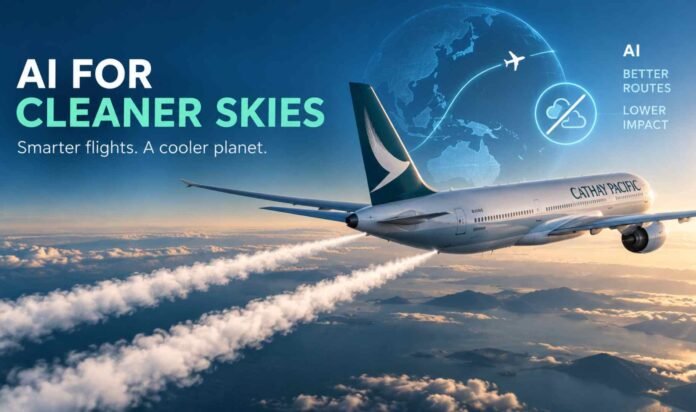
- Google and Cathay Pacific are testing AI that helps aircraft avoid atmospheric conditions likely to create persistent contrails.
- Early tests involving 80 Cathay Pacific flights reportedly reduced the warming impact of contrails by about 40%.
- The system uses satellite data, weather forecasts and AI predictions to recommend small altitude changes.
- The approach could reduce contrail related warming using existing aircraft and fuel, although larger scale testing is still needed.
A small change in the altitude of an aircraft could have a surprisingly large effect on its environmental impact. Google and Cathay Pacific are testing an AI based system designed to help aircraft avoid the atmospheric conditions that create persistent contrails, with early trials showing a reduction of about 40% in the warming effect linked to those trails.
The technology is now moving beyond a limited trial and is being introduced across Cathay Pacific’s wider network in the Asia Pacific region. The project is particularly significant because it does not require new aircraft, alternative fuels or major changes to existing flight operations.
Instead, the system identifies sections of the atmosphere where an aircraft is more likely to produce a persistent contrail. Pilots can then make relatively small adjustments to the aircraft’s altitude to avoid those areas.
The concept is straightforward, but the science behind it is more complicated.
Contrails form when hot aircraft exhaust meets very cold and humid air at cruising altitude. Under the right conditions, water vapour can freeze around particles in the exhaust and create tiny ice crystals. These crystals can form the familiar white lines seen behind aircraft.
Not every contrail has the same environmental effect. Some disappear relatively quickly, while others can remain for hours and spread into broader areas of cloud. These persistent contrails can influence the amount of heat retained in the atmosphere, adding to aviation’s overall climate impact.
AI looks for the right atmospheric conditions
Google’s system combines several sources of information to predict where persistent contrails are most likely to form. Satellite observations, weather forecasts and AI based atmospheric modelling are used to identify areas that aircraft may want to avoid.
The objective is not to redesign an entire flight path. Instead, the system can recommend small changes in altitude that allow an aircraft to pass through a different section of the atmosphere.
That makes the idea potentially easier to introduce into existing airline operations.
According to Google, the recommended adjustments are similar to altitude changes already made for operational reasons. The company says the system is designed with flight safety and normal cockpit procedures in mind.
Information can also be provided to aircraft through in flight connectivity, allowing recommendations to reach crews without creating a separate process that would interfere with standard cockpit workflows.
This matters because any climate technology used in commercial aviation has to work within a highly regulated and operationally demanding environment. A solution that requires substantial changes to aircraft or flight procedures would naturally face a much higher barrier to adoption.
Early Cathay Pacific trials show promising results
Cathay Pacific has already tested the system on 80 flights. Google says those flights produced an approximately 40% reduction in the warming impact associated with contrails.
That figure should be viewed as an early trial result rather than a guarantee that every flight can achieve the same reduction. Atmospheric conditions vary significantly from one flight to another, and the effectiveness of contrail avoidance depends on whether suitable alternative altitudes are available.
Even so, the results point to an interesting opportunity for the aviation industry.
Airlines already have sophisticated systems for managing fuel consumption, weather, traffic and flight routes. Adding contrail formation to that decision making process could allow aircraft operators to reduce an often overlooked part of aviation’s climate footprint.
The potential benefit is also notable because the approach can be used with existing aircraft and conventional aviation fuel.
Google has previously explored similar contrail avoidance work in other regions, including US airspace and transatlantic routes. Expanding the project into the Asia Pacific region gives researchers another large and diverse operating environment in which to test the technology.
That region is also seeing rapid growth in air travel, making the timing of the project particularly relevant.
Why contrail avoidance could become important
Aviation emissions are usually discussed in terms of carbon dioxide and other gases produced when jet fuel is burned. Contrails add another layer to the picture.
Their climate effect is difficult to measure precisely because it depends on atmospheric conditions, the duration of the contrail and the way the resulting cloud interacts with incoming and outgoing radiation.
This makes targeted avoidance attractive. Rather than trying to prevent contrails on every flight, an airline could focus on flights and atmospheric regions where persistent contrails are expected to have a particularly strong warming effect.
Research cited by the nonprofit Contrails.org suggests that avoiding contrail formation on a relatively small proportion of flights could prevent a much larger share of contrail related warming. The exact outcome would depend on how accurately high impact regions can be identified and how easily aircraft can alter their routes.
For airlines, the appeal is clear. The technology could potentially reduce part of aviation’s climate impact without waiting for the wider adoption of new aircraft designs, sustainable fuels or other long term solutions.
There are still questions to answer. Airlines will need to determine how consistently the system works across different weather patterns, how much additional fuel may be consumed by altitude changes and how the recommendations interact with air traffic management.
The technology will also need to demonstrate that climate benefits remain worthwhile when the operational costs of making those changes are taken into account.
For now, the Cathay Pacific trials provide an encouraging indication that AI could help airlines make more informed decisions about where aircraft fly, rather than simply focusing on how much fuel they burn.
If the approach continues to perform well at a larger scale, avoiding the right atmospheric conditions could become another practical tool for reducing aviation’s environmental footprint.
Follow TechBSB For More Updates

