
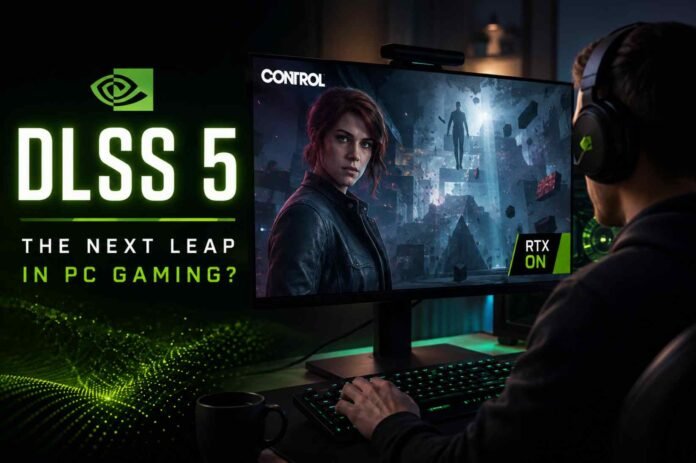
- A leaked experimental version of DLSS 5 has been tested in Control by modders.
- Gamer reaction appears far more positive than during Nvidia’s original DLSS 5 reveal.
- The visual improvements look promising, but some players still dislike the AI enhanced character models.
- Performance is the biggest concern after early tests reportedly showed a major frame rate drop.
Nvidia’s DLSS 5 has had a difficult start in the court of public opinion. Ever since the company introduced its next generation neural rendering technology, many PC gamers have reacted with suspicion, frustration and, in some cases, outright hostility.
The biggest complaint was simple: gamers did not want AI interfering with the look of their games.
Early demonstrations led to accusations of artificial looking visuals and unwanted changes to characters and scenes. The phrase “AI slop” became an easy way for critics to dismiss the technology, and Nvidia found itself defending an idea that was supposed to represent the next major step in PC graphics.
But a newly discovered and unofficial version of the technology may be changing that conversation.
A leaked neural rendering DLL reportedly found alongside NBA 2K27 early access files has been explored by members of the modding community, who managed to get the experimental technology running in Control. The results are far from a finished product, and there are plenty of reasons to remain cautious, but the reaction from gamers has been noticeably different this time.
For the first time, a significant number of previously skeptical players appear willing to admit that DLSS 5 could be something genuinely exciting.
An early glimpse at what DLSS 5 could become
The most important thing to remember is that none of this represents an official Nvidia release. The software involved appears to be experimental, its development status is unclear, and modders have had to make it work in a game that was never designed around the technology.
Still, the footage and screenshots circulating from the Control experiment have given gamers something they did not get from Nvidia’s original demonstrations: a chance to see the technology operating in a familiar game.
At the moment, the neural rendering effect appears to be focused largely on character models rather than entire environments or objects. Even with that limitation, some viewers have been impressed by the potential.
That is particularly significant because character rendering was one of the biggest sources of controversy when DLSS 5 was first shown. Faces and human features can quickly fall into uncanny valley territory, and early demonstrations left many gamers worried that AI enhancement would replace an artist’s work with something synthetic and visually inconsistent.
The experimental Control results have not convinced everyone, but they appear to have demonstrated that the underlying technology may be more capable than the original presentation suggested.
In other words, perhaps the problem was not necessarily the idea behind DLSS 5. Perhaps Nvidia simply did a poor job of showing what it could really do.
Gamers begin changing their minds
The shift in tone is one of the most interesting parts of this story.
PC gaming communities are still filled with criticism, but there is now considerably more curiosity than there was during the initial reveal. Some gamers who dismissed the technology immediately are beginning to acknowledge that the concept itself could have enormous potential if Nvidia gives developers enough control over how it is used.
That distinction matters.
AI assisted rendering could be used aggressively, changing the appearance of a game so dramatically that it barely resembles the original artistic vision. But it could also work as a subtle enhancement layer, improving lighting, materials, faces or fine visual details without replacing the work created by developers.
The leaked software reportedly includes different styles along with controls for elements such as intensity, tone and structure. Whether those options reflect what Nvidia eventually plans to ship remains unknown, but they offer a glimpse into how neural rendering might be adjustable rather than simply switched on or off.
That possibility is helping change the conversation.
Gamers who previously saw DLSS 5 as an unavoidable AI filter are now considering another possibility: what if it becomes a tool that developers can carefully tune to improve graphics?
That is a much easier idea to sell.
The performance problem is still impossible to ignore
There is, however, one major issue standing in the way of the current excitement: performance.
Early testing in Control reportedly showed a dramatic reduction in frame rates when neural rendering was enabled. A system using an RTX 5070 Ti at 4K with high ray tracing settings and DLSS Quality reportedly dropped from around 71fps to roughly 35fps.
That is a massive hit.
Nobody buying a modern graphics card wants to sacrifice half their performance for better looking visuals, particularly when DLSS itself became popular because it offered the opposite proposition. DLSS was designed to improve performance while maintaining, and often improving, image quality.
However, it would be premature to treat these numbers as representative of the final DLSS 5 experience.
This is apparently leaked and experimental software being forced into an older game by modders. Nvidia has not confirmed the code, the version, its intended hardware requirements or its level of optimization.
There is also no realistic scenario in which Nvidia would release a major gaming feature that routinely cuts frame rates in half and expect widespread adoption.
The performance results are concerning, certainly, but they are not yet a verdict on the finished technology.
DLSS 5 could still have a difficult road ahead
Despite the growing enthusiasm, plenty of gamers remain unconvinced.
Some still believe the enhanced character models look unnatural. Others are concerned that screenshots can hide problems that become much more obvious when the game is moving. There are also legitimate questions about developer control, hardware requirements and whether the technology could eventually become another feature limited to Nvidia’s newest GPUs.
Those concerns deserve answers.
DLSS 5 could be technically impressive and still fail to win over players if it is too demanding, too restrictive or too aggressive in changing the look of games.
But this leak has achieved something Nvidia’s original demonstrations struggled to accomplish: it has made people curious.
The conversation is no longer dominated entirely by anger and mockery. More gamers are now asking what the technology could do for games such as Control, Microsoft Flight Simulator and other visually demanding titles.
That does not mean Nvidia has won the argument. Far from it.
But the early reaction suggests DLSS 5 may have more potential than its controversial debut indicated. If Nvidia can preserve performance, give developers meaningful control and avoid the artificial look that worried so many players, neural rendering could eventually become one of the biggest changes to PC graphics in years.
For now, though, this remains an intriguing experiment rather than proof of a finished revolution.
Follow TechBSB For More Updates