
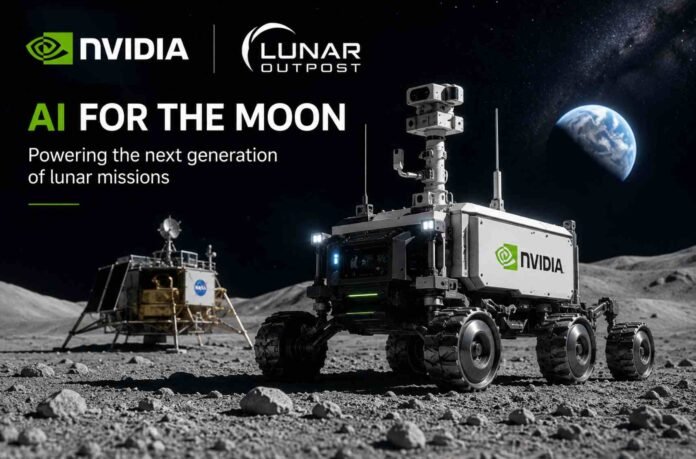
- Nvidia will provide Jetson edge AI technology for Lunar Outpost’s future Moon missions.
- Lunar Voyage 2 will use AI for navigation, mapping, LiDAR processing, and scientific analysis.
- The partnership supports NASA Artemis goals and long term lunar infrastructure.
- Future missions will combine autonomous robotics with astronauts to help build a sustainable Moon base.
Nvidia is taking another significant step beyond Earth by partnering with Lunar Outpost to bring advanced edge AI computing to future lunar missions. The collaboration will see Lunar Outpost integrate Nvidia’s Jetson platform and CUDA X software libraries into its next generation robotic systems, enabling autonomous navigation, scientific research, terrain mapping, and onboard data processing directly on the Moon.
Unlike traditional space missions that rely heavily on constant communication with Earth, these AI powered systems will make decisions locally. That is a major advantage because signals traveling between Earth and the Moon experience noticeable delays, making real time human control difficult for complex operations.
The partnership is designed to support Lunar Outpost’s expanding role in NASA’s Artemis program, which aims to establish a long term human presence on the Moon. As missions become more ambitious, spacecraft and robotic explorers will increasingly need the ability to process information independently without waiting for instructions from mission control.
According to Nvidia, its edge AI technologies will allow Lunar Outpost’s rovers to analyze their surroundings, identify hazards, generate maps, process scientific data, and manage communications while operating in one of the harshest environments ever explored.
Lunar Voyage 2 will be the first major test
The first major deployment of the partnership is expected during the Lunar Voyage 2 mission, which is scheduled to launch during the second half of 2026 aboard a SpaceX Falcon 9 rocket.
The mission will target Reiner Gamma, one of the Moon’s most unusual geological formations. Often referred to as a lunar swirl, the region has intrigued scientists for decades because of its bright, swirling surface patterns that remain poorly understood.
Lunar Voyage 2’s rover will use Nvidia Jetson modules to manage its LiDAR based command and control systems while handling onboard navigation and environmental mapping. Rather than sending every piece of raw data back to Earth, the rover will process much of the information locally, allowing it to react faster to changing terrain and unexpected obstacles.
This onboard intelligence is expected to improve mission efficiency while reducing communication demands between the spacecraft and mission controllers on Earth.
Chen Su, Head of Edge AI Product Marketing at Nvidia, said lunar exploration requires intelligent systems capable of processing data and making decisions in real time. He added that Nvidia’s Jetson platform and CUDA X libraries provide the computing performance needed for autonomous navigation, terrain mapping, mission data processing, and scientific discovery.
Building toward a permanent Moon presence
The Nvidia partnership represents more than a single mission. It aligns closely with Lunar Outpost’s broader vision of supporting long term human exploration beyond Earth.
The company has already built an impressive resume in space technology. It previously worked with NASA and the Massachusetts Institute of Technology on the MOXIE project, which successfully demonstrated oxygen production from the Martian atmosphere between 2021 and 2023. That experience has strengthened Lunar Outpost’s position as one of the leading private companies developing technologies for future space infrastructure.
More recently, Lunar Outpost secured a contract to design and deliver the Pegasus Lunar Terrain Vehicle for NASA. The vehicle is expected to play an important role in Artemis missions by transporting astronauts and equipment across the lunar surface.
Founder and Chief Executive Officer Justin Cyrus described Nvidia as the benchmark for advanced AI computing and said the collaboration would help deliver increasingly intelligent systems on the Moon while supporting the long term objective of building a sustainable lunar base.
As future missions involve both astronauts and autonomous machines working together, AI will become an essential tool for improving safety, efficiency, and scientific productivity.
Future missions will expand AI capabilities
The partnership is expected to grow considerably over the next several years.
Following Lunar Voyage 2, Lunar Outpost plans to deploy Nvidia’s Space 1 Vera Rubin Module during Lunar Voyage 3 and Lunar Voyage 5. These future missions are expected to showcase even more advanced capabilities, including real time data processing, live video streaming from the Moon, autonomous mapping, and coordinated human robot exploration.
Lunar Outpost currently has contracts supporting nine additional lunar and cislunar missions before the end of the decade. As activity around the Moon accelerates through government and commercial programs, onboard AI is likely to become one of the defining technologies of modern space exploration.
Processing information directly where it is collected reduces reliance on limited communication bandwidth while allowing spacecraft to respond immediately to changing situations. That capability will become increasingly valuable as missions travel farther from Earth and operate for longer periods without continuous human supervision.
The Nvidia and Lunar Outpost partnership reflects a broader shift in the space industry toward intelligent autonomous systems.
Rather than serving only as remote controlled machines, future lunar vehicles will function more like independent explorers capable of making informed decisions in real time. That evolution could play a central role in establishing a permanent human presence on the Moon and eventually supporting missions deeper into the solar system.
Follow TechBSB For More Updates

