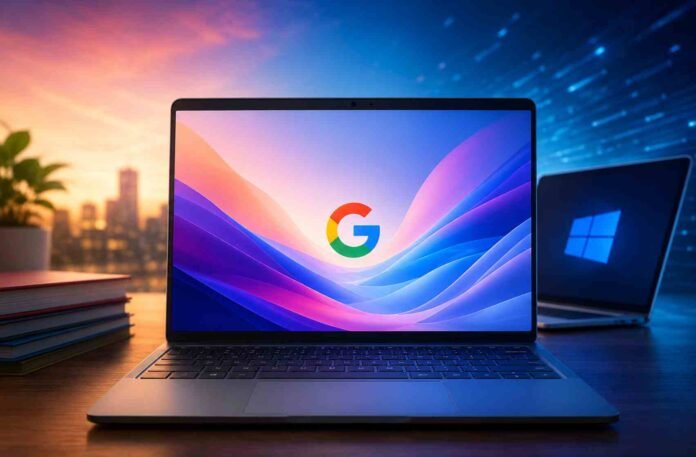
- Googlebooks signals Google’s shift from cloud first laptops to AI first personal computing.
- Android is expected to provide better app performance and tighter ecosystem integration.
- Google is positioning Googlebooks as a direct competitor to Windows instead of just replacing Chromebooks.
- Success will depend on whether Google’s AI experience can outweigh Windows’ software advantage.
Google appears ready to take the next major step in its personal computing strategy with Googlebooks. While Chromebooks are expected to remain available for some time, the company’s direction suggests that Googlebooks will gradually become its primary laptop platform. This is not simply a refreshed Chromebook with a different name. Instead, it represents a broader shift from Google’s long standing cloud first philosophy toward an AI first computing experience.
For years, Chromebooks have been known for their affordability, security, and ease of management. These strengths made them particularly successful in schools, where millions of students became familiar with Google’s ecosystem. That widespread adoption has created something valuable for Google. A generation of users has grown up using Chrome OS instead of Windows, and the company now has an opportunity to keep those users within its ecosystem as they enter college and the workforce.
The transition to Googlebooks reflects changing expectations in personal computing. Artificial intelligence is becoming central to how people interact with devices, and Google wants its next generation of laptops to be designed around AI from the very beginning rather than treating it as an additional feature.
Android Gives Googlebooks a Stronger Foundation
One of the biggest changes behind Googlebooks is its reported move to an Android based platform. This decision could solve several limitations that have followed Chromebooks over the years.
Although Chrome OS has supported Android applications, the experience has often felt secondary. Performance has varied, app compatibility has not always been ideal, and the integration between mobile and desktop experiences has remained inconsistent. Building Googlebooks directly on Android could significantly improve how applications perform while offering a more seamless connection between phones, tablets, and laptops.
This move also reflects how Google’s priorities have evolved. Early Chromebooks were designed around web applications and cloud services, minimizing the need for powerful local hardware. That approach worked well for basic productivity, education, and internet based tasks. However, AI powered features increasingly rely on stronger hardware and deeper operating system integration.
By shifting toward Android, Google gains greater flexibility to build AI features directly into the operating system instead of relying primarily on browser based experiences. This creates room for smarter assistants, more personalized workflows, and better on device intelligence that responds instantly without depending entirely on cloud processing.
A New Battle With Windows Begins
The real competition for Googlebooks may not be Chromebooks at all. Instead, Google’s attention appears focused squarely on Windows PCs.
Microsoft is also investing heavily in AI powered computing, integrating intelligent features across Windows while expanding support for advanced processors capable of handling demanding AI workloads. Although Microsoft’s AI strategy is still evolving, it already benefits from decades of desktop software support and an enormous developer ecosystem.
Google understands that matching Windows application libraries alone would be difficult. Instead of trying to replicate Microsoft’s strengths, the company seems prepared to compete on an entirely different front by delivering an operating system where AI is the foundation of the experience.
This strategy could prove effective because personal computing is entering a new phase. Traditional software remains important, but users increasingly expect devices to summarize information, automate repetitive work, generate content, and understand natural language commands. If Googlebooks delivers these capabilities in a smooth and reliable way, it may appeal to users who value intelligent assistance more than access to legacy desktop software.
Google also benefits from deep integration with services such as Search, Gmail, Docs, Photos, and Gemini. Bringing these experiences together within an AI first operating system could create a compelling alternative for users already invested in Google’s ecosystem.
Why Timing Could Work in Google’s Favor
The timing of Google’s reported strategy may be one of its biggest advantages. Millions of students who spent years using Chromebooks are now entering higher education and professional environments where Windows has traditionally been the default choice.
Instead of forcing these users to adapt to Windows, Google can offer a familiar environment that feels more capable, modern, and AI driven. If Googlebooks successfully combines the simplicity people appreciated in Chromebooks with significantly more powerful features, it could become a natural upgrade path.
At the same time, the premium Chromebook Plus initiative has already shown that consumers are willing to spend more on Google’s hardware when the experience improves. Better build quality, stronger performance, and earlier access to AI features have demonstrated that Google’s audience extends beyond budget conscious buyers.
The challenge, however, will be convincing developers and enterprise customers that Googlebooks can meet their long term productivity needs. Windows still dominates professional computing, creative software, and business infrastructure. Closing that gap will require more than AI innovation.
Even so, the arrival of AI centered operating systems changes the competitive landscape. Rather than competing solely through hardware specifications or application catalogs, future platforms may be judged by how intelligently they help users complete everyday tasks.
If Google executes this vision effectively, Googlebooks could become much more than the successor to Chromebooks. It could emerge as Google’s strongest attempt yet to reshape the laptop market and establish itself as a genuine competitor to Windows in the AI era.
Follow TechBSB For More Updates