
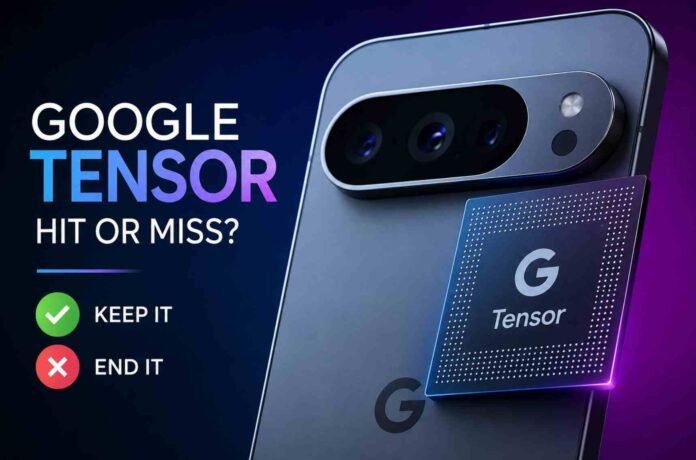
- Most Pixel users in a recent poll believe Google should move away from Tensor because of battery, heat, and performance issues.
- Tensor continues to offer AI focused features, but competitors have largely caught up in artificial intelligence capabilities.
- Supporters believe Google should continue investing in Tensor, comparing its journey with Apple’s early custom chip development.
- The Pixel 11 and Tensor G6 are expected to focus on better efficiency and battery life, areas users consider the highest priority.
Google’s decision to build its own Tensor processors was meant to reshape the Pixel experience. When the first Tensor chip arrived in 2021, the company promised smarter AI features, tighter hardware and software integration, and a unique identity that would separate Pixel phones from the sea of Android devices powered by Qualcomm Snapdragon processors.
Nearly five years later, that vision remains a work in progress.
A recent reader poll shows that many Pixel users have lost confidence in Google’s in house chipset strategy. While Tensor has helped introduce exclusive AI powered experiences, complaints about battery life, heat management, and overall performance continue to overshadow those software advantages. Even so, a sizeable group of Pixel fans believes Google should remain committed to Tensor and continue refining the platform rather than abandoning it.
Most readers believe Tensor has not lived up to expectations
A poll of more than 1,700 readers paints a clear picture of current sentiment surrounding Google’s custom silicon. Around 69 percent of respondents believe Google should stop using Tensor chips because the company has not been able to deliver a competitive experience. Roughly 31 percent still support Google’s long term investment, arguing that the benefits outweigh the drawbacks.
The results reflect frustrations that have been building across multiple Pixel generations. While Google’s software experience remains one of the strongest in the Android ecosystem, many users feel the hardware powering those features has consistently lagged behind the competition.
Battery endurance has become one of the biggest concerns. Pixel devices powered by Tensor often struggle to match similarly priced smartphones equipped with Snapdragon processors or Apple’s latest A series chips. Heat generation during gaming, video recording, or extended camera sessions has also been a recurring criticism, with some users reporting noticeable throttling during demanding workloads.
Performance is another sticking point. Although everyday tasks remain smooth, Tensor processors have rarely challenged flagship Snapdragon or Apple silicon when it comes to raw CPU and GPU power. That gap has become increasingly difficult to ignore as rival chipsets continue to improve efficiency while maintaining stronger sustained performance.
AI strengths have not erased hardware concerns
Google designed Tensor primarily to accelerate artificial intelligence and machine learning tasks rather than compete solely on benchmark scores. Features such as advanced voice recognition, real time translation, image processing, and on device AI have become defining parts of the Pixel experience because of this approach.
However, many users now question whether Tensor’s AI advantages remain exclusive. Competing flagship processors from Qualcomm and Apple have significantly improved their own AI capabilities over the past few years, narrowing the gap that once helped justify Google’s custom silicon strategy.
Some Pixel owners argue that Tensor no longer offers a meaningful advantage in AI performance while still trailing competitors in battery efficiency, graphics capability, and sustained processing power. For buyers spending premium smartphone prices, that trade off has become increasingly difficult to accept.
The frustration extends beyond hardware alone. Some users also feel Google has limited newer software features to recent Pixel devices despite older models having capable hardware. That perception has led to concerns that software support decisions are reducing the long term value of Pixel phones.
Many Pixel fans still believe Google should stay committed
Despite the criticism, Tensor continues to have loyal supporters who believe Google should not abandon its long term vision.
Many compare Google’s journey with Apple’s early years of developing custom processors. Apple’s first generations of A series chips were not industry leaders overnight. Instead, they improved steadily over several product cycles before becoming the benchmark for smartphone performance and efficiency.
Supporters believe Google deserves the same opportunity. Developing competitive silicon is a long term investment that requires multiple generations of refinement. Switching back to Snapdragon could solve some immediate hardware concerns, but it would also reduce Google’s ability to optimize hardware and software together in ways that make Pixel devices unique.
Some Pixel owners also point out that they choose Google’s phones for reasons beyond benchmark numbers. The camera experience, timely Android updates, exclusive software features, and clean interface remain major selling points. For these users, improvements to battery life and thermal efficiency matter more than chasing the highest processing scores.
Pixel 11 could be an important test for Tensor
Early reports suggest the upcoming Pixel 11 series will continue using Google’s Tensor platform. Rumors indicate the next generation Tensor G6 may feature newer Arm CPU cores that promise better overall performance, although expectations for graphics improvements remain modest.
If those reports prove accurate, Google’s biggest challenge will not be adding more AI features but addressing long standing complaints about power efficiency, heat management, and battery endurance.
Another reader poll highlights exactly what consumers want from the next Pixel generation. Better battery life emerged as the highest priority, attracting more than half of all votes. Improved performance ranked second, while faster charging and camera upgrades received far less attention.
That suggests Google’s priorities for future Tensor chips are already clear. Buyers are asking for a processor that delivers dependable everyday efficiency alongside Google’s software strengths rather than simply adding new AI capabilities.
Follow TechBSB For More Updates