
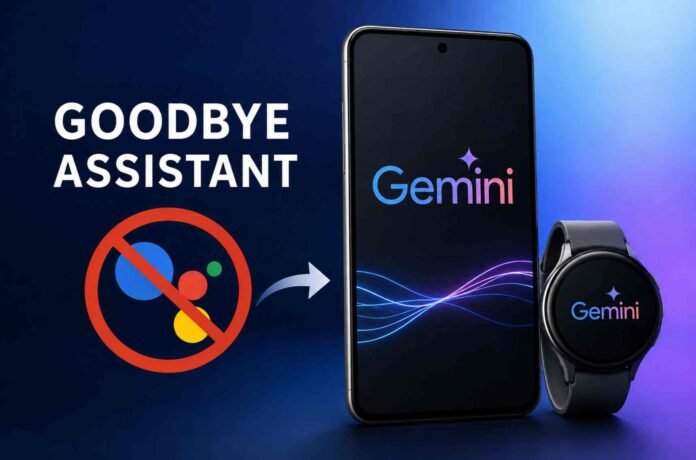
- Google Assistant will begin disappearing from Android and Wear OS devices starting September 4.
- The rollout will happen gradually and may take several weeks to reach all users.
- Once removed, users will not be able to switch back to Google Assistant.
- Google is replacing Assistant with Gemini as its primary AI powered assistant across Android devices.
Google Assistant is officially nearing the end of its run. After months of speculation and Google’s gradual transition toward Gemini, the company has confirmed that Google Assistant will begin disappearing from Android phones, tablets, and Wear OS smartwatches starting in September.
The move marks the end of one of Google’s most recognizable consumer products. Introduced in 2016, Google Assistant became the company’s answer to voice assistants like Apple’s Siri and Amazon’s Alexa. Over the years, it powered millions of smartphones, smartwatches, smart speakers, and connected devices, helping users perform everyday tasks through simple voice commands.
Now, Google is completing its long planned shift toward Gemini, its AI powered assistant that offers more advanced conversational abilities and deeper integration with Google’s ecosystem. Once the transition begins, users will no longer have the option to switch back to Google Assistant on supported Android devices.
September Rollout Will Remove Google Assistant
According to notifications sent to users, Google Assistant will start being removed from Android devices on September 4. The rollout will happen in stages, meaning not every eligible device will lose access on the same day. Google says the transition could take several weeks before it reaches all users.
The company has also made it clear that once Google Assistant is removed from a device, it cannot be restored or selected again. Phones, tablets, and paired Wear OS devices will instead rely on Gemini as Google’s default assistant experience.
This gradual rollout is designed to avoid disruptions while giving users time to become familiar with Gemini. Many newer Android devices already ship with Gemini as the default assistant, making the change less surprising for recent buyers.
For users who have relied on Google Assistant for years to control smart home devices, manage reminders, check the weather, or send messages, the transition represents a significant change in the way they interact with Google’s services.
Gemini Becomes Google’s Main AI Assistant
Google’s decision reflects a broader strategy that has been unfolding throughout the past two years. Instead of modernizing Google Assistant with generative AI capabilities, the company chose to build its future around Gemini.
Gemini offers a more conversational experience compared to the traditional command based interactions that defined Google Assistant. It is designed to understand context better, generate detailed responses, assist with writing, summarize information, and perform more complex tasks using artificial intelligence.
The company has steadily expanded Gemini across Android smartphones, productivity apps, and Google services. As a result, Google Assistant has gradually taken a back seat, with fewer new features arriving while Gemini continued receiving regular improvements.
The retirement of Google Assistant is therefore less of a surprise and more of the final step in Google’s AI transformation. The company had already signaled that Gemini would become its primary assistant across devices, but users now have a clear timeline for when that change will become permanent.
End of an Era for Google’s Voice Assistant
When Google Assistant debuted in 2016, it quickly established itself as one of the smartest voice assistants available. Its natural voice recognition, fast search integration, and growing compatibility with third party devices helped it stand out in a competitive market.
Over time, it became a central feature across Google’s hardware lineup, including Pixel smartphones, Nest speakers, smart displays, Android Auto, and Wear OS smartwatches. Millions of users came to rely on it for everyday productivity and smart home automation.
However, the rapid rise of generative AI has changed expectations around digital assistants. Instead of simply responding to commands, users increasingly expect assistants to understand conversations, provide detailed answers, and assist with creative and professional tasks.
Google’s competitors are following similar paths. Amazon has introduced a more capable AI powered version of Alexa, while Apple is preparing major AI upgrades for Siri. Google’s answer is not an upgraded Google Assistant but a completely different platform built around Gemini.
The retirement of Google Assistant joins a growing list of well known technology products that have been phased out as companies shift toward newer platforms. While many users may miss the familiar assistant that served them for nearly a decade, Google believes Gemini represents the next generation of AI experiences across Android and beyond.
For Android users, September marks the official end of Google Assistant’s journey and the beginning of a future centered entirely on Gemini.
Follow TechBSB For More Updates