
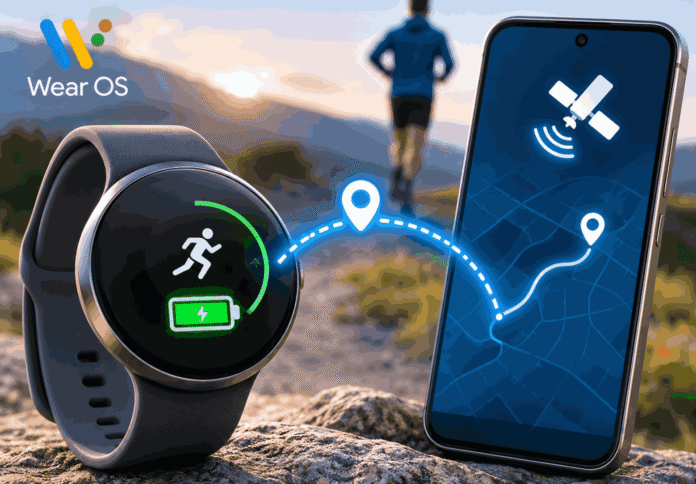
Wear OS smartwatches are getting a useful upgrade that could make long outdoor workouts less stressful for users worried about battery life. Google’s latest Google Play Services update introduces a feature that allows compatible smartwatches to use an Android phone’s satellite positioning system to track location during workouts.
The change could make a noticeable difference for people who regularly go running, walking or cycling while wearing a Wear OS smartwatch. Instead of relying entirely on the watch’s built in GNSS receiver, the device can use the location tracking hardware in a connected smartphone.
This means the smartwatch can potentially save a considerable amount of battery during outdoor activities, allowing users to track their workouts without draining their watch as quickly.
The feature arrives through Google Play Services version 26.45, and it is particularly interesting for owners of devices such as the Google Pixel Watch and Samsung Galaxy Watch series.
There is one important catch, though. You will need to carry your Android phone during your workout to benefit from the improvement. The phone must also have Battery Saver switched off for the feature to work.
Google lets Wear OS watches use an Android phone’s GNSS
The latest Google Play Services update introduces an alternative way for Wear OS smartwatches to handle location tracking during outdoor workouts.
Previously, smartwatches generally relied on their own GNSS receivers to determine their location. While this approach allows users to leave their phones at home and still record outdoor activities, it can consume a noticeable amount of battery.
That becomes particularly important during longer workouts. Running, hiking and cycling sessions can keep satellite positioning active for extended periods, putting additional pressure on a smartwatch’s relatively small battery.
With Google Play Services version 26.45, Wear OS devices can use the GNSS hardware in a connected Android phone instead.
GNSS stands for Global Navigation Satellite System. It is a general term covering satellite based positioning technologies, including GPS and Galileo.
By shifting location tracking to the smartphone, the smartwatch no longer needs to rely entirely on its own positioning hardware during supported workouts.
This should help reduce power consumption on the wearable, potentially extending its battery life during longer outdoor activities.
The improvement is particularly useful because smartwatch batteries are considerably smaller than smartphone batteries. Even when both devices perform similar location tracking tasks, the impact on their respective battery levels can be very different.
Your smartwatch battery benefits, but your phone takes the strain
Although the update is good news for smartwatch owners, it does not eliminate battery consumption altogether.
Instead, it shifts some of the workload from one device to another.
When your Wear OS watch uses your phone’s GNSS receiver, the smartphone has to handle satellite based location tracking. That means your phone’s battery will also drain during the workout.
However, smartphones generally have much larger batteries than smartwatches, giving them more capacity to handle demanding tasks.
For example, someone going on a lengthy run might previously have noticed their smartwatch losing a significant amount of battery because its GNSS receiver remained active throughout the session.
With the new feature, the watch can rely on the connected phone for location information, reducing the workload on its own hardware.
This could be especially helpful for people who regularly track longer outdoor activities and want to preserve enough battery for the rest of the day.
There are two important conditions to remember.
First, you will need to carry your Android smartphone with you. If you prefer leaving your phone at home during a run, this feature will not offer much practical benefit.
Second, your phone must not be running Battery Saver mode. According to the reported feature details, the phone’s power saving mode prevents this location sharing functionality from working.
So, while the update offers a convenient way to conserve smartwatch battery, it requires users to make a small compromise.
Which Wear OS smartwatches will receive the feature?
The biggest unanswered question concerns device compatibility.
Google Play Services version 26.45 introduces the functionality, but it is not yet clear whether every Wear OS smartwatch will support it.
That leaves some uncertainty for owners of popular devices, including the Google Pixel Watch 5 and Samsung Galaxy Watch 9.
The feature could become available across a wider range of Wear OS devices, but the current information does not confirm universal compatibility.
It is therefore worth checking whether the functionality appears on your smartwatch after your phone receives the latest Google Play Services update.
Google Play Services updates are generally installed automatically, so many users may receive the feature without needing to do anything.
However, if you want to check manually, you can follow these steps:
- Open Settings on your Android phone.
- Go to Google.
- Select All services.
- Open System services.
- Select Google Play services.
- Check whether an update is available and install it if necessary.
Once the update is installed, you can check whether your Wear OS smartwatch supports phone based GNSS tracking during outdoor workouts.
The feature is a welcome addition for anyone who regularly uses their smartwatch to monitor physical activity. It also shows how software improvements can make existing wearable hardware more useful without requiring users to purchase a new device.
Google has not confirmed whether every smartwatch model will receive the functionality, so compatibility will be an important factor.
For now, the update offers a practical solution to one of the more frustrating limitations of wearable technology. You get to preserve more battery on your wrist, although your smartphone will have to do a little more work.
Follow TechBSB For More Updates