
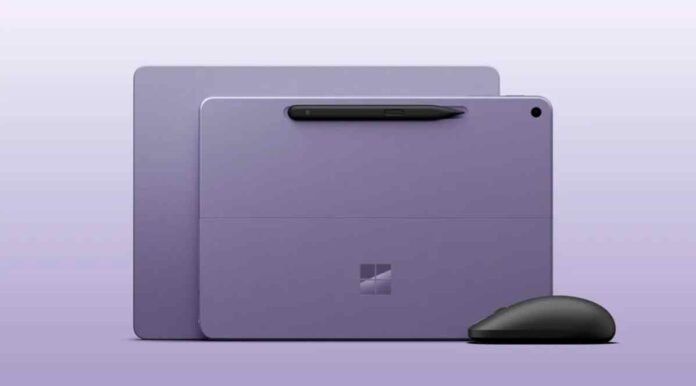
- Microsoft has announced a 12 inch Surface Pro and 13 inch Surface Laptop powered by Snapdragon X2 Plus.
- Microsoft claims better performance, graphics, battery efficiency and local AI performance.
- The Surface Laptop offers strong connectivity and a claimed 22.5 hour battery life, but its 60Hz 1920 x 1280 display may disappoint.
Microsoft is giving its Surface range another push with two new consumer focused devices, the Surface Pro 12 inch and Surface Laptop 13 inch. Both machines are powered by Qualcomm’s six core Snapdragon X2 Plus processor and are designed to compete in the increasingly crowded market for thin, efficient Windows PCs.
The new devices are scheduled to go on sale on October 13, 2026. The Surface Pro starts at $1,149.99, while the Surface Laptop starts at $1,199. That puts both models directly into the territory occupied by Apple’s MacBook Air, making the comparison almost impossible to avoid.
Microsoft says the new Snapdragon powered Surface machines can deliver up to 17% faster Office performance, up to 18% better battery efficiency and more than 60% faster graphics performance compared with their predecessors. There is also a major focus on local artificial intelligence, with Qualcomm’s Hexagon NPU delivering 80 TOPS and Microsoft claiming up to 95% faster local AI performance.
Surface Pro returns with a sharper focus on portability
The new Surface Pro 12 inch is positioned as a flexible Windows 11 tablet that can also serve as a laptop when paired with a keyboard accessory.
It uses a six core Snapdragon X2 Plus processor and comes with either 16GB or 24GB of LPDDR5x memory. Storage options include 256GB and 512GB. The 12 inch LCD panel has a 2196 x 1464 resolution and supports refresh rates of up to 90Hz.
Microsoft says the display is 25% brighter than the previous generation and the company is also introducing a black finish for this model.
Battery life is another major selling point. Microsoft estimates up to 15.5 hours of local video playback and around 13 hours of web browsing on a single charge.
At $1,149.99, the Surface Pro sits in an interesting position. It offers the flexibility of a tablet and the familiarity of Windows, but buyers who want to use it primarily as a laptop will need to factor in the additional cost of a keyboard.
That makes the headline starting price less straightforward than it initially appears.
The Surface Laptop has impressive battery claims but a familiar weakness
The Surface Laptop 13 inch shares much of its internal hardware with the new Surface Pro. It is also powered by the six core Snapdragon X2 Plus and comes with 16GB or 24GB of LPDDR5x RAM alongside 256GB or 512GB of storage.
The laptop has a 13 inch touchscreen with a 1920 x 1280 resolution. Microsoft says the 500 nit display is 25% brighter than the previous generation.
There is plenty to like about the hardware. The machine includes two USB C ports, a USB A port and a 3.5mm headphone jack. Wi Fi 7 and Bluetooth 5.4 are also supported, giving it a useful selection of modern connectivity options.
Battery life could be the biggest attraction. Microsoft claims up to 22.5 hours of use, which would be a particularly strong figure if real world testing comes close to that estimate.
The display, however, could prove harder to justify against similarly priced rivals. The 60Hz refresh rate is fairly conservative for a new laptop in this price range, while the 1920 x 1280 resolution is considerably lower than the 2560 x 1664 panel used by the MacBook Air.
For buyers who care about screen sharpness, workspace and overall display quality, that difference could become noticeable.
Microsoft is finally making the Surface consumer friendly again
The bigger story here may not actually be the Snapdragon X2 Plus chip. Microsoft appears to be putting more attention back into consumer Surface hardware after several generations that increasingly focused on business customers.
That matters because the Surface brand was originally built around showing what premium Windows hardware could look like. The combination of Microsoft’s software and hardware gave the company a way to challenge Apple’s approach rather than simply compete with conventional Windows laptop makers.
The arrival of Apple’s own Arm based silicon changed that equation considerably. Apple has spent several years refining its approach to performance and efficiency, while Microsoft’s Windows on Arm strategy has taken longer to mature.
Qualcomm’s newer Snapdragon chips give Microsoft another opportunity to close that gap.
The Snapdragon X2 Plus is not positioned as a high end processor, however. The six core version used in these Surface models means Microsoft is clearly targeting efficiency and everyday productivity rather than trying to make these machines performance monsters.
That could actually make sense for the intended audience. Office applications, web browsing, video calls and local AI workloads are exactly the kind of tasks where an efficient Arm based processor can make a strong case.
The bigger question is whether the overall hardware package is compelling enough.
The Surface Laptop’s battery claims are impressive, but its 60Hz display and relatively modest resolution could become weaknesses when shoppers compare specifications side by side. The Surface Pro has a more interesting display and its 2 in 1 design gives it an advantage in flexibility, although the keyboard adds another expense.
Microsoft therefore has a credible new generation of consumer Surface products, but the MacBook Air comparison will ultimately depend on more than processor specifications. Real world battery life, application compatibility, sustained performance, display quality and pricing will all matter.
The new Surface devices will go on sale October 13, 2026. Once independent reviews arrive, it should become much clearer whether Microsoft’s latest attempt can turn its Surface hardware into a serious alternative to Apple’s approach.
Follow TechBSB For More Updates