
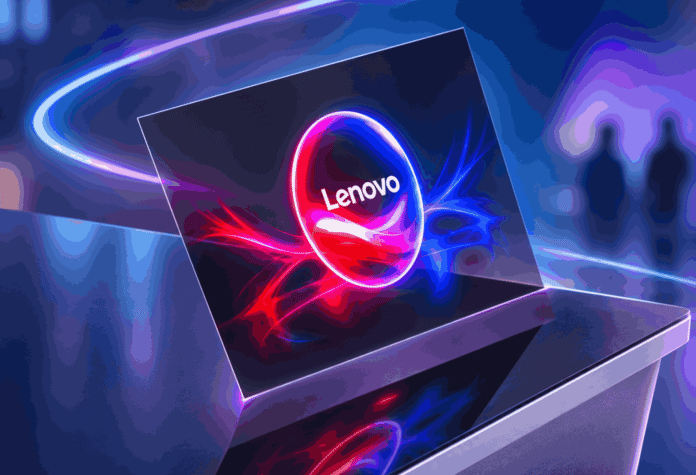
Lenovo Project Hoverview could be one of the most unusual technology concepts showcased at CES 2027. A new leak suggests that the company is developing an innovative aerial display that can project a floating image above a physical surface, potentially changing how people interact with digital screens in retail stores and public spaces.
The concept reportedly features a touchscreen display measuring around 12 inches, although its final dimensions could range between 10 and 15 inches. Unlike traditional holographic technology, Lenovo’s approach is said to use a two dimensional image that appears to float above the device.
Details remain limited, but leaked images suggest that the display could be integrated into a large countertop rather than designed as a standalone gadget. This means consumers probably should not expect a futuristic television or portable computer monitor just yet.
According to Dutch publication NieuweMobiel, Lenovo could officially introduce Project Hoverview at CES 2027. The company has not confirmed the product or its specifications, so the leaked information should be treated with caution.
Still, the concept offers an interesting look at how display technology could evolve beyond conventional screens.
Lenovo Project Hoverview could bring a 12 inch floating touchscreen to CES 2027
The most interesting aspect of Project Hoverview is its unusual display technology.
According to the leak, Lenovo is developing an aerial display that presents a two dimensional image above a physical surface. The reported screen has a 9:5 aspect ratio and is expected to support touch enabled interactions.
Although its precise dimensions have not been revealed, NieuweMobiel estimates that the display could measure approximately 12 inches diagonally. The actual size could be somewhere between 10 and 15 inches.
Leaked concept images show what appears to be a floating interface positioned above a glossy countertop. The design looks considerably different from conventional monitors, tablets and interactive display panels.
However, there is an important distinction between Project Hoverview and traditional holographic displays. Lenovo is reportedly not attempting to create a fully three dimensional hologram. Instead, the technology would display a flat image that appears to hover in the air.
That distinction matters because it suggests the company is exploring a more focused application of aerial display technology rather than attempting to replace conventional screens entirely.
The physical design also appears to be relatively bulky. Rather than functioning as a portable device, the display is reportedly intended to be installed inside a dedicated table or countertop.
This could make it particularly interesting for businesses looking to introduce interactive product demonstrations without requiring customers to handle physical screens.
Project Hoverview could be designed for retail stores and exhibitions
While a floating touchscreen might sound like something designed for futuristic homes, the leaked information points towards a different target audience.
Project Hoverview reportedly focuses on commercial environments, particularly retail stores, public demonstrations and trade exhibitions.
One possible application is interactive product demonstrations. Retailers could use the floating display to showcase product information, specifications and promotional content without requiring customers to touch a conventional screen.
This could be particularly useful in busy stores where multiple people interact with demonstration devices throughout the day.
Traditional touchscreen displays frequently accumulate fingerprints, smudges and dirt. A system that allows customers to interact with an image floating above a surface could help reduce direct contact with the physical display.
The second potential application involves trade shows and exhibitions.
Companies regularly use large displays to demonstrate upcoming products and technologies to visitors. Project Hoverview could offer a more visually engaging alternative, allowing businesses to present interactive information in a way that attracts attention.
Visitors could potentially explore different features using gestures rather than interacting with a traditional touchscreen.
However, these are suggested applications rather than confirmed product features. Lenovo has not yet explained exactly how the technology will work or which interaction methods will be supported.
For now, the commercial focus appears more convincing than the idea of using Project Hoverview as an everyday home entertainment device.
How does floating display technology work, and what are its limitations?
Project Hoverview is not the first attempt to bring floating images into everyday technology.
Previous aerial display concepts have explored techniques involving microscopic mirrors and specialised optical components. These systems can redirect light from a physical display into the surrounding space, creating the appearance of an image floating above a surface.
Some implementations also use sensors to track finger movements, allowing users to interact with projected images through gestures.
This approach could offer a more futuristic experience than conventional touchscreens, but it also comes with several technical challenges.
Viewing angles are one potential problem. Depending on the display technology, the floating image may only be clearly visible from certain positions. This could make the experience less convenient when several people are trying to view the same screen.
Lighting conditions are another concern. Bright ambient light can interfere with the visibility of projected images, potentially reducing contrast and making content harder to read.
Gesture controls also have their limitations. Without physical feedback, interacting with an aerial display may feel less satisfying than using a conventional touchscreen.
For example, users cannot physically feel where a virtual button is located. This could make precise interactions more difficult, particularly when navigating complicated menus or entering information.
Lenovo will need to address these issues if it wants Project Hoverview to become more than an impressive technology demonstration.
The leaked images offer very little information about the underlying hardware, so it remains unclear which optical system Lenovo intends to use.
Lenovo could reveal more about Project Hoverview at CES 2027
CES 2027 could provide the first proper look at Lenovo’s aerial display concept.
The technology certainly has the potential to attract attention, particularly as manufacturers continue experimenting with new ways to make digital interfaces more interactive.
However, it is important to keep expectations realistic. Project Hoverview does not currently appear to be a replacement for televisions, computer monitors or conventional tablets.
Its reported countertop design suggests that Lenovo is initially exploring specialised commercial applications rather than developing a product for everyday home use.
Pricing, availability, final dimensions and technical specifications are also unknown.
The biggest question is whether Lenovo can make the floating display practical enough for businesses to adopt. An impressive visual effect alone will not be sufficient if the technology struggles with visibility, interaction accuracy or different lighting conditions.
If Lenovo manages to overcome these challenges, Project Hoverview could offer an interesting alternative to traditional interactive displays.
For now, the leaked concept is worth watching ahead of CES 2027. It may not bring holographic screens into our homes, but it could provide an early glimpse of how businesses might use aerial display technology in the future.
Follow TechBSB For More Updates