
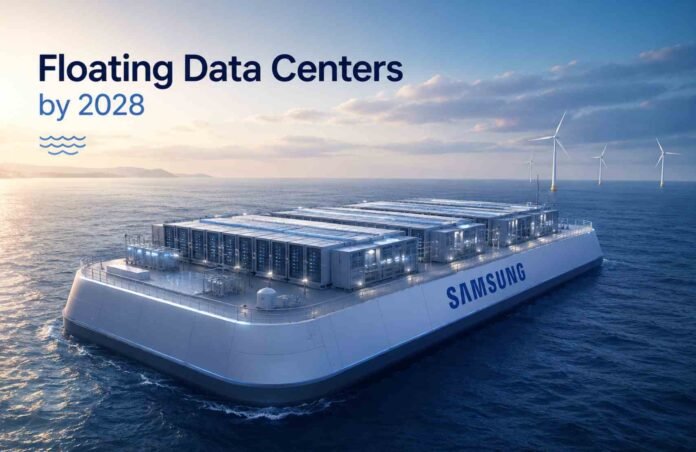
- Samsung Heavy Industries aims to commercialize floating data centers by 2028.
- Water based facilities could reduce cooling costs and bypass land shortages.
- Initial deployments will use shore supplied electricity, with future renewable options under consideration.
- Marine conditions such as corrosion, humidity, and platform stability remain key engineering challenges.
While artificial intelligence continues to fuel an unprecedented surge in global computing demand, technology companies are under increasing pressure to build more data centers. However, expanding traditional facilities on land has become more difficult due to limited space, rising construction costs, lengthy approval processes, and growing concerns over energy and water consumption.
Samsung believes it has found an alternative. The company’s shipbuilding arm, Samsung Heavy Industries, is developing floating data centers that could enter commercial service as early as 2028. The concept is designed to combine the efficiency of marine engineering with the growing needs of AI driven cloud infrastructure.
The company sees floating data centers not just as an engineering experiment but as a potential business opportunity that could reshape how future computing facilities are built.
Samsung Wants to Bring Data Centers to the Sea
Samsung Heavy Industries plans to create specially designed barges capable of housing servers, electrical systems, and supporting infrastructure. Rather than occupying valuable land, these facilities would operate on water, where naturally lower and more stable temperatures could help improve cooling efficiency.
Cooling remains one of the biggest operational expenses for modern data centers. AI workloads generate enormous amounts of heat, forcing operators to invest heavily in advanced cooling technologies. By placing data centers on water, Samsung expects to reduce cooling requirements while improving overall energy efficiency.
The first floating facilities are expected to rely on electricity supplied from nearby land based power grids. This approach allows Samsung to focus on the deployment of floating infrastructure without immediately depending on offshore power generation.
The company has also explored additional energy options for future projects. Earlier concepts included liquefied natural gas powered solid oxide fuel cells, while renewable sources such as offshore wind and solar power may also become part of future deployments.
Faster Deployment Could Become a Major Advantage
One of Samsung’s biggest selling points is speed.
Building a conventional data center often requires years of planning, environmental assessments, zoning approvals, and construction work. These regulatory processes have become increasingly complicated as local communities raise concerns about land use, electricity demand, and water consumption.
Floating data centers could avoid many of these obstacles. Since they are built using existing shipbuilding facilities and manufacturing techniques, Samsung believes production timelines can be significantly shortened.
Instead of constructing facilities entirely on site, large portions could be assembled in shipyards before being transported to their operating locations. This modular approach could help cloud providers expand computing capacity much faster than traditional land based projects.
Samsung is reportedly aiming to secure customer orders before the first commercial installations begin, highlighting confidence that demand for alternative infrastructure will continue to grow alongside AI adoption.
Engineering Challenges Still Need Solutions
Despite the potential benefits, floating data centers also introduce several technical challenges.
Operating sophisticated computing equipment in a marine environment requires strong protection against saltwater corrosion, humidity, and accidental water ingress. Electronic systems must remain reliable despite constant exposure to moisture and changing weather conditions.
Engineers must also ensure that floating platforms remain stable despite waves, tides, and ocean currents. Even minor movement can create operational challenges for sensitive computing equipment.
Power distribution, maintenance access, and long term durability will also require careful planning before floating facilities can compete with traditional land based data centers on a large scale.
These challenges are significant, but Samsung believes advances in offshore engineering and shipbuilding expertise can help overcome many of these obstacles.
Floating Data Centers Are Becoming a Global Trend
Samsung is not alone in exploring new ways to support the world’s growing AI infrastructure.
Several companies and research groups have proposed offshore computing facilities as demand for processing power continues to climb.
Startup Panthalassa is working on floating platforms that combine seawater cooling with wave generated electricity. The concept aims to create largely self powered offshore computing facilities.
Japan is also investing in similar technology. A recent collaboration involving Hitachi and shipping company Mitsui OSK Lines seeks to develop floating data centers capable of supporting future digital infrastructure.
China has already launched an underwater data center project that places sealed server modules beneath the ocean. The facility uses seawater for passive cooling while supporting AI computing, 5G services, and large scale data processing.
Microsoft previously explored underwater data centers through its Project Natick program. Although the company demonstrated that underwater server capsules could operate successfully, the project did not move into commercial deployment.
Meanwhile, discussions continue around even more ambitious concepts, including space based data centers. While such ideas remain largely experimental, floating platforms appear to offer a more practical path for near term expansion.
Samsung’s proposal reflects a growing industry trend toward rethinking where and how computing infrastructure should be built. As AI workloads continue to increase, companies are searching for faster, more efficient, and more sustainable ways to deliver computing power.
If Samsung successfully commercializes its floating data centers by 2028, the project could become one of the most significant changes in data center design in decades.
Follow TechBSB For More Updates