
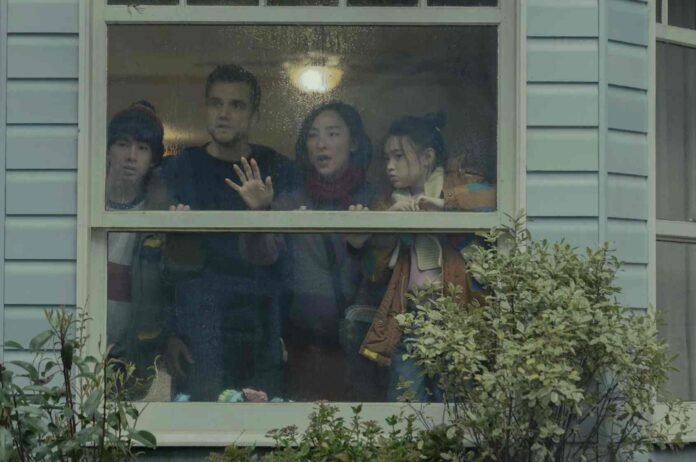
- The family is trapped for five years by mysterious sea creatures that can control water.
- Ruth believes the creatures are reclaiming Earth rather than simply invading it.
- Jason captures one creature but releases it after Ruth asks him to show mercy.
- The creatures spare the family, while the flooded world forces them to start a completely new life.
The Last House turns a simple survival story into something much stranger. What begins as a family trapped inside their Seattle home eventually becomes a story about mysterious sea creatures, a flooded world, human survival and, ultimately, the possibility that mercy is the only way to escape.
The film deliberately keeps many of its biggest questions unanswered. That can make the ending feel abrupt, but there is a clear idea behind what happens to the family and the creatures controlling the water.
Why is the family trapped inside the house?
The story begins when Ann, Jason and their children, Ruth and Graham, suddenly find themselves unable to leave their home. The entire neighborhood appears to be experiencing the same problem.
The explanation initially seems impossible. Water behaves as though it is alive, forming barriers around the houses and preventing anyone from escaping. As the rain continues, the family realizes that this is not an ordinary natural disaster.
At first, they consider the usual explanations. Perhaps the government knows what is happening. Perhaps it is an attack. Perhaps something from outside Earth is responsible.
The truth is considerably stranger.
The creatures responsible are enormous aquatic beings that appear to have emerged from the ocean. They resemble the legendary monsters associated with stories of the Kraken or Leviathan, but the movie never gives them a precise scientific identity.
Ruth becomes convinced that the creatures are not invading Earth. They are reclaiming it.
That distinction is central to the film.
The family has spent years assuming they are victims of an unexplained attack. Ruth eventually suggests that humans may actually be the intruders from the creatures’ perspective.
How does the family survive for five years?
The horror of The Last House is not limited to the creatures outside. Much of the film’s tension comes from watching an ordinary family slowly adapt to an impossible situation.
Food becomes the biggest problem.
The family initially survives on whatever supplies they have inside the house. Eventually, those supplies disappear. Jason begins finding ways to catch animals using the house itself, while Ann turns parts of the interior into a garden.
Their survival becomes increasingly grim.
One of the film’s most disturbing moments involves their dog, Cassidy. When the family runs out of food, they are forced to kill the animal and preserve its body so they can survive. It is an ugly decision, but it establishes just how far the family has been pushed.
Five years later, the people who once surrounded them are gone. The family has effectively become the last surviving household in the neighborhood.
That is where the title takes on its most literal meaning.
What are the creatures trying to do?
The film never provides a complete explanation, and that is important.
Ruth believes the creatures come from the ocean and have the ability to manipulate water. Their behavior suggests that they are not simply hunting humans. They are changing the environment around them.
Seattle is eventually overwhelmed by water.
The implication is that the creatures are restoring the world to a state that existed before humans dominated it. From their perspective, the destruction of human settlements may not be an act of conquest at all.
It may be an act of reclamation.
The movie also connects this idea to humanity’s treatment of the oceans. Plastic pollution, environmental destruction and the enormous amount of waste entering marine ecosystems all sit behind the story.
The creatures therefore function as more than conventional monsters. They represent a force of nature responding to the damage humans have caused.
The problem is that the movie leaves this environmental argument largely implicit. It gives viewers the pieces and expects them to connect them.
Why does the family finally get released?
The ending depends on one crucial decision.
By this point, Jason has prepared the house for an attack. The family uses traps, weapons and improvised defenses to capture one of the creatures.
For the first time, they have power over their enemy.
Jason threatens to kill it.
This is where Ruth intervenes.
Rather than allowing her father to destroy the creature, she asks him to release it. Jason eventually does so.
That decision changes everything.
The creature does not respond by attacking the family. Instead, it appears to communicate with the other creatures. Shortly afterward, the family is allowed to leave.
The message is deliberately simple: the family showed mercy, and the creatures returned that mercy.
The film’s final narration makes the idea explicit. Survival is no longer presented as something achieved through violence alone. The family survives because it chooses not to become the thing it has spent five years fearing.
The house itself finally gives way as the surrounding water recedes enough for the family to escape.
When they emerge, however, they discover that the world they knew is gone.
What does the ending mean?
The final scenes reveal the real scale of the disaster.
The city has been transformed by flooding, leaving familiar landmarks surrounded by water. The family finds a boat belonging to a dead neighbor and uses it to begin searching for somewhere else to live.
They rename the boat Cassidy, after the dog whose death helped keep them alive.
That detail is important because the family is not simply celebrating its escape. They are carrying the memory of everything they sacrificed along the way.
The film ends with the family beginning a new chapter, essentially returning to Day 1.
There is no confirmation that other humans survived. There is no definitive explanation of where the creatures came from or whether they will ever return.
That uncertainty is intentional.
The family has spent five years believing that their home was their prison. By the end, they realize that the entire world has changed. The house was never the whole story. It was simply the place where they happened to survive the collapse of the world they knew.
The creatures also remain out there somewhere.
The final suggestion is that humans and these mysterious beings may now have to share the same planet differently.
That is the strongest idea in The Last House: the family does not defeat the monsters. They learn to coexist with them.
The ending therefore works less as a traditional horror conclusion and more as a moral resolution. Violence gives Jason control of the creature, but compassion gives the family freedom.
The film’s environmental message follows the same logic. Humanity has treated the natural world as something it owns. The Last House flips that perspective and asks what would happen if nature finally pushed back.
Whether the movie explains that idea convincingly is another question. Its mythology remains deliberately vague, and several practical questions about the creatures and their powers are left unanswered.
But the central point is clear.
The family survives because they stop treating the creatures as enemies that must be destroyed.
They recognize that this is their world too.
Follow TechBSB For More Updates

