
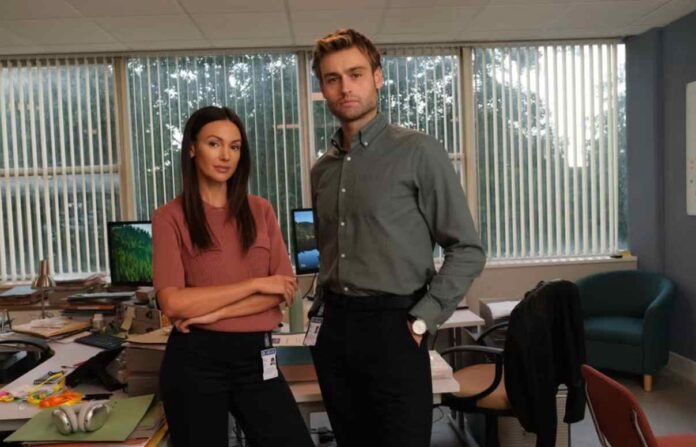
ITV’s new crime thriller The Blame opens with a murder investigation that quickly becomes a disturbing examination of sexism, institutional failure and the people entrusted with protecting the public. Starring Michelle Keegan as DI Emma Crane and Douglas Booth as DI Tom Radley, the series follows two detectives working in the fictional town of Wakestead.
The opening episode initially looks like a familiar police procedural, but its focus soon shifts towards the culture inside the department. Crane and Radley are introduced during a night out with colleagues, where the men’s behaviour towards a barmaid reveals an uncomfortable attitude towards women.
Radley joins in by approaching the woman and asking for her number, while Crane watches the exchange with visible displeasure. The following morning, the atmosphere at the station offers little improvement. Male colleagues share inappropriate jokes and images on their phones, leaving Crane excluded from conversations that appear to be routine for everyone else.
The investigation begins when the team receives news that 16 year old Sophie Madsen has gone missing. Sophie is a figure skater, and early glimpses of her life through social media offer a contrast to the grim circumstances surrounding her disappearance.
The search ends when detectives discover her body in a woodland area. What initially appears to be a straightforward murder investigation soon reveals a much more troubling story.
Sophie Madsen’s murder exposes serious police failures
As Crane and Radley begin investigating Sophie’s death, they learn that the teenager had recently argued with her skating coach, Frasier, played by Joe Armstrong. The disagreement resulted in Sophie being removed from the team, making the coach an obvious person of interest.
However, the investigation uncovers information that raises serious questions about the police department itself.
Crane discovers that one of her colleagues had previously encountered Sophie while she was distressed in a car with an older man. Rather than offering meaningful assistance, the officer apparently failed to act appropriately and later treated the encounter as an opportunity for an offensive joke.
The situation becomes even more concerning when Sophie’s friend Chloe contacts Crane. She reveals that Sophie had previously made a complaint against her skating coach, but the police did not properly investigate it.
Crane is surprised to learn that a recording of the complaint exists. When she finds the footage, she watches Sophie describe an incident in which the coach touched her without consent while they were in his car.
Instead of treating the teenager’s account with the seriousness it deserves, the officers questioning her appear dismissive. Sophie is subjected to inappropriate questioning and pressured to demonstrate what happened, while someone behind the camera laughs.
The footage changes Crane’s understanding of the case. The problem is no longer limited to one suspect. It raises questions about how the department handles complaints from women and whether other victims have been ignored.
Frasier initially offers little useful information during questioning. Later, however, he changes his account and admits to touching Sophie, while claiming that she had wanted it.
His admission adds another disturbing dimension to the investigation, but it does not resolve the central question of who killed the teenager.
Emma Crane confronts sexism and Radley’s reluctance to act
The discovery of Sophie’s complaint forces Crane to confront the department’s wider culture. She believes the officers responsible should be held accountable and considers exposing what happened.
Radley, however, urges her to reconsider. He admits that he has encountered similar behaviour at other stations and describes the problem as systemic. His response suggests that he has become accustomed to misconduct rather than willing to challenge it.
For Crane, this is a significant turning point. She had previously viewed her colleagues as a professional team, but she now questions whether the department can be trusted to protect vulnerable people.
Her suspicions deepen when she manages to look at her boss’s phone and discovers a WhatsApp group containing photographs of women who have visited the station to make statements. The images are accompanied by crude jokes and offensive comments, including jokes about sexual violence.
The casual way these conversations sit alongside everyday workplace messages makes the discovery particularly disturbing.
Crane is appalled by what she sees and begins to question how many women may have been let down by the same officers. Her growing determination to expose the behaviour puts her at odds with Radley, who is more concerned about protecting his career.
Radley admits that he has remained silent when colleagues behave inappropriately. Although he acknowledges his own cowardice, he makes it clear that he is unwilling to risk losing his job for the sake of doing what he believes is right.
Their relationship becomes increasingly complicated as Crane struggles to reconcile her feelings for him with his unwillingness to take responsibility. Despite the warning signs, the pair become romantically involved.
That decision adds another layer of tension to an already uncomfortable partnership.
The ending reveals a shocking connection to Tom Radley
The final moments of The Blame Episode 1 deliver the biggest twist of the investigation.
After Frasier’s alibi falls apart, the skating coach is arrested for Sophie’s murder. His admission about touching Sophie and the evidence surrounding their conflict make him a significant suspect.
However, Crane has been pursuing another lead. She obtains dashcam footage from a lorry that was travelling on the day Sophie was killed.
When she watches the recording, she sees Sophie getting into Radley’s car.
The discovery changes the meaning of everything that has happened between the detectives. Radley had been working alongside Crane throughout the investigation, while also discouraging her attempts to expose police misconduct.
The footage does not, by itself, establish that Radley killed Sophie. It does, however, place him directly in the investigation in a way that Crane cannot ignore.
His connection to the teenager raises immediate questions about what he knew, why Sophie was in his car and whether he has concealed important information from his colleague.
Frasier’s arrest may have appeared to bring the investigation closer to a conclusion, but the dashcam revelation leaves the case wide open.
The episode ends with Crane facing a deeply personal dilemma. She must consider whether the man she has become romantically involved with could be connected to the murder she is investigating.
With the department’s conduct already under scrutiny, the discovery also threatens to expose further failures within the police force.
Follow TechBSB For More Updates

