
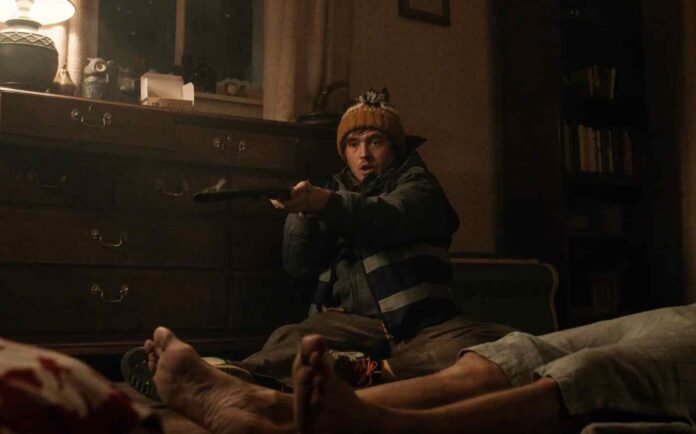
- Bryan Hodukavich, a medical courier, becomes trapped in Raccoon City during a deadly outbreak caused by Umbrella Corporation.
- After being bitten, Bryan discovers that his medical delivery contains the final ingredient needed to create a cure.
- He reaches the hospital laboratory, but his infection progresses and he transforms into a dangerous biological monster.
- Bryan knocks the antidote out of reach, apparently destroying the final chance to stop the outbreak as the film cuts to black.
Zach Cregger’s Resident Evil adaptation takes a sharp turn away from the familiar survival horror formula, delivering an ending that leaves its protagonist with almost nothing to show for his desperate fight. Rather than giving audiences a triumphant final battle or a last minute rescue, the film closes on a devastating note that challenges the idea that survival is always possible.
The new film, starring Austin Abrams as Bryan Hodukavich, tells an original story set in the Resident Evil universe. It does not directly adapt one of Capcom’s games, continue the previous film series or rely on familiar characters from the franchise. Instead, Cregger creates a fresh nightmare built around an ordinary man caught in an extraordinary biological disaster.
For viewers accustomed to the games’ emphasis on perseverance, resourcefulness and overcoming seemingly impossible odds, the conclusion could prove divisive. However, the film’s bleak final moments fit neatly into Cregger’s approach to horror, where familiar expectations can be turned upside down without warning.
Bryan’s desperate journey through Raccoon City
Bryan is a medical courier whose life is about to change. His girlfriend, Michele, is pregnant, and the couple is preparing to discuss their future together. Before he can get home, however, Bryan accepts a last minute delivery job that promises double pay.
His assignment is to transport a secure medical case containing a high priority organ to Raccoon City General Hospital. The journey takes him through snowy mountain roads and into a city that is already descending into chaos.
Things quickly spiral out of control when Bryan accidentally hits a woman with his car. The collision becomes the beginning of a terrifying ordeal when he discovers that the woman is infected with a rapidly mutating virus.
The outbreak has been unleashed by the Umbrella Corporation, setting off a chain of events that leaves Bryan fighting for his life. What initially appears to be a dangerous delivery soon becomes a desperate struggle against increasingly horrifying biological creatures.
The film captures several familiar elements of the games, including limited ammunition, dangerous environments and weapons that become more powerful as the danger escalates. Bryan, however, is no trained action hero. He struggles to handle the increasingly powerful guns he finds, making his fight for survival feel even more precarious.
His situation becomes worse when he discovers that the medical cargo he is carrying contains the final ingredient needed to produce a cure. By then, he has already been bitten by an infected individual, leaving him racing against the virus spreading through his own body.
The infected creatures are also far more dangerous than ordinary zombies. Shooting them in the head does not necessarily stop them. Instead, their remains can fuse together into grotesque masses of limbs and tentacles, creating new monsters that continue to pursue Bryan.
How Resident Evil ends
Bryan eventually reaches the secure laboratory on the 28th floor of Raccoon City General Hospital. Getting there means surviving a series of increasingly horrific encounters, including dive bombing zombies, an acid vomiting monster and an infected maternity ward.
Once inside the laboratory, Bryan hands over the key ingredient for the cure to a team led by Umbrella scientist Carl, played by Zach Cherry.
The scientists begin preparing the antidote, hoping to deliver it to National Guard soldiers who are expected to land on the hospital roof. Their arrival could offer a chance to contain the outbreak before it spreads any further.
But Bryan’s infection has progressed too far.
As the team completes the cure, his body begins to mutate beyond his control. His limbs transform into grotesque weapons, lashing out at the people around him. The scientists are killed one by one, and their bodies are dragged into the growing mass of Bryan’s mutated form.
Bryan is no longer simply fighting the infected. He is becoming one of the most dangerous creatures in the building.
Realising what is happening, Bryan begs the scientists to inject him with the antidote. He wants them to stop his transformation before it becomes irreversible.
Unfortunately, the situation deteriorates too quickly. Some of the scientists are incapacitated, while others are too frightened to act.
Eventually, Bryan crashes through a window while holding the last surviving scientist. For a brief moment, there is still a chance to save him. The technician has the cure and appears ready to administer it.
Then the film delivers its final twist.
Bryan knocks the syringe out of the scientist’s hand. It falls out of reach, plunging dozens of stories into the darkness below.
With the cure gone and Bryan’s transformation continuing, the last opportunity to stop the disaster appears to have vanished. National Guard helicopters circle the hospital as Bryan lets out a monstrous roar.
The film cuts to black.
There is no surprise rescue, no triumphant showdown and no last second reversal. Bryan’s desperate attempt to deliver the cure ends in failure, leaving the audience to consider the possibility that the outbreak will continue unchecked.
Why Zach Cregger chose such a bleak ending
The ending stands apart from the kind of resolution many fans associate with Resident Evil. The games often place their characters in seemingly hopeless situations before allowing them to escape through persistence, combat or a last minute breakthrough.
Cregger takes the opposite approach.
Bryan manages to reach the laboratory, deliver the crucial ingredient and survive a series of terrifying encounters. Yet none of those achievements guarantees that he will survive or that the city will be saved.
That decision makes the conclusion particularly harsh. Bryan’s journey has a clear objective, and the audience watches him get painfully close to completing it. The loss of the antidote at the last possible moment turns that progress into an agonising failure.
The director has spoken about his confidence in the ending, comparing the experience of finding the right conclusion to the process of developing the ending of his earlier film Weapons.
In an interview with Men’s Health, Cregger explained that he experienced a similar moment of certainty when he worked out how Resident Evil should finish. He described the satisfaction of reaching a point where an idea feels complete and no longer needs to be changed.
For Cregger, the final scene was not simply a way to shock viewers. It was the conclusion he felt the story needed.
The result is a film that leans into horror nihilism, leaving its characters and audience without the reassuring resolution that often accompanies a survival story.
That does not mean every viewer will respond to the decision in the same way. Some fans may appreciate the willingness to break from established expectations, while others may find the lack of a conventional final battle frustrating.
The ending also leaves the wider story unresolved. Bryan’s fate appears catastrophic, but Cregger has suggested that he is still thinking about other directions the Resident Evil story could take.
In an interview with The Playlist, the filmmaker said he had ideas for where the story could go next, although he did not confirm that a sequel was happening.
For now, the future of this particular Resident Evil universe remains uncertain. What is clear is that Cregger has chosen to end Bryan’s story with a devastating failure rather than a familiar victory.
Follow TechBSB For More Updates