
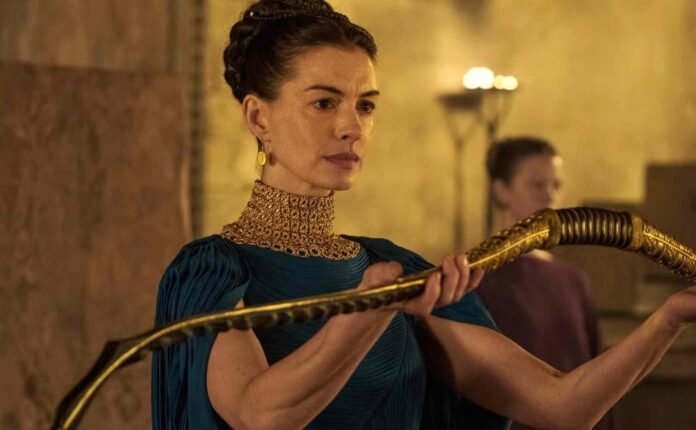
Christopher Nolan’s The Odyssey may be one of the biggest cinematic interpretations of Homer’s legendary poem, but it is hardly the first time the story has been given the Hollywood treatment.
More than two decades before Nolan brought Odysseus, Athena, Penelope and the gods to the big screen, The Simpsons managed to tell a surprisingly ambitious version of the same story in just seven minutes.
That comparison sounds like a joke, but there is a genuine reason it works.
Nolan has approached The Odyssey as both a huge scale adventure and a serious examination of Homer’s original story. His film expands the poem into a lavish theatrical experience, giving its characters room to breathe and its mythology plenty of cinematic weight.
The Simpsons, meanwhile, had almost no time at all.
The animated series tackled the story in Season 13, Episode 14, “Tales from the Public Domain.” The episode is divided into three literary stories, with the first segment turning Homer Simpson into Homer’s Odysseus.
The segment, titled “D’oh, Brother Where Art Thou?”, immediately signals its comic intentions with a reference to the Coen brothers’ O Brother, Where Art Thou?, another famous adaptation inspired by Homer’s epic.
Yet beneath all the jokes, the episode does something remarkably similar to what Nolan’s film attempts. It adapts The Odyssey while also poking fun at the way the story has been interpreted over the centuries.
Nolan Gives Homer’s Epic Room To Breathe
One of the biggest advantages Nolan has is time.
At roughly three hours, The Odyssey can explore the enormous scale of Odysseus’ journey, from the aftermath of the Trojan War to his struggle to return home to Ithaca. The film can spend time establishing its world, developing its characters and presenting the mythology as something grand and serious.
That approach makes sense for a story as enormous as The Odyssey.
Odysseus is not simply travelling from one location to another. His journey is filled with monsters, gods, temptation, death and strange encounters. The story repeatedly tests his intelligence, loyalty and ability to survive.
Nolan’s film treats those elements as major cinematic events.
The Simpsons had a completely different problem. It needed to get through the story before the audience had time to wonder how quickly it was moving.
That limitation became part of the joke.
Instead of trying to reproduce every detail, the episode races through the most recognisable parts of the myth. The result is less a conventional adaptation and more a compressed comic tour through Homer’s greatest hits.
The Simpsons Turns The Odyssey Into A Joke Machine
The basic story remains familiar in both versions.
Odysseus fights at Troy, attempts to return home and encounters a series of increasingly bizarre obstacles. The journey takes years, while Penelope waits in Ithaca and the gods continue to interfere with mortal affairs.
But where Nolan generally plays the mythology straight, The Simpsons asks what would happen if Homer Simpson were the hero.
That question produces one of the episode’s best jokes.
Circe turns Odysseus’ men into pigs, just as she does in Homer’s original poem. But there is a crucial difference. Homer Simpson sees the pigs as food and eats them before discovering that they were his own men.
It is exactly the kind of joke that could only work in The Simpsons, while still demonstrating how efficiently the episode understands the source material.
The same approach appears when Odysseus reaches Hades.
Nolan’s underworld is presented as a bleak and unsettling place, filled with the dead and wrapped in an atmosphere of darkness. The Simpsons turns the River Styx into an opportunity for a musical gag, using the band Styx’s “Lady” as Odysseus sails through the underworld.
The Trojan Horse receives a similar treatment.
Nolan presents the famous horse with a more grounded and striking visual approach. The Simpsons puts its Trojan Horse on wheels, turning one of the most famous images from ancient literature into an instantly recognisable cartoon gag.
The Gods Reveal The Biggest Difference
The most interesting contrast between the two adaptations may be the way they treat the gods.
In The Simpsons, the gods occupy a more traditional position. They sit above humanity, watching events unfold from the clouds.
Nolan takes a more unusual approach.
His gods can appear among ordinary people, which connects to one of the important ideas running through Homer’s story: the possibility that a seemingly insignificant stranger could actually be a divine figure in disguise.
That idea gives hospitality a deeper meaning. Treating a stranger with respect is not merely good manners. It could be the difference between pleasing or angering a god.
Nolan uses this concept to bring figures such as Athena closer to the human world. Instead of simply looking down from the heavens, the gods can become active participants in the events surrounding Odysseus.
It is a more serious interpretation, but it is also a reminder that The Odyssey has always been flexible enough to support radically different readings.
Seven Minutes Can Still Say A Lot
It would obviously be unfair to compare a three hour theatrical epic directly with a seven minute animated comedy.
Nolan has the space to build an entire cinematic world. The Simpsons has to deliver a joke before the next commercial break.
But that is what makes the comparison so entertaining.
Both versions understand that The Odyssey is fundamentally a story about a man trying to get home after an unimaginably long journey. Both versions recognise its most important characters and set pieces. Both also understand that Homer’s poem is so strange that it naturally lends itself to comedy.
The difference is what they do with that material.
Nolan expands it into a sweeping mythological adventure. The Simpsons compresses it into a rapid fire parody packed with references and visual jokes.
In some ways, the seven minute version demonstrates just how efficient the original story is. Remove the elaborate production, the visual spectacle and the extended character development, and the central structure is still incredibly easy to recognise.
That may be the greatest compliment The Simpsons can receive.
It did not simply make fun of The Odyssey. It understood the story well enough to make fun of it.
And while Nolan has spent years turning Homer’s epic into one of cinema’s biggest spectacles, The Simpsons had already discovered that you can get surprisingly far with Odysseus, a handful of famous scenes and seven minutes of screen time.
Follow TechBSB For More Updates