
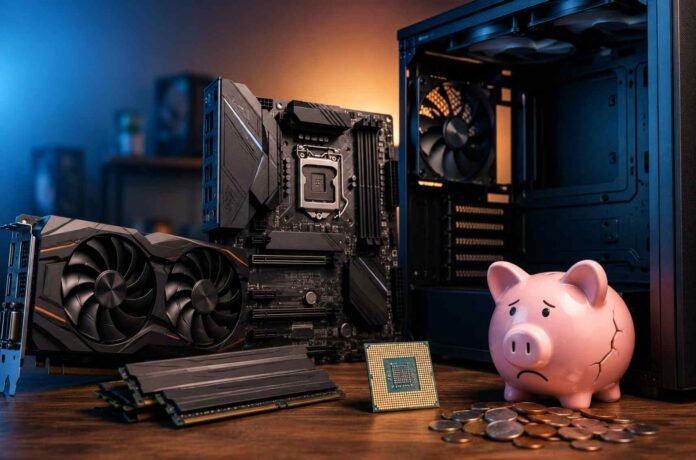
- Expensive RAM can make a complete platform upgrade much more costly.
- Moving from DDR4 to DDR5 may require both new memory and a new motherboard.
- Upgrading a graphics card or storage separately can be a cheaper way to improve an older PC.
- Always calculate the total upgrade cost before buying a new CPU or other major component.
The current RAM crisis is starting to create a problem that goes beyond the price of a memory kit.
If you are building a new PC, expensive memory is frustrating enough. You can compare prices, reduce your capacity or simply decide to wait. But upgrading an existing machine can be much more complicated. In some cases, buying one new component means replacing several others that were perfectly usable just a short time ago.
That is where the real cost of the memory shortage becomes obvious.
Consider someone still running an older AMD AM4 system. A processor such as the Ryzen 5 5600X remains perfectly capable for many gaming and everyday workloads, but eventually there comes a point when the extra performance offered by a newer CPU becomes tempting.
The problem is that moving to AMD’s current AM5 platform is not a simple processor swap.
A new AM5 CPU requires a compatible motherboard, and the platform uses DDR5 memory. That means an upgrade that appears to be a CPU purchase on paper can quickly turn into a CPU, motherboard and RAM purchase.
Under normal circumstances, that is an expensive but manageable upgrade. With memory prices under pressure, however, the calculation looks considerably less attractive.
One component can force three purchases
This is the part of the PC upgrade process that is easy to overlook.
When people talk about rising RAM prices, they naturally focus on the cost of the memory itself. That makes sense if you are buying a new laptop or adding more RAM to an existing desktop.
But platform upgrades are different.
If your current machine uses DDR4 and your next platform requires DDR5, your existing memory has little value as part of the upgrade. It might still work perfectly well, but it cannot simply move into the new system.
Suddenly, the cost of the upgrade is not determined by the CPU alone.
A person who had planned to spend money on a faster processor could instead find themselves looking at the price of a processor, motherboard and DDR5 kit. The total can be high enough to make the original upgrade plan difficult to justify.
There is another problem too. People often upgrade PCs gradually because it spreads the cost over time. You might buy a graphics card one year, a processor later and add storage when prices fall.
Platform changes can break that strategy.
Once the old motherboard and memory become the limiting factors, there is much less room for a gradual upgrade. You are effectively buying into a new ecosystem.
That is why the RAM crisis matters even to people who are not planning to buy RAM immediately.
Waiting could be the sensible option
For anyone sitting on an older but still functional PC, the current market creates an awkward choice.
You can upgrade now and accept that the total bill may be considerably higher than expected. Or you can wait and hope memory prices become more reasonable.
Neither option is particularly exciting.
The sensible answer for many people may be to hold on to the hardware they already have. If a PC is still delivering acceptable gaming performance and handling everyday tasks without major problems, there is little reason to replace half of it simply because a newer platform exists.
There is also something to be said for upgrading the parts that do not require a complete platform change.
A graphics card can often be replaced without changing the CPU, motherboard or memory. Storage can usually be expanded in the same way. Those upgrades may provide useful improvements without turning a relatively simple purchase into a complete system rebuild.
Of course, graphics card prices are not exactly immune to wider market pressures either. The point is simply that some upgrades can be made independently, while a platform change can force several purchases at once.
That distinction becomes much more important when component prices are already elevated.
Calculate the upgrade before buying anything
The biggest lesson from the current situation is simple: do not price a PC upgrade by looking at the component you want first.
Start with the entire upgrade path.
If you want a new CPU, check whether your motherboard supports it. If it does not, find out what motherboard you would need. Then check the memory requirement. Consider whether your existing cooler is compatible, whether your power supply is sufficient and whether your case can accommodate everything.
Only after that should you calculate the real cost.
This matters even more during periods of unusually high component prices. A processor that looks like a reasonable purchase at first glance can become considerably harder to justify once the supporting hardware is included.
For anyone using an older DDR4 system, this is particularly important. Keeping the current platform alive for another year may be frustrating, but it could still be cheaper than replacing the CPU, motherboard and memory together.
The PC market has always rewarded patience, and the current RAM crisis may be one of those moments when waiting makes more sense than chasing every new generation.
There is nothing wrong with wanting faster hardware. The mistake is assuming that the price on the box tells you what the upgrade will actually cost.
The hidden expense is everything that has to change around it.
Follow TechBSB For More Updates