
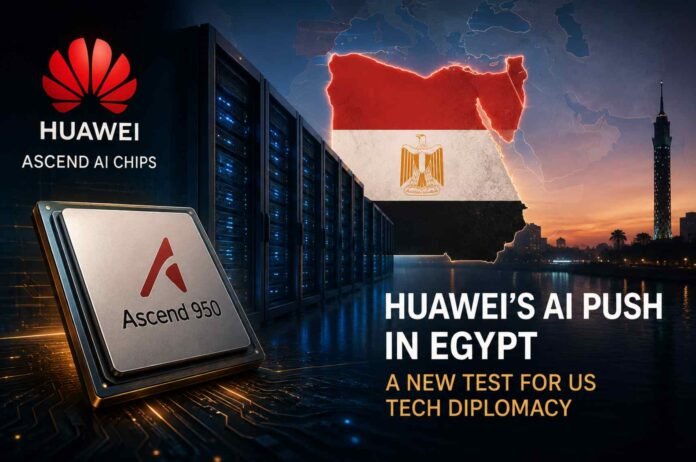
- Huawei wants to build a major AI data center in Egypt using its Ascend AI chips.
- The US is reportedly considering a competing offer involving Nvidia, AMD and Microsoft.
- The project could give Huawei a bigger role in AI infrastructure across the Middle East and Africa.
- Egypt may become an important test of US and Chinese influence in the global AI technology race.
Huawei is making a bold move in the global artificial intelligence race by pitching Egypt on a major AI data center project powered by its Ascend processors.
The proposal is more than another data center deal. It puts Huawei’s AI hardware directly into a market where the US and China are competing for influence, while giving Washington a fresh reason to worry about the reach of Chinese technology.
According to reports based on Bloomberg’s coverage, Huawei has proposed building AI infrastructure for Egyptian government use, including military, surveillance and other public sector applications. The plan reportedly includes 1,408 Ascend 950 series AI chips for cloud services, along with another 600 chips for a separate system designed to manage AI models during development.
If the project goes ahead, it would represent an important step for Huawei. The company has spent years trying to build an AI hardware business capable of reducing China’s dependence on US technology. An overseas deployment at this scale would show that its ambitions now extend well beyond the Chinese market.
Egypt is also an important choice. The country is positioning itself as a regional technology and data center hub, making it a potentially valuable market for companies looking to establish AI infrastructure across the Middle East and Africa.
Why Nvidia and AMD are part of the story
The Egyptian proposal has caught Washington’s attention because the competition is no longer simply about which company sells the fastest AI chip.
The US has used export controls to limit China’s access to advanced semiconductor technology. At the same time, companies such as Nvidia and AMD remain among the most important suppliers of AI accelerators used for training and running advanced models.
Washington now faces a different challenge. Instead of trying to stop China from accessing technology, US officials may need to persuade other countries to choose American technology over increasingly capable Chinese alternatives.
Reports indicate that the US State Department has approached Nvidia, AMD and Microsoft about putting together a competing proposal for Egypt.
That changes the nature of the competition.
Egypt is not simply deciding which chip to purchase. It could be deciding which technology ecosystem becomes part of its long term AI infrastructure.
For Washington, that makes the Egyptian project a test of whether American technology diplomacy can compete with Huawei’s ability to offer hardware, networking, cloud infrastructure and other services as part of a broader package.
The US has already adjusted some semiconductor export policies this year. In January, American officials moved to a case by case review system for certain Nvidia and AMD chips destined for China, subject to security conditions.
The bigger question is whether export controls alone can protect US technological leadership when Chinese companies are increasingly looking for customers outside China.
Huawei wants Ascend to become a global AI platform
Huawei’s Ascend processors are central to this strategy.
The company has been developing its own AI hardware and software ecosystem as US restrictions make access to the most advanced American chips more difficult. Huawei is also trying to make its technology easier for developers and organizations to adopt.
This is important because AI infrastructure is not just about the processor. Software compatibility, networking, data center design, cloud services and developer tools all determine how useful a chip becomes once it is deployed.
Nvidia has built a huge advantage around this broader ecosystem. Its CUDA software platform has helped make its GPUs the default choice for many AI developers. Huawei is attempting to build an alternative ecosystem around its Ascend hardware and CANN software platform.
There are still major challenges. Huawei’s AI ecosystem has historically faced software compatibility issues and limitations compared with Nvidia’s mature platform. Its chips also face manufacturing constraints, which could make large scale international deployments difficult.
That means the Egyptian proposal should not automatically be viewed as proof that Huawei has caught up with Nvidia.
Instead, it shows that Huawei is willing to compete where the political and commercial conditions give it an opening.
Egypt could become a test case for the wider AI race
The most interesting part of this story may be what happens after Egypt.
If Huawei successfully establishes a large AI infrastructure project there, other governments could see Chinese technology as a practical alternative to American systems.
That possibility matters because many emerging markets are not necessarily looking to choose sides in the US China technology rivalry. They want affordable computing power, reliable infrastructure and access to AI capabilities.
For those countries, political restrictions can become a secondary consideration if another supplier can deliver the required technology.
This is where the US faces a difficult balancing act. Export controls may protect sensitive technology, but they can also create space for competitors to establish themselves in markets that would otherwise be open to American companies.
The Egyptian proposal therefore represents something larger than a contest between Huawei and Nvidia.
It is a test of whether AI infrastructure is becoming another form of international influence.
The winner will not necessarily be the company with the fastest chip. It could be the company that convinces governments to build their AI future around its hardware, software and services.
For Huawei, Egypt offers an opportunity to prove that its Ascend chips can travel beyond China.
For the US, it is a reminder that controlling access to technology is only one part of the global AI competition. Selling technology, building partnerships and maintaining influence may be just as important.
Follow TechBSB For More Updates