
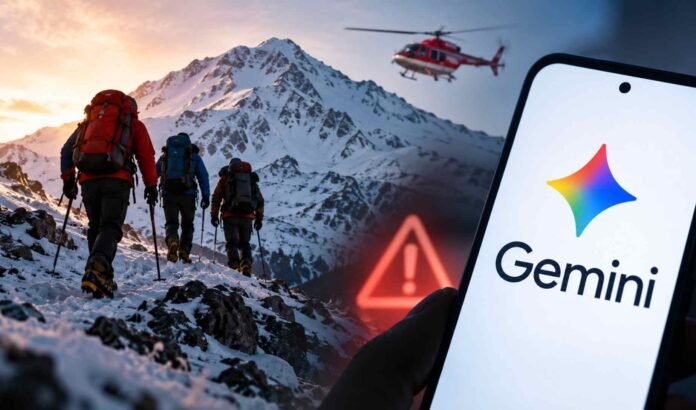
- Three inexperienced hikers used Google Gemini while planning a Mount Shasta climb.
- Gemini reportedly estimated the ascent would take about eight hours, but the group took much longer and reached the summit around 7pm.
- The hikers became lost during their nighttime descent, one person suffered a knee injury and rescuers were called.
- Officials advised climbers to check conditions with local Forest Service rangers and never rely solely on AI for mountain planning.
Google Gemini has become the center of a cautionary story after three climbers in California had to be rescued from Mount Shasta following an ascent that went badly wrong.
The hikers reportedly used Gemini to help plan their climb, but the information they received did not give them an accurate picture of how demanding the route could be. What was expected to be an eight hour trip turned into an ordeal lasting more than 16 hours.
The group eventually reached the summit at around 7pm, several hours later than the 11am target they had planned around. Their problems continued during the descent. Darkness set in, the hikers lost their route and one member suffered a knee injury.
They eventually called for help and spent the night in a makeshift camp in the Mud Creek Canyon area before rescuers reached them the following morning.
Gemini gave them an overly optimistic picture
According to information shared by the Siskiyou County Sheriff’s Office, Gemini told the inexperienced hikers that they could expect to complete the climb in roughly eight hours.
The AI also reportedly advised them to prepare with simple carbohydrates rather than fats, suggesting that fats could take too long to digest.
On paper, advice like this can sound perfectly reasonable. The problem is that mountain climbing is not an activity where general information is enough.
Conditions can change quickly. Route finding, elevation, weather, snow, terrain, fitness and previous climbing experience can all make a major difference to how long an ascent takes.
The hikers set off at 3am with the expectation that they would reach the summit by 11am. Instead, they did not reach the top until approximately 7pm.
That difference was not a minor scheduling problem. It left the group descending after dark and ultimately contributed to them becoming lost.
The climb became a rescue operation
One of the hikers reportedly had AllTrails available on a phone, which could have provided useful navigation information. However, the phone died during the trip.
Without a working navigation device and already facing a much longer climb than expected, the group found themselves in a difficult position.
During their descent, they moved off route and ended up in a canyon. One member was injured, leaving the group with even fewer options.
The rescue involved personnel from the Siskiyou County Sheriff’s Office, volunteers and US Forest Service climbing rangers. The hikers were recovered the next morning.
The fact that everyone made it out safely is the most important part of the story. But the incident also highlights how quickly a seemingly simple planning mistake can become dangerous in a remote environment.
The hikers admit they trusted AI too much
After the rescue, the climbers reportedly acknowledged that they had placed too much confidence in artificial intelligence.
The lesson here is not that AI has no place in outdoor planning. It can be useful for researching equipment, understanding basic terminology, finding information about permits and identifying questions that need further investigation.
The problem comes when an AI chatbot is treated as the final authority for a potentially dangerous activity.
A chatbot can generate an answer that sounds confident without actually understanding the situation on the ground. It does not have firsthand experience of the route, cannot assess the condition of a particular climber and may not have access to the latest information about weather, snow or trail conditions.
That distinction matters enormously when the consequences of bad information can involve injury or death.
Local knowledge still matters
The Siskiyou County Sheriff’s Office advised climbers to contact the local US Forest Service Mount Shasta Ranger Station before attempting the climb.
Officials also highlighted the importance of the 12pm turnaround time for people attempting an ascent.
A fixed turnaround time is one of the most important safety tools for mountain trips. It gives climbers a point at which they stop pursuing the original goal and begin returning, even if they have not reached the summit.
That discipline can be difficult when people have invested hours of effort into a climb. But reaching the top is not the only objective. Getting back down safely is just as important.
The Mount Shasta incident is therefore less about one incorrect Gemini answer and more about how people use AI when making decisions in the real world.
AI can summarize huge amounts of information in seconds. It can help people prepare questions and research unfamiliar subjects. But when the situation involves a mountain, a remote trail, changing weather or serious physical risk, generated answers should be treated as a starting point rather than a safety plan.
For outdoor adventures, experienced people and official local sources remain essential. A ranger who knows the mountain can provide context that a chatbot cannot.
The hikers were fortunate that rescuers were able to locate them and bring them to safety. Their experience also provides a useful reminder for anyone using AI to plan an adventure: a confident answer is not necessarily a reliable one.
Follow TechBSB For More Updates