
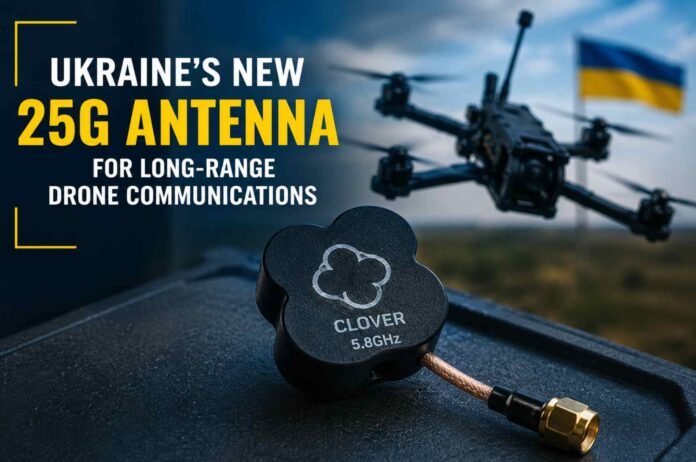
- BlueBird Tech’s CLOVER antenna weighs only 25 grams and operates from 4.9 to 6.1 GHz.
- It is designed for FPV drones, monitoring equipment, detection systems and ground robots.
- Its circularly polarized and omnidirectional design is intended to support communication while platforms change orientation.
- The antenna itself is not a weapon, and its real communication range depends on the radio system and operating conditions.
Ukraine’s defence technology sector is continuing to develop compact hardware for unmanned systems, with BlueBird Tech introducing an antenna that weighs just 25 grams.
Called the CLOVER 5.8 GHz, the antenna is designed to provide radio connectivity across a frequency range of 4.9 to 6.1 GHz. That places it close to the 5.8 GHz frequencies widely used by many first person view drone systems.
The small size and low weight could make the antenna particularly useful on compact unmanned platforms, where every additional gram can affect flight performance, endurance and payload capacity.
Despite its modest dimensions, the CLOVER is designed for applications that require reliable radio communication in environments where the position and orientation of a platform can change rapidly.
BlueBird Tech says the antenna uses a clover shaped design that provides circular polarization and an omnidirectional radiation pattern. In practical terms, that design is intended to maintain usable communication without requiring the antenna to remain pointed in a particular direction.
That can be valuable for moving drones and other robotic platforms, where orientation can change constantly during operation.
Designed for drones and ground based systems
According to information provided by BlueBird Tech, the CLOVER 5.8 GHz is not limited to airborne platforms.
The company says it can be integrated into FPV drones, unmanned aerial vehicle detection equipment and radio monitoring systems. It can also be used with measurement equipment and ground based robotic platforms.
The antenna comes with an SMA male connector and RG402 cable. These are relatively familiar components in radio equipment, potentially making integration easier for systems that already use compatible connections.
The 4.9 to 6.1 GHz operating range is also significant because it covers a substantial portion of the spectrum around the 5.8 GHz band used by many FPV systems.
However, the antenna itself should not be confused with a complete long range communications system.
An antenna is only one part of a radio link. The actual communication distance depends on several other factors, including transmitter power, receiver sensitivity, antenna placement, interference, terrain, atmospheric conditions and the communications equipment connected to it.
The 25 gram weight is therefore one of the more straightforward claims to assess. Claims about exceptional battlefield range would require considerably more information about the complete radio system and the conditions under which that range was achieved.
A component rather than a secret weapon
The description of the CLOVER as a new drone weapon may make the product sound more dramatic than it actually is.
BlueBird Tech has presented it as communications hardware. There is no indication in the available information that the antenna itself contains electronic warfare equipment, encryption technology, autonomous flight capabilities or interception functions.
Its primary role is to transmit and receive radio signals.
That distinction matters because the effectiveness of an antenna depends heavily on the equipment surrounding it. A well designed antenna can improve the reliability and efficiency of a communications link, but it does not automatically turn an ordinary radio into a long range system.
The circularly polarized design could nevertheless be useful for FPV platforms. These drones can experience rapid changes in orientation, particularly during aggressive manoeuvres. Maintaining a more consistent radio link while the aircraft changes position can be important for both control and video transmission.
The same principle could apply to detection equipment and ground robots operating in environments where movement and changing orientation are expected.
Part of Ukraine’s expanding unmanned technology sector
The CLOVER antenna is appearing alongside a growing collection of Ukrainian developments focused on unmanned technology.
Another Ukrainian defence technology company, WINFLY, has introduced the WINFLY Spider, a reusable interceptor designed to capture aerial targets using a net.
The Spider and CLOVER serve very different purposes. The Spider is intended for aerial interception, while CLOVER is a communications component that can be incorporated into several types of equipment.
That difference highlights how broad Ukraine’s unmanned technology industry has become. Development is taking place not only in complete drones, but also in antennas, communications equipment, detection systems, robotic platforms and other components that can support unmanned operations.
For the CLOVER, the most interesting feature may ultimately be its combination of size, weight and frequency coverage rather than any single headline performance claim.
At only 25 grams, it can be added to relatively small platforms without imposing a significant payload penalty. Its broad frequency coverage also gives system designers some flexibility when selecting compatible radio equipment.
Whether those advantages translate into a meaningful improvement in real world operations will depend on how the antenna performs when integrated into complete systems.
BlueBird Tech has not published enough information to independently assess its maximum communication range or performance under heavy interference. Those factors are especially important in contested environments, where radio systems can face significant congestion and disruption.
For now, the CLOVER 5.8 GHz is best understood as a lightweight communications component rather than a standalone weapon.
Its importance could come from something much less dramatic but potentially more practical: giving compact drones, monitoring equipment and robotic platforms a small and flexible antenna that can operate across a widely used section of the radio spectrum.
Follow TechBSB For More Updates