
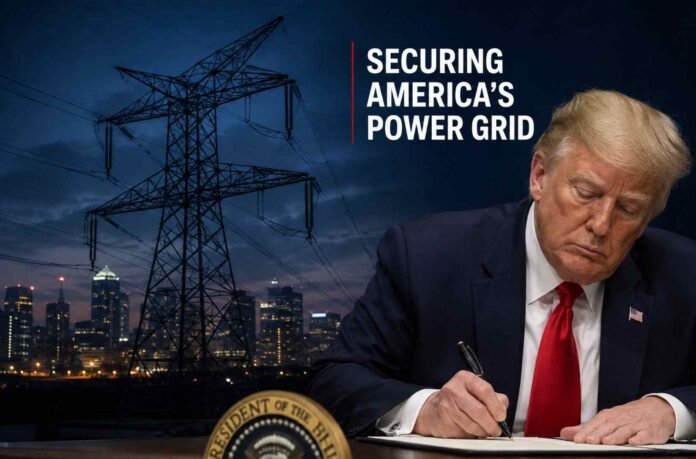
- Trump has declared a national emergency focused on securing the US bulk power system.
- The order restricts certain foreign made hardware and software used in critical energy infrastructure.
- The Department of Energy has 120 days to create enforcement and compliance rules.
- While not named directly, China is widely seen as the primary target of the policy.
President Donald Trump has signed a new executive order declaring a national emergency over security risks within the United States bulk power system, reviving a policy first introduced during his previous term. The move aims to restrict the use of foreign made equipment and software in the nation’s electricity infrastructure, citing concerns that adversarial nations could exploit vulnerabilities to disrupt essential services.
The order covers a wide range of systems that support electricity generation and transmission across the country. These include power plants, substations, transformers, transmission networks, and the digital platforms that help manage and operate them. According to the administration, these assets form the backbone of the US electrical grid and are critical to national security, economic stability, and public safety.
The White House argues that foreign sourced technology embedded within these systems could create opportunities for cyberattacks, espionage, or operational disruptions. As a result, federal agencies have been directed to take a closer look at both future purchases and existing infrastructure already deployed across the country.
Foreign Hardware and Software Face New Restrictions
Under the executive order, US companies and organizations will be prohibited from purchasing, importing, transferring, or installing certain foreign produced bulk power system equipment if it is deemed to pose a national security threat. Notably, the restrictions extend beyond physical hardware and also include software used to manage and control power infrastructure.
While the order establishes the framework for the restrictions, many of the details remain unclear. The Department of Energy has been given 120 days to develop enforcement rules and determine how potentially risky technologies will be identified. The agency will work alongside other federal departments to create the guidelines and implementation process.
In addition to limiting future acquisitions, the administration wants a comprehensive review of equipment already operating within the US grid. Officials will assess the extent of foreign technology currently in use and explore ways to isolate, remove, or replace components considered high risk. The effort could eventually lead to a significant overhaul of parts of the nation’s energy infrastructure if widespread vulnerabilities are identified.
Echoes of a Similar Policy From 2020
The latest order closely mirrors a measure introduced during Trump’s first term in 2020. At that time, the administration also declared a national emergency related to foreign threats against the power grid and imposed restrictions on certain transactions involving bulk power system equipment.
However, the policy had a short lifespan. Shortly after taking office in 2021, President Joe Biden suspended the order for review, and it was later formally revoked by the Department of Energy. The new executive order effectively restores the original approach while expanding attention toward software and digital systems that play an increasingly important role in modern grid operations.
Supporters of the move argue that strengthening oversight of critical infrastructure is necessary as cyber threats become more sophisticated. Critics, however, are expected to raise questions about implementation costs, supply chain disruptions, and the availability of domestic alternatives for specialized equipment.
China Expected to Be the Primary Focus
Although the executive order does not specifically mention any country by name, industry observers widely believe China is the main target. The Trump administration has long expressed concerns that Chinese manufactured technology could be used for surveillance, intelligence gathering, or cyber operations against US interests.
Similar concerns drove earlier actions against Chinese telecommunications companies, including Huawei and ZTE. During Trump’s first term, both firms faced significant restrictions in the United States, with federal agencies citing national security risks. The government also launched programs designed to remove Chinese telecommunications equipment from domestic networks.
The same concerns are now being applied to the energy sector. China remains a dominant force in several parts of the global energy supply chain, including solar manufacturing and power equipment production. Security experts have repeatedly warned that dependence on foreign technology in critical infrastructure could create strategic vulnerabilities during periods of geopolitical tension.
With the Department of Energy now tasked with drafting implementation rules, the next four months will be crucial in determining how aggressively the administration moves to reshape the nation’s energy infrastructure and reduce reliance on foreign technology.
Follow TechBSB For More Updates