
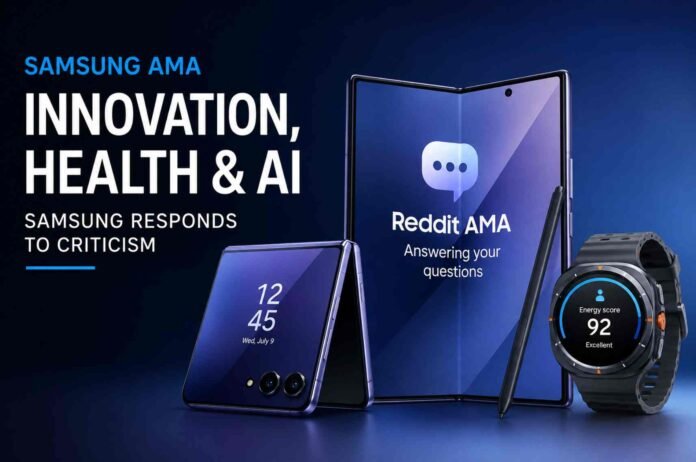
- Samsung defended its innovation strategy during a Reddit AMA following the launch of its latest foldable devices.
- The company said future innovation will focus heavily on personalized health features and wearable technology.
- Samsung reiterated that Galaxy AI features are optional and can be disabled by users.
- The discussion highlighted ongoing debate over whether Samsung’s recent hardware upgrades are significant enough for long time customers.
Samsung has rarely been this open to public criticism, but its latest Reddit AMA gave the company a chance to directly respond to some of the biggest concerns surrounding its smartphones. Instead of avoiding uncomfortable questions, Samsung addressed complaints about slowing innovation, the growing role of artificial intelligence, and what users can expect from future Galaxy devices.
The discussion followed the launch of the Samsung Galaxy Z Fold 8, Galaxy Z Fold 8 Ultra, and Galaxy Z Flip 8. Representing Samsung was Annika Bizon, Vice President of Product and Marketing for Mobile Experience at Samsung Electronics UK and Ireland, who answered questions ranging from hardware upgrades to AI features and health technology.
While some responses naturally reflected Samsung’s official messaging, the AMA also revealed how the company views its current direction and where it believes the next wave of innovation will come from.
Samsung responds to claims that innovation has slowed
One of the most talked about questions came from a long time Samsung customer who argued that the company no longer delivers meaningful hardware upgrades. The Reddit user explained that earlier Galaxy phones introduced major improvements every couple of generations, but recent releases have felt too similar to justify frequent upgrades.
Rather than dismissing the criticism, Bizon challenged the perception that Samsung has stopped innovating. According to her, innovation is no longer measured only by dramatic hardware changes but also by how devices adapt to increasingly personal user experiences.
She pointed to the Galaxy Z Fold 8 as an example of Samsung listening to customer feedback. The company expanded its foldable lineup this year to meet demand for larger displays that offer a more immersive experience for productivity, entertainment, and multitasking. She also highlighted the Galaxy Watch Ultra 2, saying it received significant improvements designed for users with demanding fitness and outdoor lifestyles.
Bizon stressed that Samsung continues experimenting, but its priorities are now shaped by what customers actually ask for rather than creating new technology simply for attention.
That response carries more weight this year than it might have in previous product cycles. Samsung has introduced several noticeable hardware updates across its foldable portfolio, making 2026 one of its more active years for product innovation.
Health technology is becoming Samsung’s biggest priority
Beyond smartphones, Bizon suggested that health technology is where Samsung sees its biggest opportunity.
She described health as one of the most exciting areas of mobile development because wearable devices are evolving beyond simple fitness tracking into tools that help users understand their overall wellbeing before problems become serious.
Samsung’s latest Galaxy Watch models include new sensors capable of monitoring overnight skin temperature and heart rate. Features such as Vitals are designed to detect meaningful changes that could indicate illness before obvious symptoms appear.
The company is also expanding sleep analysis. Instead of only measuring total sleep duration, newer features examine sleep latency, helping users understand how long it actually takes them to fall asleep and what conditions contribute to better rest.
Fitness tracking has also become more personalized. Bizon shared her own experience training for an ultramarathon, explaining how newer tools like Fitness Index and Nutrition Alert can identify signs of fatigue or dehydration before performance begins to decline.
Samsung believes this represents a broader shift in healthcare, moving from reactive treatment toward prevention through continuous monitoring and personalized recommendations.
AI remains central despite mixed consumer reactions
Artificial intelligence inevitably became another major topic during the Reddit session.
Several users questioned Samsung’s growing focus on AI, with some saying they simply do not want AI integrated into their smartphones. Others raised broader concerns beyond usefulness, including privacy and ethical issues surrounding AI technologies.
Bizon responded by emphasizing that Galaxy AI features remain optional. Users can disable AI tools they do not wish to use, allowing them to customize the experience according to their preferences.
She also encouraged skeptical users to try AI in practical situations before dismissing it entirely. One example she shared involved pointing a phone’s camera at a concert poster and asking the device to locate tickets automatically. Her argument was that if AI saves time in everyday tasks, users may gradually discover value in it.
However, convincing every user may prove difficult. While some consumers remain unconvinced because AI features appear unnecessary, others object to AI on principle regardless of whether individual tools can be switched off.
That distinction highlights one of Samsung’s biggest challenges as AI becomes more deeply integrated into consumer electronics.
Samsung’s next challenge will be proving momentum continues
The Reddit AMA offered a rare glimpse into Samsung’s thinking beyond polished product launch presentations.
The company appears confident that foldables, wearable health features, and personalized AI experiences will define the next generation of Galaxy products. At the same time, the conversation showed that many loyal Samsung customers remain unconvinced that innovation has kept pace with the company’s earlier years.
Samsung’s willingness to engage with those criticisms publicly is notable in itself. Whether its strategy resonates with buyers will ultimately depend less on marketing and more on whether future Galaxy devices deliver meaningful improvements that people notice in daily use.
The company’s next flagship smartphone lineup will likely provide the clearest indication of whether this renewed focus on innovation continues or whether customers remain eager for bigger leaps in hardware design.
Follow TechBSB For More Updates