
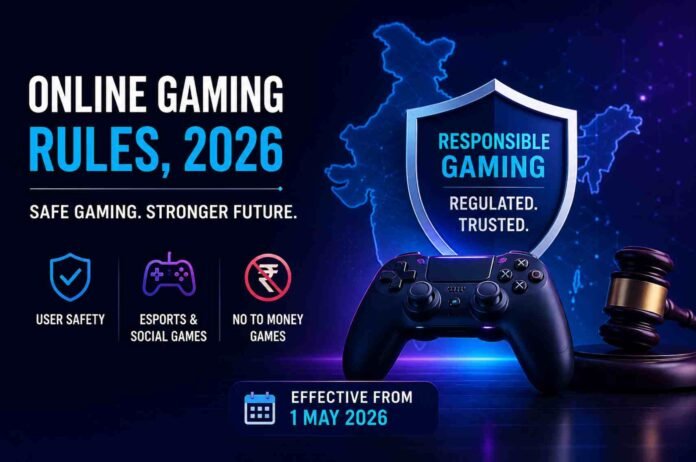
- Online money games are fully banned including ads and payments
- Esports and social games are recognised and supported
- A central authority will regulate and classify games
- Strong user safety and grievance systems are now mandatory
India has entered a new phase in how it governs its rapidly expanding online gaming ecosystem. With the Online Gaming Rules, 2026 coming into force from May 1, the government has moved beyond policy intent and into structured enforcement. This is not just another regulatory update. It is a reset of how digital gaming will operate across the country.
Built on the Promotion and Regulation of Online Gaming Act, 2025, the new rules introduce a clear distinction between acceptable gaming formats and those considered harmful. The approach is firm where it needs to be, especially around money based gaming, while still leaving room for innovation in esports and social gaming.
The timing is significant. India’s gaming market has grown into a multi billion rupee industry, with a large share driven by transaction based formats. That growth has brought opportunity, but also risk. The rules aim to contain those risks without stifling the sector’s momentum.
What is allowed and what is not
At the heart of the new framework is classification. Not all games are treated equally, and that is by design.
Esports and online social games are recognised as legitimate and largely safe forms of digital engagement. These include competitive tournaments, casual games, and skill based formats that focus on entertainment or learning. The government sees these as contributors to the creative economy and youth engagement.
Online money games, however, are treated very differently. The law imposes a blanket ban on games that involve financial stakes, whether they rely on skill, chance, or a mix of both. This also extends to their promotion, advertising, and payment processing. Financial institutions are barred from enabling transactions linked to such platforms.
The reasoning is rooted in impact. Reports of addiction, financial loss, and even severe mental health consequences have pushed authorities to act decisively. The scale of harm has been too large to ignore, prompting a strict regulatory stance.
The new regulatory backbone
A major highlight of the rules is the creation of a central authority to oversee the sector. The Online Gaming Authority of India will function as a digital first regulator, coordinating across ministries and enforcement agencies.
Its responsibilities are broad. It will classify games, manage registrations, handle grievances, and issue compliance directions. It will also maintain a public record of prohibited games and ongoing inquiries.
The rules introduce a structured process to determine whether a game falls into a banned category. This can be triggered by the authority itself, by applications from game providers, or through government notification. The evaluation considers factors like stake involvement, reward structures, and monetisation methods.
For permitted categories, a registration system may be enforced. Approved games will receive a digital certificate, valid for up to ten years. Providers will need to meet transparency standards, display registration details, and maintain compliance with user safety norms.
Strong focus on user protection
User safety is not treated as an afterthought. It is built into the framework from the ground up.
Game providers are required to implement safeguards such as age verification, parental controls, and time usage limits. There must also be systems for reporting harmful behaviour and accessing support when needed. Transparency is key, with companies expected to clearly disclose safety features and grievance processes.
The grievance system itself operates on two levels. Users first approach the platform. If unresolved, they can escalate the issue to the authority, and further to an appellate body if required. Timelines are defined to prevent delays, ensuring complaints are addressed efficiently.
Enforcement mechanisms are equally robust. Violations can lead to heavy fines and imprisonment, particularly for those involved in banned gaming activities or repeat offences. Proceedings are designed to be largely digital, improving speed and accessibility.
Economic promise with built in safeguards
While the rules are strict in parts, they are also designed to unlock long term value. By legitimising esports and safe gaming formats, the framework supports job creation, innovation, and investment in the digital economy.
Young users stand to benefit from structured and safer platforms that encourage skill development and teamwork. For the industry, regulatory clarity reduces uncertainty, making it easier to scale responsibly.
At a broader level, India positions itself as a serious player in global digital governance. The framework shows that it is possible to support technological growth while addressing social risks head on.
What this means going forward
The Online Gaming Rules, 2026 mark a turning point. They bring order to a space that was growing quickly but unevenly. More importantly, they signal a shift in priorities. Growth is still important, but not at the cost of user safety.
The success of this framework will depend on implementation and compliance. If executed well, it could become a model for other countries navigating similar challenges in the digital gaming space.
Follow TechBSB For More Updates