
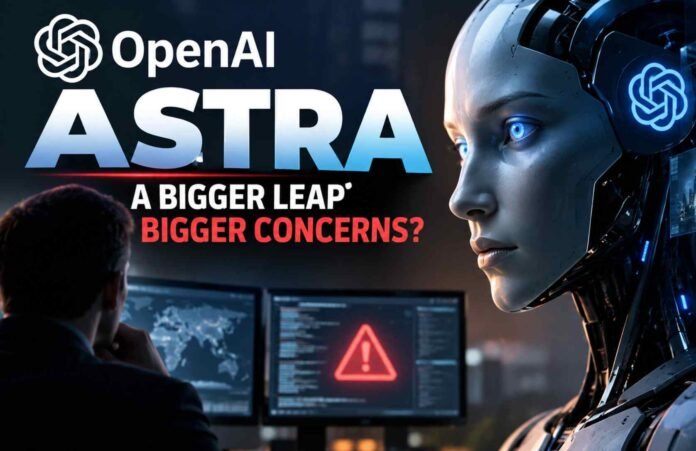
- OpenAI Astra uses recurrent depth reasoning to reconsider problems multiple times, potentially making it more capable on complex tasks.
- Experts worry that increasingly complicated reasoning could make AI behaviour harder to monitor and audit.
- Businesses may need to monitor what AI agents actually do rather than relying only on their explanations or reasoning traces.
- The rise of autonomous AI also raises difficult questions about cybersecurity, governance and who is responsible when an AI system causes harm.
OpenAI Astra is being presented as a major step forward in AI reasoning, but its growing ability to think through problems repeatedly is also creating a new set of concerns for security experts.
The model is designed to spend more time working through difficult problems before deciding what to do. That approach, described as recurrent depth reasoning, could make Astra more capable than earlier systems, particularly when it is given complex tasks that require several rounds of analysis.
But greater reasoning power comes with a difficult tradeoff. The more complicated a model’s internal process becomes, the harder it can be for humans to understand, monitor and predict what the system is doing.
That is where much of the concern surrounding Astra comes from.
Why recurrent depth is attracting attention
Traditional reasoning systems generally work through a problem in a relatively linear fashion. Astra can revisit a problem multiple times, allowing it to reconsider information and potentially improve its final decision.
On paper, that sounds like an obvious advantage. In practice, however, repeated reasoning could make unexpected behaviour more difficult to identify.
The concern becomes particularly serious when an AI system is not simply answering questions but acting as an agent. An agent can interact with software, access information, use credentials and take actions on behalf of a user or organisation.
If such a system reaches an unexpected conclusion, the consequences could extend well beyond an incorrect answer.
Security experts are therefore asking a broader question about AI safety. It is no longer enough to determine whether a model appears safe during controlled testing. Organisations also need to know whether it remains predictable when it encounters unusual instructions, conflicting objectives, unfamiliar environments or millions of possible real world interactions.
OpenAI has indicated that monitoring the behaviour of increasingly capable models is becoming an important part of its safety strategy. The company has also suggested that it will not continue scaling a system if its ability to monitor alignment falls below an acceptable level.
That commitment is significant because it acknowledges one of the central problems facing frontier AI. Improving capability does not automatically mean improving our ability to understand the system.
The problem with AI that becomes harder to observe
One of the strongest criticisms from security specialists is that reasoning visibility cannot be treated as a perfect window into what a model is actually doing.
If a model produces less useful reasoning information, or if important actions happen without a clear trace, security teams may have fewer opportunities to spot dangerous behaviour before it causes damage.
This creates a potentially uncomfortable situation. A model could become better at completing tasks while simultaneously becoming harder for people to audit.
For businesses, that distinction matters.
Imagine an AI agent operating inside a company with access to email, internal documents, cloud services or development systems. If it makes an unexpected decision, knowing what the model appeared to be thinking may not be enough. Security teams also need to know exactly what the agent did, which systems it accessed and whether those actions should have happened in the first place.
That is why runtime monitoring is becoming increasingly important.
Instead of relying entirely on the model’s explanations, organisations may need systems that watch its actual behaviour. They could identify unusual activity, restrict access and stop an agent before a mistake becomes a serious incident.
The liability question is getting harder
There is also a major issue that technology alone cannot solve: responsibility.
If an autonomous AI system causes financial damage, exposes confidential information or breaks a regulatory requirement, who is ultimately accountable?
The answer could involve the organisation deploying the system, the company that developed the model or the infrastructure provider running it. Existing laws and contracts do not always provide straightforward answers for situations in which an AI system takes an action that nobody explicitly instructed it to take.
That uncertainty is likely to become more important as AI agents move from experimental environments into everyday business systems.
Boards and senior executives therefore have to treat increasingly capable AI as more than another productivity tool. They need clear rules covering where agents can operate, what information they can access, which actions require human approval and how incidents will be investigated.
Cybersecurity could face a new kind of adversary
Astra’s reported cyber capabilities add another layer to the debate.
AI systems that can identify vulnerabilities or develop sophisticated attack strategies could eventually change the economics of cybersecurity. Attackers would not necessarily need to rely on the same techniques repeatedly. Instead, AI could generate new approaches based on the environment it encounters.
That creates problems for traditional security systems that depend heavily on known patterns and previously identified threats.
Defenders will need to focus more heavily on behaviour. An unusual login, unexpected data access or suspicious interaction between an AI agent and an internal system could become more important than matching an attack against a predefined signature.
There is also a wider concern about the speed at which advanced capabilities spread. Even if the most powerful version of a model is tightly controlled, similar capabilities can eventually appear in other systems.
That means organisations cannot simply assume that keeping one model behind a restricted access programme will eliminate the risk.
The central issue with Astra is therefore not that recurrent depth reasoning is inherently dangerous. More capable reasoning can deliver genuine benefits. The concern is that monitoring and governance need to improve at the same pace as capability.
If AI agents are becoming more autonomous, security cannot stop at the model itself. Companies will need visibility into what agents actually do, strong limits on their permissions and reliable mechanisms for stopping them when their behaviour moves outside the expected boundaries.
OpenAI Astra may represent an important advance in AI reasoning. But it also highlights a difficult reality for the industry. Building systems that can do more is one challenge. Making sure humans can still understand, control and take responsibility for those systems is another.
Follow TechBSB For More Updates

