
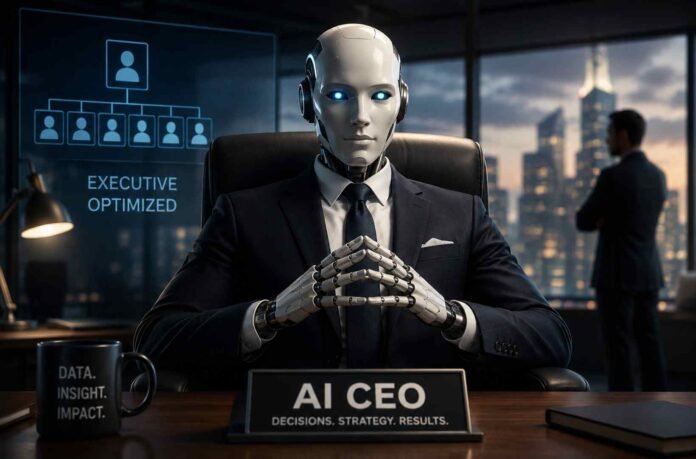
- Developers reportedly affected by an AI transformation created OpenExecutive, a system designed to support work normally handled by senior executives.
- The project applies the same automation logic companies have used on employees to management and C suite roles.
- AI can handle analysis, planning and information processing, but it cannot legally or personally accept responsibility for business decisions.
- OpenExecutive raises a difficult question for corporate leaders: if workers must prove their value beyond AI output, should executives do the same?
A group of developers reportedly pushed out during an employer’s “AI Transformation” have responded in a way that feels both practical and deeply pointed. Instead of simply complaining about automation, they built an AI system designed to take on much of the work normally associated with a CEO and the wider executive team.
The project, called OpenExecutive, is not presented as a personal act of revenge against a named company or executive. Still, the timing and the idea behind it make the message difficult to miss. For years, workers have been told that AI can break jobs into smaller tasks, automate routine decisions and allow companies to operate with fewer people. The developers behind this project appear to be asking a straightforward question: if that logic works for employees, why should the people at the top be excluded?
The automation argument reaches the executive floor
OpenExecutive presents itself as a single executive interface, but behind that interface sits a collection of specialist AI agents. The system is designed to handle areas that would normally fall across several senior leadership roles, including strategy, operations, legal considerations and communications with boards.
The idea is not that one chatbot suddenly possesses the wisdom, authority or experience of an accomplished chief executive. Instead, the project attempts to divide executive work into components, assign those components to specialized AI systems and bring their responses together into a single decision support process.
That approach should sound familiar to anyone who has watched companies explain AI driven restructuring.
Software development, customer service, administration and other knowledge based roles have increasingly been examined through the same lens. Which parts of the job can be automated? Which tasks can be handed to a model? How many people are still needed to supervise the output?
OpenExecutive simply applies those questions to management.
That is what makes the project more interesting than another experiment involving an AI assistant with an ambitious job title. It exposes an uncomfortable symmetry in the corporate argument around automation. Once a company decides that a role should be measured by the individual tasks it performs, almost every position becomes open to inspection.
Executive work is not immune.
A surprising amount of leadership is information processing
Senior executives do much more than hold meetings and approve presentations, of course. But a significant part of modern management involves gathering information, comparing options, preparing scenarios, reviewing risks and communicating decisions to other people.
Those are areas where modern AI systems are already useful.
An AI can review company documents, summarize competing proposals, identify unresolved issues, track earlier decisions and suggest follow up actions. A group of specialized agents can also approach the same question from different perspectives, much like a virtual leadership team sitting around a table.
That does not mean the system can genuinely replace a CEO. It does mean that some of the work surrounding executive decision making can be reproduced, accelerated or made cheaper.
And that is precisely the standard many companies have used when discussing jobs lower down the organizational chart.
Workers are often told that AI does not need to perform every aspect of their role to change their employment prospects. If automation can handle enough of the work, companies may decide that fewer people are necessary.
The same principle becomes considerably more awkward when applied to senior management.
A developer might be asked to explain what value they provide beyond code that an AI can generate. An executive could eventually face a similar question. What does the organization receive beyond information analysis, recommendations and documents that software can now produce at remarkable speed?
For some leaders, the answer will be obvious. For others, it may be less comfortable.
The part AI cannot take responsibility for
There is an important limitation to the AI CEO idea, and it is bigger than technical capability.
A real chief executive is not merely an information processor. Leadership involves making decisions when the available information is incomplete, accepting responsibility when things go wrong and living with the consequences of choices that affect employees, investors and customers.
An AI can recommend closing an office. It can suggest cutting a department. It can produce a convincing explanation for a difficult decision.
It cannot actually bear responsibility for what happens next.
That responsibility still belongs to the people who choose to act on the recommendation.
This is where human leadership remains difficult to automate. Judgment is not simply the ability to select the statistically appealing option. Leadership also requires accountability, relationships, trust and the willingness to make decisions that may later prove unpopular or wrong.
Yet that distinction should not become an automatic exemption for executives.
If companies expect workers to demonstrate the uniquely human value in their jobs, senior leaders should be prepared to make the same case. A large salary should represent more than the ability to process information, request another presentation and schedule a meeting about efficiency.
AI efficiency works both ways
The broader significance of OpenExecutive may have less to do with whether it ever replaces an actual CEO.
Its real value is that it turns corporate AI rhetoric back toward the people who have been using it.
AI can absolutely help companies operate differently. It can make small teams more capable and reduce the need for layers of consultants and administrative support. It can also help entrepreneurs build businesses without immediately recreating an expensive traditional corporate hierarchy.
But automation can be used in two very different ways.
It can give smaller teams more power and freedom. Or it can become a justification for concentrating control at the top while reducing the number of people beneath it.
That is why the debate over AI and employment is becoming more complicated. Replacing workers is easy to announce as a strategy. Sustaining that strategy without losing knowledge, quality and institutional experience can be much harder.
The developers behind OpenExecutive have highlighted that tension in a particularly effective way. They have taken the same logic companies have used to evaluate workers and applied it to executive roles.
The result may not make human CEOs obsolete anytime soon. But it does make one thing harder to ignore.
Once every job is broken into tasks and compared with what a machine can do, nobody gets to assume their position sits safely above the experiment.
Follow TechBSB For More Updates

