For more than a decade, automated electric vehicle charging has been one of those futuristic ideas that seemed destined to remain a concept. Tesla famously teased a robotic charging arm back in 2014, even demonstrating a working prototype that could connect itself to a vehicle without any human involvement. Yet despite the excitement, the technology never made it beyond the demonstration stage.
Now, Xiaomi appears ready to turn that vision into a real product.
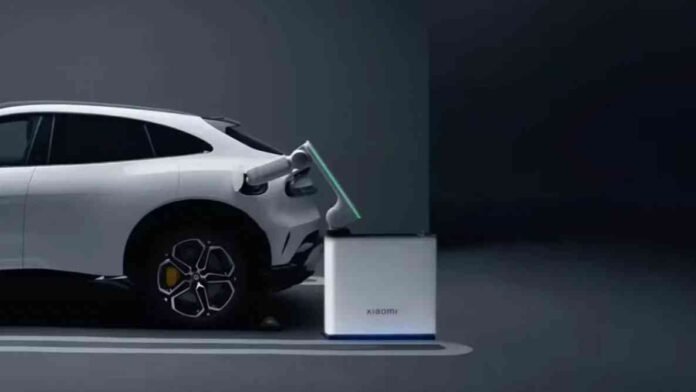
The Chinese technology giant has unveiled a robotic charging solution designed specifically for its growing lineup of electric vehicles. Unlike Tesla’s ambitious snake like charger concept, Xiaomi’s version is compact enough to fit inside a residential garage and is aimed at making daily EV ownership simpler and more convenient.
A Charging Experience That Requires No Effort
The newly revealed system is built around a robotic arm that automatically connects a charging cable to the vehicle once it is correctly parked. Instead of stepping out of the car and manually handling a charging cable, owners can simply park their vehicle and leave the rest to the machine.
According to Xiaomi, the charging arm identifies the vehicle, positions itself, and plugs in automatically. Once the battery reaches the desired charge level, the system disconnects the cable and neatly stores it away.
The process removes one of the most repetitive aspects of EV ownership. Drivers no longer need to handle cables, search for charging ports in poor lighting, or deal with dirty connectors that are often exposed to the elements.
Xiaomi has also integrated smartphone controls into the system. Owners can remotely initiate a charging session through their mobile device, provided the vehicle is parked within the robotic arm’s operating range. This means users do not even need to stand near the vehicle to begin charging.
While Xiaomi has yet to reveal pricing or launch details, promotional footage suggests the product is already close to production readiness. As a result, a commercial launch in China could arrive sooner rather than later.
Tesla’s Long Delayed Vision Finally Finds a Home
The announcement inevitably draws comparisons with Tesla’s robotic charging project.
When Elon Musk first discussed the concept in 2014, the idea captured widespread attention. Tesla later demonstrated a charging arm that emerged from a wall mounted unit and automatically connected itself to a Model S. The technology looked impressive, but it never progressed into a consumer product.
Industry observers have long speculated that the system’s complexity, manufacturing costs, and limited practical benefits may have prevented large scale deployment. Tesla eventually shifted focus toward improving charging infrastructure and charging speeds rather than pursuing automated cable connections.
Xiaomi’s approach appears more practical and focused. Rather than creating a dramatic robotic mechanism, the company has developed a solution intended for everyday residential use. If successful, it could become one of the first commercially available automated charging systems designed specifically for home EV owners.
The Race Toward Cable Free Convenience
Xiaomi is not alone in exploring new ways to simplify charging.
Automakers and technology companies are increasingly investing in solutions that reduce or eliminate the need for drivers to physically connect their vehicles to a power source. Porsche recently showcased wireless charging technology for its upcoming electric Cayenne, allowing vehicles to recharge simply by parking over a charging pad.
Chinese manufacturers are also moving quickly in this area. Aito previously demonstrated a robotic charging arm for its electric vehicles, while Li Auto has discussed plans to introduce similar technology across parts of its charging network.
These developments highlight a growing industry trend. As electric vehicles become more advanced, manufacturers are looking beyond battery range and charging speed to improve the overall ownership experience.
Could Robotic Charging Become the Next EV Luxury Feature?
Modern electric vehicles are already equipped with cameras, sensors, connectivity systems, and advanced parking technologies. Integrating these capabilities with automated charging equipment is a logical next step.
For premium EV buyers, convenience is becoming just as important as performance. A charging system that works without human intervention could appeal to drivers who want a completely seamless ownership experience.
There are still challenges to overcome, including installation costs, compatibility limitations, and long term reliability. Xiaomi’s solution will reportedly work only with the company’s own electric vehicles, restricting its appeal to a wider audience.
Even so, the technology offers a glimpse into a future where charging an electric vehicle becomes almost invisible to the user. Instead of handling cables and connectors, drivers may simply park, walk away, and let automation take care of the rest.
If Xiaomi successfully launches the product and proves its reliability, it could mark an important step toward making hands free EV charging a mainstream reality.
Follow TechBSB For More Updates