
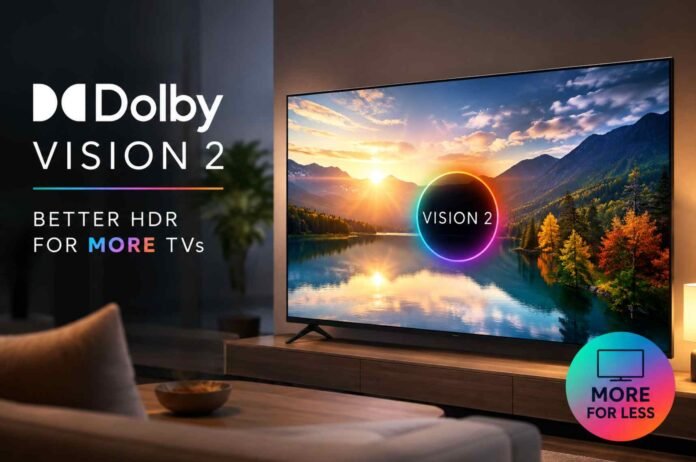
Dolby Vision 2 was introduced as the next generation of Dolby’s HDR technology, but the company is taking a slightly different approach this time. Instead of offering one version aimed at every type of television, Dolby has divided the technology into two versions.
Dolby Vision 2 Max is designed for premium televisions. It is intended to take advantage of brighter panels, wider colour ranges and more powerful processing hardware. Dolby sees this version as the successor to the Dolby Vision experience already found on higher end TVs.
The standard Dolby Vision 2 version has a different job. It is designed for mainstream and more affordable televisions that may not have included Dolby Vision in the first place.
That could be an important change for buyers. Dolby Vision has traditionally been associated with mid range and premium televisions, partly because manufacturers have to consider licensing costs as well as the hardware needed to support the technology.
According to Dolby executives Chris Turkstra and Jonas Klittmark, the new standard version was developed with those cheaper televisions in mind.
The argument is straightforward. Improving a TV’s picture quality by changing its panel or upgrading its backlighting can be expensive. Adding better image processing through Dolby Vision 2 could offer manufacturers a less costly way to improve the picture.
Turkstra says Dolby has seen particularly noticeable results when comparing affordable TVs running the older Dolby Vision technology with the new system. The company believes Dolby Vision 2 can improve image accuracy while recovering more detail from the picture.
That does not mean every budget television will suddenly get Dolby Vision 2. Dolby says there are minimum requirements, and Full HD televisions will not qualify. However, the company expects the technology to reach significantly more models than the original Dolby Vision system.
Dolby Vision 2 Max takes the premium position
The distinction between the two versions is important because Dolby Vision 2 Max is not simply a more expensive licence for the same experience.
Premium televisions increasingly have much brighter screens and more advanced processing capabilities than TVs did when the original Dolby Vision launched. Dolby Vision 2 Max is intended to make better use of those improvements.
Dolby sees Max as the version that will eventually occupy the premium position currently held by Dolby Vision.
Standard Dolby Vision 2 is being positioned differently. Its purpose is to bring the benefits of the new technology to a broader range of televisions without requiring manufacturers to move into more expensive hardware.
For shoppers, that could make Dolby Vision 2 much less of a premium feature.
There is also an important hardware development behind this plan. At present, MediaTek’s Pentonic 800 is the main television processor supporting Dolby Vision 2. It is already being used in televisions from brands including Hisense and TCL.
Dolby says this will not remain the only option.
More TV chips are on the way
Dolby is working with silicon manufacturers to bring support for Dolby Vision 2 to more TV processing platforms. The company says new chips are already being developed for mainstream televisions.
That could be the key to making the technology widespread.
A television manufacturer cannot simply add a new HDR format through software if the underlying processing hardware does not support the necessary technology. As compatible chips become cheaper and more widely available, Dolby Vision 2 should become easier to include in less expensive models.
Dolby also wants support to extend across the wider TV chip industry rather than remaining tied to one supplier.
This makes 2027 particularly interesting. The first wave of Dolby Vision 2 televisions is arriving this year, but the bigger test will come when compatible processors begin appearing in cheaper sets.
TCL, Hisense and Philips are among the brands expected to support Dolby Vision 2, although availability varies by market and model.
If Dolby gets its way, the technology will eventually become something buyers encounter across a much wider section of the TV market rather than something reserved mainly for premium screens.
What this means for TV buyers
The most interesting part of Dolby Vision 2 may not be what it does on expensive OLED or Mini LED televisions. It could be what it does for a television costing considerably less.
A better panel will always matter, but not every buyer can justify paying for a premium display. If Dolby Vision 2 can deliver meaningful improvements through image processing at a relatively small additional cost, manufacturers have a strong reason to adopt it.
There is still a question over how much of the benefit consumers will actually see. Picture quality depends on the panel, brightness, contrast, backlighting and processing working together. Dolby Vision 2 cannot turn a basic television into a premium one.
Even so, the prospect of better HDR processing reaching cheaper TVs is significant.
The original Dolby Vision helped establish advanced HDR as a premium feature. Dolby Vision 2 could take the opposite route and make advanced HDR processing much more accessible.
The real test will be the next generation of affordable televisions. If compatible chips become widespread and licensing costs stay low enough, Dolby Vision 2 could become one of the more interesting upgrades in budget TV technology.
Follow TechBSB For More Updates

