
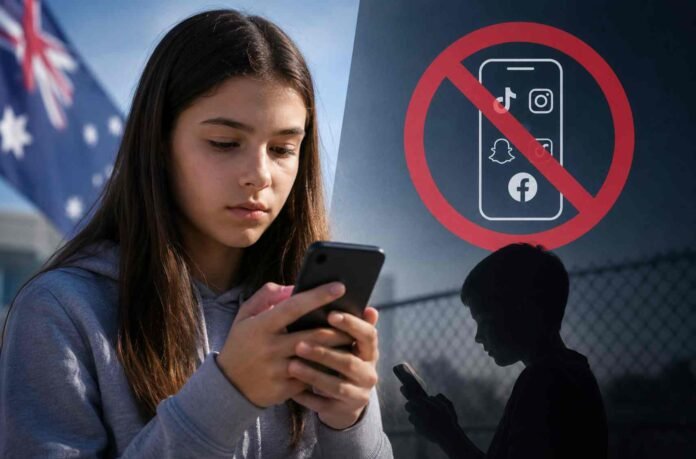
Australia made global headlines when it introduced one of the world’s toughest social media restrictions for children under 16. The law was designed to protect young people from cyberbullying, harmful content, online exploitation, and the growing influence of addictive social platforms. However, less than a year after the ban took effect, new findings suggest that the legislation is facing significant challenges in practice.
A recent study by Australia’s online safety regulator shows that the overwhelming majority of teenagers who were expected to leave social media have continued using these platforms. The report highlights how difficult it is to enforce age restrictions in the digital world and raises important questions about whether legislation alone can change online behavior.
Most Under 16 Users Remain Active Despite the Ban
According to Australia’s eSafety regulator, more than eight out of every 10 children aged between 10 and 15 were still using age restricted social media platforms three months after the law came into force.
Before the restrictions were introduced, nearly 86 percent of surveyed children reported using at least one social media platform covered by the law. Three months later, the figure had only dropped slightly to just above 81 percent. Daily social media usage also remained almost unchanged, declining from around 60 percent to 58 percent.
The findings indicate that while millions of accounts may have been removed, many young users either retained access to existing accounts or successfully created new ones.
One of the biggest reasons behind the limited impact was the lack of effective age verification. Around half of the children who kept their accounts said they were never asked to verify their age. Others reported that their profiles already listed them as being 16 or older, while some said automated age checking systems incorrectly identified them as adults.
The regulator concluded that social media companies had not consistently implemented strong enough age assurance measures, making it relatively easy for underage users to remain online.
Why Enforcing the Ban Has Been So Difficult
Experts had warned from the beginning that enforcing such a broad social media ban would be challenging.
Many teenagers are already familiar with tools that help bypass online restrictions. Some use virtual private networks to mask their location, while others enter false birth dates during registration. Facial age estimation systems can also produce inaccurate results, allowing younger users to gain access.
Another challenge is that young people often move to alternative digital spaces when mainstream platforms become harder to access. Some shift to newer social apps, while others spend more time on online gaming platforms, which are not covered by Australia’s current restrictions.
The latest report reinforces concerns that technology often evolves faster than regulation. Even when platforms remove accounts, determined users can frequently return using different credentials or devices unless verification systems become considerably stronger.
Interestingly, researchers also found little evidence that the ban significantly changed children’s everyday activities. Participation in sports, music, arts, family time, and community events remained largely the same after the restrictions were introduced.
Government Defends the Policy Despite Mixed Results
Australian officials continue to support the legislation, arguing that its success should not be measured solely by complete compliance.
Government representatives say the policy has already influenced national discussions about children’s digital wellbeing and encouraged more families to think carefully about social media use.
Officials also point out that no law achieves perfect compliance. They compare the measure to minimum drinking age laws, which remain valuable despite violations. From their perspective, reducing exposure and setting clear legal expectations still offers meaningful public benefits.
Earlier this year, authorities announced that approximately 4.7 million accounts believed to belong to Australian children had been removed across major social media platforms. However, the latest findings suggest that many young users have since returned through newly created accounts.
The policy has also faced legal scrutiny. Reddit challenged parts of the legislation in Australia’s High Court while continuing to comply with its requirements. The case remains ongoing and could influence how the law develops in the future.
Growing Global Debate Over Children’s Online Safety
Australia’s experiment is attracting close international attention because several countries are considering similar restrictions.
The United Kingdom plans to introduce comparable rules from 2027 that would restrict access to platforms such as TikTok, Instagram, and Snapchat for younger users while excluding messaging apps, educational services, music streaming, and ecommerce platforms.
Denmark has announced plans to prohibit social media use for children under 15, while Malaysia is preparing restrictions for users under 16. Greece has also proposed limiting social media access for children younger than 15 beginning in 2027, subject to parliamentary approval.
The broader discussion extends beyond screen time. Experts increasingly warn that children face growing risks from AI generated misinformation, manipulated images, deepfakes, harmful recommendations, and inappropriate content. Research from organizations including the American Psychological Association and UNICEF suggests that younger users may struggle to recognize AI generated material or understand how recommendation systems influence what they see online.
Australia’s experience demonstrates that passing legislation is only one part of the solution. Stronger age verification, improved platform accountability, digital literacy, parental involvement, and better online safety education will likely be necessary if governments hope to reduce children’s exposure to online risks. As more countries prepare their own social media restrictions, Australia’s early results will serve as an important case study for policymakers around the world.
Follow TechBSB For More Updates

