
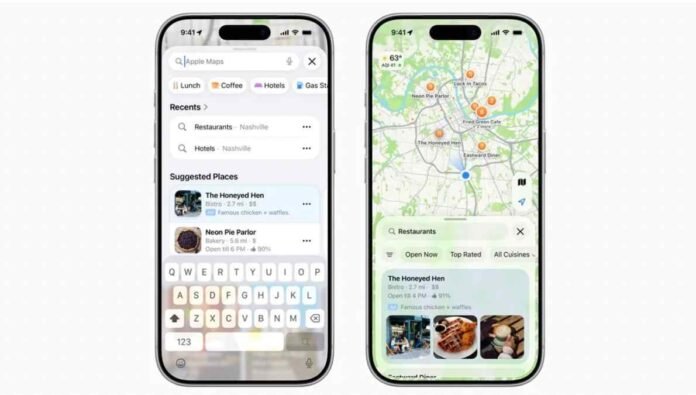
- Apple Maps is now showing ads to users in the US and Canada.
- Ads can appear in Suggested Places and at the top of search results.
- Users cannot turn the ads off, even with iCloud or Apple One subscriptions.
- Some users say they may switch to Google Maps because Apple Maps no longer has an ad free advantage.
Apple Maps has gained a reputation for being the cleaner alternative to Google Maps. One of its biggest advantages was simple enough: users could search for places without having advertisements pushed into their results.
That advantage has now disappeared for users in the US and Canada.
Apple has started rolling out ads in Apple Maps, placing sponsored listings in the Suggested Places section before a user even begins searching. Ads can also appear at the top of search results once a query has been entered.
The change may not completely transform the Maps experience overnight. Apple says there will be no more than one ad in each of these areas, and sponsored results will carry a clear blue ad label. That should make them relatively easy to spot and skip.
But for many Apple Maps users, the issue is less about how intrusive the ads are and more about what their arrival represents.
Apple Maps was one of the few major mapping services that offered a largely ad free experience. Now that distinction is gone, and some users are questioning why they should continue using Apple’s mapping service when Google Maps offers a broader set of features.
Apple Maps ads cannot be removed, even for paying customers
One of the biggest complaints is that there is currently no option to switch the ads off.
That means paying for Apple’s wider ecosystem does not give users an ad free Maps experience. An iCloud subscription or Apple One membership does not remove the sponsored listings.
For people who already pay Apple every month, that is proving particularly frustrating.
The expectation among some users is that paying for Apple’s services should provide a cleaner experience across its apps. Instead, Apple Maps is introducing advertising without offering a premium setting that would allow subscribers to opt out.
It is also a notable change in direction for Apple.
The company has increasingly expanded its advertising business in recent years, but Apple Maps had remained one of the more obvious places where users could avoid that commercial layer. With sponsored results now appearing in Maps, that separation is becoming harder to maintain.
The ads themselves are relatively limited for now. Apple is not filling the screen with banners or turning navigation into an advertising wall. The sponsored result simply appears at the top of the relevant section.
Still, users are reacting to the principle as much as the implementation.
Some Apple Maps users are ready to switch to Google Maps
Initial reactions online have been predictably negative.
Some users have said the lack of advertising was one of the main reasons they preferred Apple Maps in the first place. Others argue that Google Maps already has an advantage when it comes to accuracy, search functionality and the amount of information available about businesses and locations.
For those users, Apple’s decision could remove one of the few reasons they had for sticking with Maps.
The argument is straightforward. If Google Maps is considered more useful for finding places and getting information, while Apple Maps no longer offers an ad free experience, there may be little left to differentiate the two from a user’s perspective.
Of course, that does not mean millions of people are suddenly going to delete Apple Maps.
Maps is deeply integrated into the iPhone, Siri, CarPlay and other parts of Apple’s ecosystem. Many people will simply continue using whichever mapping service they are already familiar with.
There are also reasons why some users may continue to prefer Apple Maps.
Privacy remains an important part of Apple’s pitch, and some users prefer the company’s approach to location data. Apple Maps can also feel tightly integrated with the wider iPhone experience, which is something Google Maps cannot completely replicate.
Battery performance and the overall design are other areas where some users may have their own preferences.
So the arrival of ads does not automatically make Apple Maps a worse product across the board. It does, however, remove a particularly appealing advantage.
The bigger concern is where Apple Maps goes from here
The immediate advertising rollout is relatively restrained. One sponsored result at the top of a section is hardly the same as turning the entire Maps interface into an advertising platform.
The concern is what happens next.
Users who are unhappy today are likely to be wondering whether this is simply the first stage of a much larger advertising strategy. If Apple eventually expands the number of sponsored listings or introduces more commercial placements, the current rollout could look like the beginning of a bigger shift.
That is why Apple’s decision has attracted so much attention.
The company has an opportunity to prove that advertising in Maps can remain limited, clearly labelled and unobtrusive. If it does, users may eventually get used to the change.
If the ads become more frequent or harder to ignore, Apple risks damaging one of the qualities that made Maps appealing in the first place.
For now, Apple Maps users in the US and Canada are being asked to accept sponsored results with no option to turn them off. Whether that is enough to push people toward Google Maps remains to be seen.
But one thing is already clear: Apple Maps has lost one of its simplest selling points.
Follow TechBSB For More Updates

