
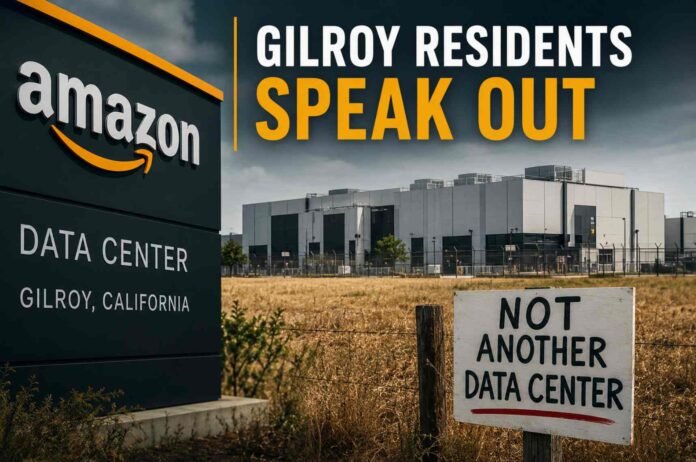
- Amazon is building a large data center on a 56 acre site in Gilroy, California.
- Residents say many people did not learn about the project until construction had already started.
- Critics are questioning the use of an old zoning rule and the level of public involvement.
- Amazon and city officials point to jobs, tax revenue, infrastructure funding and community donations as benefits.
Construction of a large Amazon data center in Gilroy, California, has sparked anger among local residents who say they were given little meaningful opportunity to understand or challenge the project before work began.
The facility, which covers about 438,500 square feet on a 56 acre site, is being built on what was previously farmland roughly 30 miles south of San Jose. While plans for the development were first submitted in 2020, some residents say they only became aware of the project once construction was already underway.
That has become the central issue surrounding the development. Local opposition is not focused solely on Amazon or the growing demand for data centers. Instead, many residents are questioning how the project was approved and why they did not feel adequately informed during the planning process.
One resident who attempted to raise an objection was reportedly told that public comments on the project had closed in 2024. For residents who say they had not even heard about the development at that point, the explanation has done little to ease concerns.
The situation has also raised broader questions about how cities handle major technology infrastructure projects at a time when demand for artificial intelligence and cloud computing is driving rapid expansion of data center capacity.
An old planning rule is at the center of the dispute
The development reportedly benefited from an existing Gilroy zoning provision dating back several decades. The rule was originally designed to encourage industrial development along a freeway corridor.
Critics argue that using this older planning framework allowed the Amazon facility to move through the approval process without the level of public scrutiny that residents might have expected for a project of this size.
For local opponents, the controversy is therefore about more than a single building. They say the process exposed a gap between formal planning procedures and genuine public awareness.
Landon Sepulveda, a 21 year old college student involved in organizing opposition, told the Wall Street Journal that residents should not have to actively monitor city records just to discover major developments taking place in their community.
The concern is particularly significant because data centers can have substantial demands for electricity, water and supporting infrastructure. They can also influence traffic, land use and local tax revenues for years after construction is complete.
Elementary school teacher Coleen Crew made a similar point during a recent city council meeting, saying that many residents first learned about the project only after construction had begun.
Amazon and city officials point to local benefits
Amazon and Gilroy officials have defended the project by highlighting the economic benefits they believe it will bring to the community.
The data center is expected to generate jobs and additional tax revenue, while Amazon has also made financial contributions to the city. The company has donated $1 million toward a new fire truck and provided funding to local nonprofit organizations and Gilroy’s annual Garlic Festival.
Water use has also become part of the discussion. Amazon has reportedly made arrangements related to wastewater from the facility, an issue that has become increasingly important as communities across California debate whether they can accommodate large data centers without putting additional pressure on local water resources.
Mayor Greg Bozzo has defended the development and suggested that Gilroy needs to adapt to changing economic conditions. He has also compared the data center with a recently approved food distribution center, arguing that both represent new forms of commercial development that can contribute to the local economy.
For city officials, the project appears to represent an opportunity to attract investment while increasing the resources available for public services.
For residents who oppose the development, however, those benefits do not necessarily address the concerns surrounding how the decision was made.
A bigger problem for the data center industry
The dispute in Gilroy reflects a much larger conflict emerging across the United States.
Technology companies are racing to build data centers to support cloud computing, artificial intelligence and increasingly demanding digital services. Communities, meanwhile, are becoming more aware of the amount of electricity, water and land these facilities can require.
That has made public acceptance increasingly important.
The Gilroy controversy illustrates why transparency can matter almost as much as the economic case for a major development. Even when a project complies with existing planning rules, residents can still feel excluded if they discover it too late to participate meaningfully.
AWS Vice President of Economic Development Roger Wehner said the Gilroy project followed standard approval procedures. He also said Amazon had subsequently met with residents and held an open house to answer questions and hear concerns.
Those efforts may help address some of the local frustration, but construction is already well underway. For many residents, the more difficult question is whether they should have been given a stronger voice before the project reached that point.
Follow TechBSB For More Updates

