
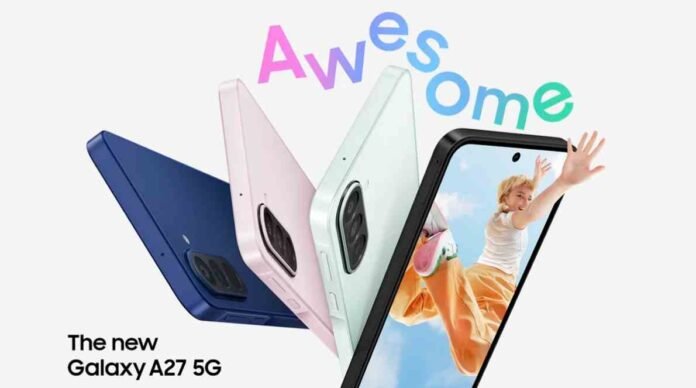
Samsung has officially unveiled the Galaxy A27, its latest budget phone, and on paper it looks like a sensible update to last year’s Galaxy A26. There’s more power under the hood, a cleaner design on the front, and a few welcome software improvements that should make day to day use feel a little more polished.
But there’s a catch. In fact, there are two.
While the Galaxy A27 gains some genuinely worthwhile upgrades, it also takes a step back in a couple of key areas. The most surprising of those is durability, with Samsung lowering the phone’s water resistance compared to its predecessor. That’s not the sort of compromise you expect to see on a newer model, especially when brands usually treat protection ratings as an easy way to signal progress.
So while the Galaxy A27 is shaping up to be a stronger performer overall, it’s also a reminder that newer doesn’t always mean better in every department.
A more powerful Galaxy A phone, with a cleaner design
The biggest upgrade here is performance. Samsung has equipped the Galaxy A27 with a Snapdragon 6 Gen 3, giving the phone a healthier dose of power than the Galaxy A26. For buyers in this price bracket, that matters. A faster chipset doesn’t just help with gaming or benchmarks, it improves the everyday feel of the phone too, from app launches and multitasking to camera processing and general responsiveness.
Samsung has also tidied up the design. The Galaxy A27 replaces the older notch style front camera with a punch hole cutout, which instantly makes the display look more modern. Pair that with slimmer bezels and the phone feels more in line with Samsung’s newer mid range and flagship devices, even if the rest of the hardware still sits firmly in the affordable category.
That front refresh might not sound dramatic, but it does make a difference. Budget phones often live or die by presentation, and the A27 looks noticeably less dated than the A26 as a result.
The rest of the core display package is familiar. Samsung is sticking with a 6.7 inch 120Hz screen, which is good news, because that remains one of the more appealing parts of the formula. A large panel with a high refresh rate still goes a long way in making a lower cost phone feel premium, especially for streaming, scrolling, and gaming.
Camera changes are mixed rather than straightforward upgrades
Samsung has kept the rear camera setup broadly similar, but not every change will be welcomed.
Like the Galaxy A26, the new model includes a 50MP main camera and a 2MP macro sensor. The difference comes with the ultra wide camera, which has dropped from 8MP on the Galaxy A26 to 5MP on the Galaxy A27. That doesn’t automatically mean photos will be dramatically worse, since megapixels are only one part of the equation, but it is still a spec downgrade on paper, and it’s a strange one to see on a successor.
The selfie camera also looks slightly weaker at first glance, moving from 13MP to 12MP. But this one appears less concerning. Samsung says the new front camera can capture a wider range of brightness and richer color, which suggests image processing and sensor performance may have improved enough to outweigh the lower resolution. In practice, that could mean more natural looking selfies, better handling of bright skies or backlit scenes, and more consistent skin tones.
So the camera story here is a mixed bag. The front camera may actually be better despite the lower megapixel count, while the ultra wide looks like a more obvious compromise.
The odd downgrade: water resistance gets worse
The most puzzling change on the Galaxy A27 is its IP64 rating. Last year’s Galaxy A26 came with IP67 protection, which offered a notably stronger level of resistance against water and dust. Dropping from IP67 to IP64 is not a small change either.
In practical terms, the Galaxy A27 should still be protected from dust and splashes, but it no longer offers the same reassurance around water exposure that the A26 did. For a phone that’s meant to replace its predecessor, that’s a disappointing move. Water resistance is one of those features buyers rarely think about until something goes wrong, and having less of it on a newer device is hard to spin as anything other than a downgrade.
It’s especially surprising because Samsung has otherwise done a decent job of making the A27 feel like a more refined device. Better performance, a smarter front design, and updated AI tools all point forward. The reduced water protection points in the opposite direction.
Same battery, long software support, and a familiar price
Elsewhere, Samsung hasn’t changed much. The Galaxy A27 keeps the 5,000mAh battery and 25W charging, while memory and storage top out at 8GB of RAM and 256GB of storage. That’s a perfectly reasonable setup for a budget phone in 2026, even if none of it feels especially exciting.
On the software side, though, Samsung is making a strong promise. The Galaxy A27 ships with Android 16 and is set to receive six generations of Android updates along with six years of security support. That’s one of the phone’s strongest selling points, because long term support still isn’t guaranteed in the affordable segment. For buyers who keep their phones for years rather than upgrading annually, this matters almost as much as raw hardware.
Samsung is also adding improved AI features, including multi object recognition in Circle to Search and more precise results from Object Eraser. These aren’t headline grabbing reasons to buy the phone on their own, but they do help the A27 feel more current and a little more capable than the model it replaces.
The Galaxy A27 launches in the UK on July 3 and in the US on July 14, with prices starting at $349.99 / £319. Australian pricing hasn’t been formally confirmed by Samsung at the time of writing, but reports suggest it could land there on July 3 from AU$499.
Color options include black, blue, light green, and light pink, though availability will vary by region. In the US, for example, Samsung is only offering the phone in black.
The early verdict
The Samsung Galaxy A27 looks like a better budget phone in several important ways. It should be faster, cleaner looking, and more future proof than the Galaxy A26, and Samsung’s long software support gives it real value over time. But the downgraded water resistance is difficult to ignore, and the weaker ultra wide camera spec doesn’t help.
That leaves the A27 in an unusual position. It seems like the better phone overall, but not the cleaner upgrade you might expect. For some buyers, the extra power and modernized design will easily outweigh the compromises. For others, losing stronger water protection on a new generation handset may be the detail that sticks.
Follow TechBSB For More Updates

