
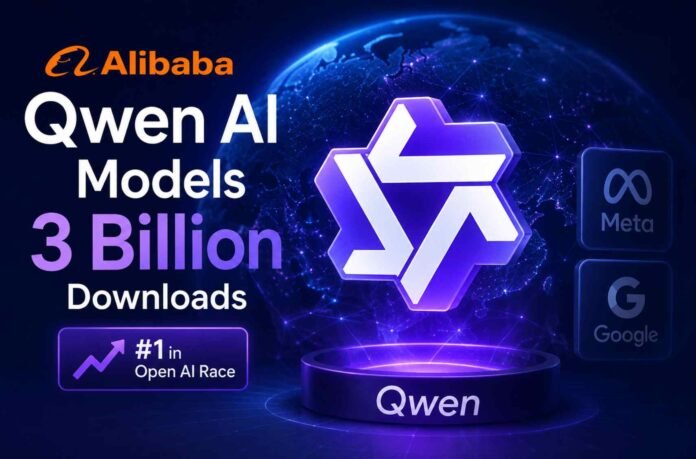
- Alibaba says its Qwen AI models have passed 3 billion global downloads in six months.
- Qwen has moved ahead of Google and Meta in reported open model downloads.
- Alibaba has released more than 460 Qwen models and its ecosystem has created over 300,000 derivatives.
- The milestone shows that open and customisable AI models are becoming increasingly important to developers.
Alibaba’s Qwen AI models have crossed a major milestone, with more than 3 billion downloads recorded globally over the past six months. The figure puts Alibaba ahead of major rivals including Meta and Google in the open weight AI race, highlighting how quickly Chinese AI models are gaining attention among developers worldwide.
The numbers are significant because downloads offer a useful glimpse into how developers are actually experimenting with AI models. While the biggest technology companies continue to compete over powerful proprietary systems, the growing popularity of models that developers can download, modify and run themselves shows that there is another important battle taking place behind the scenes.
Alibaba’s Qwen family has become one of the biggest names in that competition. The company says it has released more than 460 models, while its wider ecosystem has produced more than 300,000 derivative models. That scale suggests Qwen is no longer simply another AI model family. It is becoming a platform that developers can build on for their own projects.
Qwen is pulling ahead in open AI
The 3 billion download figure becomes more striking when compared with some of the biggest names in the industry.
According to data from Hugging Face, Google’s models recorded about 418 million downloads during 2026, while Meta’s models reached around 227 million. Alibaba’s Qwen models therefore have a substantial lead when measured by downloads across the open model ecosystem.
Downloads do not automatically mean that Qwen is technically better than every competing model. They can be influenced by factors such as licensing, availability, model size, developer interest and how easy a model is to run. Still, the sheer scale of Qwen adoption is difficult to ignore.
For developers, open weight models can be attractive because they offer more control than traditional AI services. A company can download a model, customise it for a particular task and deploy it within its own infrastructure. That can be particularly useful for businesses that do not want every AI workload to depend on an external service.
Alibaba appears to be leaning heavily into that opportunity.
Why developers are paying attention
One of the biggest advantages of the Qwen ecosystem is its range. Instead of relying on a single model, Alibaba has released a large collection designed for different uses and deployment requirements.
The company’s recent Qwen releases have also focused on practical workloads such as coding and office productivity. Some models are designed to be efficient enough for local deployment, making them more accessible to developers who do not have access to enormous data centre resources.
That matters because AI development is gradually moving beyond simply asking a chatbot questions. Developers are using models to build coding assistants, business tools, automated workflows, research applications and AI agents.
An open model can give developers greater flexibility in how these systems are built. It can also reduce some of the costs associated with relying entirely on commercial AI APIs.
The number of derivative models created from Qwen is another important signal. More than 300,000 derivatives have reportedly emerged from the Qwen ecosystem. That means developers are not merely downloading Alibaba’s models and using them unchanged. Many are adapting the technology for their own requirements.
China’s AI push is becoming harder to ignore
Alibaba’s milestone also arrives at a time when Chinese AI companies are gaining more attention outside China.
Companies such as Alibaba, DeepSeek and other Chinese AI developers have been pushing open and highly accessible models, giving developers alternatives to systems produced by leading US companies. Recent industry developments show that American technology companies are responding by increasing their own investment in open weight AI.
This competition is becoming particularly interesting because open AI models are changing the economics of the market. Developers do not always need the largest possible model. In many cases, they need something that is capable, affordable and easy to customise.
That could give smaller and more efficient models a much larger role in the next stage of AI development.
Alibaba’s position is also strengthened by its cloud business, which gives the company another route for distributing AI technology. The combination of downloadable models, a large developer ecosystem and cloud infrastructure gives Qwen several ways to reach businesses and developers.
There are still questions around the wider adoption of Chinese AI models, particularly in markets where companies have concerns about data security, transparency and regulatory requirements. Those issues could limit adoption among some organisations even as developer interest continues to rise.
What the 3 billion downloads really mean
The most important part of Alibaba’s announcement may not be the 3 billion figure itself. It is what that figure says about the direction of the AI industry.
For years, the AI race was largely defined by who could build the biggest and most capable proprietary model. That race is still happening, but the open model ecosystem is becoming an equally important battleground.
Qwen’s rapid growth shows that developers are willing to adopt models from outside the traditional leaders of the AI industry when those models are accessible and useful.
It also demonstrates the growing influence of the developer community. When hundreds of thousands of derivative models are created, the original model becomes a foundation for a much larger ecosystem. Every new adaptation can potentially lead to another application, service or workflow.
Alibaba will now have to maintain that momentum. Reaching 3 billion downloads is impressive, but keeping developers engaged requires regular improvements, competitive performance, useful licensing and strong tooling.
The bigger question is whether Qwen can turn its enormous download advantage into long term influence across businesses and consumer applications.
For now, the numbers suggest Alibaba has established itself as a serious force in open AI. Meta and Google may still have enormous resources and global reach, but Qwen has shown that developer adoption can move very quickly when a capable model is made widely available.
The open AI race is no longer a side story in the broader artificial intelligence boom. Alibaba’s latest milestone is a strong sign that it could become one of the main contests shaping what comes next.
Follow TechBSB For More Updates