
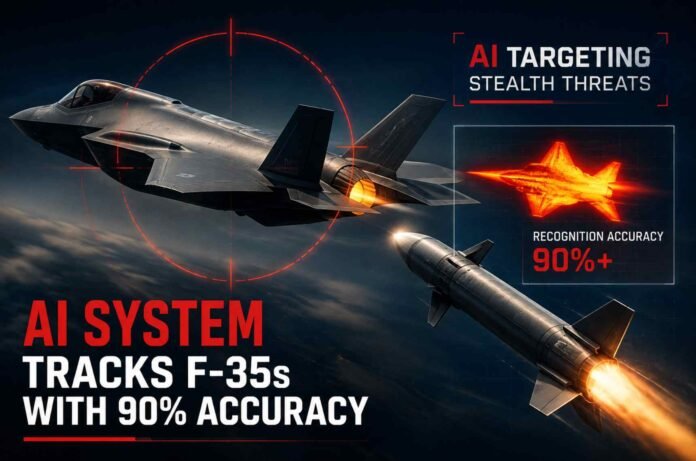
- Chinese researchers claim an AI system can recognize simulated F 35 and F 22 heat signatures with more than 90 percent accuracy.
- The system uses infrared information rather than radar to identify patterns produced by aircraft engines, exhaust and heated surfaces.
- Researchers say the lightweight AI model could eventually be useful in missile seekers with limited computing power.
- The results were based on simulations and laboratory testing, so real world performance against operational stealth aircraft remains unproven.
Chinese researchers say they have developed a lightweight artificial intelligence system capable of recognizing thermal signatures associated with advanced American stealth fighters, including the F 35 and F 22.
The research could attract attention because modern stealth aircraft are designed to reduce their visibility to enemy sensors, particularly radar. However, radar is only one part of the detection problem. Aircraft engines, exhaust systems and heated surfaces continue to produce infrared energy that can potentially be detected by thermal sensors.
According to the researchers, their approach uses artificial intelligence to examine these infrared patterns and distinguish aircraft signatures from other objects. The reported tests achieved recognition accuracy of more than 90 percent when using simulated targets representing the thermal characteristics of F 35 and F 22 aircraft.
That figure sounds significant, but it needs to be put into context. The reported results came from laboratory testing and simulated targets. They do not demonstrate that an operational missile can identify and track an actual F 35 or F 22 with the same level of accuracy during combat.
The distinction is important because the infrared signature of a real aircraft can change considerably depending on how it is flying.
The system focuses on infrared rather than radar
Stealth aircraft are primarily associated with radar evasion, but reducing radar visibility does not make an aircraft invisible to every type of sensor.
Infrared systems work differently. Instead of looking for reflected radio waves, they detect heat produced by an aircraft and its propulsion system. An aircraft flying at high speed can generate heat around its engines, exhaust and other surfaces, creating an infrared signature that sensors may be able to detect.
The Chinese research reportedly focuses on using AI to interpret these patterns more efficiently.
This could be useful for future infrared guided weapons because missile seekers have limited computing resources and need to make decisions quickly. A lightweight recognition model could potentially help a seeker determine whether a detected heat source resembles an aircraft rather than a decoy or another object.
The researchers reportedly argue that lightweight AI models could eventually have applications in air to air missiles because they can provide rapid recognition without requiring large amounts of computing power.
That is potentially more important than the reported 90 percent figure itself. Bringing capable AI processing into a compact missile seeker could allow infrared sensors to make more sophisticated distinctions while operating under severe limitations in size, power and processing capacity.
Flares may not be enough against smarter recognition
Infrared guided missiles already face a major countermeasure in the form of flares. These devices produce intense heat and are intended to convince a missile seeker that the flare is the aircraft it is pursuing.
The researchers claim their AI approach could help distinguish aircraft generated heat from flare emissions.
The underlying idea is relatively straightforward. A flare can produce a strong infrared signal, but its thermal characteristics and behavior are not necessarily identical to those of an aircraft. An AI model trained to recognize more complex patterns could potentially use those differences when deciding which target to follow.
However, that does not mean conventional countermeasures have suddenly become ineffective.
Real world infrared detection is considerably more complicated than laboratory recognition. Atmospheric conditions can alter thermal signals, while background temperatures, viewing angles, aircraft speed, altitude and maneuvering can all affect what an infrared sensor sees.
Electronic warfare and other defensive systems could also complicate the picture.
For that reason, a laboratory recognition result should not be interpreted as proof that an AI assisted missile can reliably defeat the defensive systems of an operational F 35 or F 22.
Real world performance remains the biggest question
The reported research highlights a broader issue for stealth aircraft.
Stealth has never meant complete invisibility. Instead, it is intended to make an aircraft harder to detect, track and engage by reducing or managing its signatures across different sensing technologies.
As sensors and computing systems improve, the balance between aircraft stealth and detection technology can change.
Artificial intelligence could become another part of that competition. Instead of relying solely on conventional signal processing, future sensors may use machine learning to identify subtle patterns that are difficult to describe using traditional detection techniques.
That could create new challenges for aircraft designers. Reducing radar visibility may remain essential, but infrared characteristics, exhaust management and thermal behavior could become increasingly important as AI based sensors become more capable.
The same issue could extend beyond fighter aircraft. Future stealth bombers, unmanned aircraft and other low observable platforms could also face increasingly sophisticated infrared recognition systems.
Still, there is a considerable gap between demonstrating a recognition algorithm under controlled conditions and proving that the technology works against a real aircraft in a contested environment.
The reported 90 percent accuracy therefore should be viewed as a research result rather than evidence that the F 35 or F 22 has been rendered ineffective.
The most important development may instead be the direction of the technology. Compact AI processors are becoming increasingly capable, while infrared sensors are becoming more sophisticated. Combining the two could give future missile seekers more advanced target recognition capabilities than earlier generations of infrared weapons.
For the US and other countries operating stealth aircraft, that could mean future upgrades will need to address not only radar signatures but also the way aircraft appear to increasingly intelligent infrared sensors.
Follow TechBSB For More Updates