
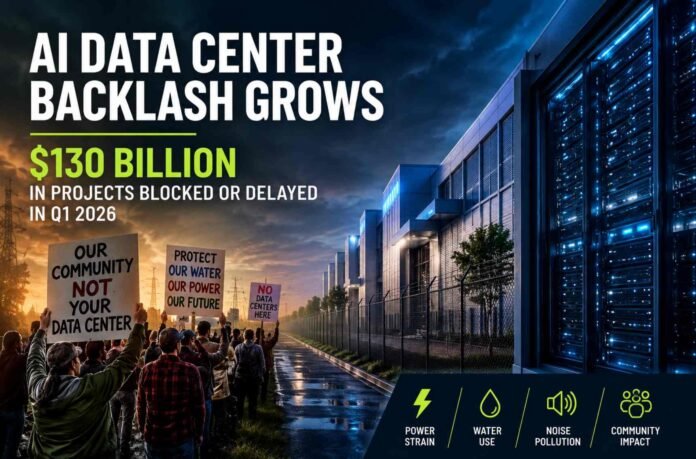
- Around $130 billion worth of US AI data center projects were blocked or delayed in Q1 2026.
- Residents are mainly concerned about electricity use, water consumption, noise, pollution and limited long term jobs.
- Developers are increasingly challenging local restrictions through lawsuits, with some already securing victories.
- Public support for data centers drops sharply when people are asked about facilities being built near their homes.
AI data center projects worth around $130 billion were blocked or delayed across the US during the first three months of 2026, putting fresh pressure on the companies racing to build the infrastructure behind the AI boom.
That figure is striking on its own, but the comparison with last year is even more revealing. Across the whole of 2025, publicly reported opposition affected about $156 billion worth of data center projects. In other words, communities managed to disrupt almost as much planned investment in just one quarter of 2026 as they did throughout the previous year.
The backlash is no longer limited to a handful of local protests. Residents, campaign groups and local officials are increasingly questioning whether the promised economic benefits of AI infrastructure justify the pressure these facilities can place on electricity supplies, water resources and surrounding communities.
And now the companies building these facilities are fighting back.
Local opposition is becoming a serious problem
The rapid expansion of AI has created an enormous appetite for computing power. Hyperscalers and other technology companies need increasingly large facilities packed with advanced servers to train and operate AI models.
The problem is that these facilities need enormous amounts of electricity. They can also require substantial quantities of water for cooling, while the generators, cooling systems and other equipment can create noise and air pollution.
For residents living close to proposed projects, the benefits can feel less obvious.
Construction can create jobs and bring additional spending into an area, while a completed facility may contribute significant tax revenue. However, once construction is finished, the number of permanent employees can be relatively small. Much of the technical management can also be handled remotely.
That has left some communities asking a straightforward question. If a project consumes huge amounts of local resources but creates comparatively few permanent jobs, how much should residents be expected to give up in return?
Those concerns have helped fuel a much broader movement against new data center construction.
Developers are taking the fight to court
AI companies and data center developers are not simply accepting local restrictions.
Some developers have begun challenging bans and other restrictions in court, arguing that local authorities may not always have the power to prevent or limit developments in the way they are attempting to.
Texas provides a useful example of how quickly the argument can become complicated.
Hill County introduced a one year restriction on data center development in rural areas. The developer behind a proposed project challenged the measure in court, after which the restriction was rescinded.
That victory could encourage other developers to challenge local restrictions, particularly as opposition becomes more widespread.
There is still an important distinction, however. A successful challenge against a county or local authority does not necessarily mean that developers can defeat restrictions imposed at the state level.
That question has become particularly important in Texas, where Governor Greg Abbott has announced a pause affecting data center construction while the impact of these facilities on communities, water supplies and the state’s electricity system is assessed.
If states become more aggressive in regulating where and how data centers can be built, developers could face a much tougher legal battle.
The public mood could become the biggest obstacle
The most difficult problem for the AI industry may not be a lawsuit. It could be public opinion.
A June 2026 Ipsos poll cited in the report found that 55% of Americans did not oppose new data centers in general. That sounds relatively encouraging for the industry.
The picture changes considerably when people are asked about a facility near their own home.
According to the same polling, 59% of Americans would oppose a data center being built within 10 miles of where they live.
That gap matters.
People may support the broader idea of building the infrastructure needed for AI while objecting strongly when a project arrives in their own community. The same tension has appeared in debates surrounding power plants, factories, warehouses and other large infrastructure projects.
For AI companies, it creates a difficult balancing act. They need enormous amounts of computing capacity, but the facilities providing that capacity have to be located somewhere.
The industry is also facing questions about whether the economic benefits promised by the AI boom will last. Data centers can be highly valuable when demand for computing remains strong, but the economics become less certain if the AI market cools sharply.
In an extreme scenario, a failed or underused facility could leave a community dealing with environmental and infrastructure costs without receiving the long term economic benefits it was promised.
That possibility is becoming part of the public debate.
AI still needs the infrastructure
None of this means the AI data center boom is about to stop.
AI companies have strong financial incentives to keep building, and governments also have reasons to support investment in advanced computing infrastructure. Data centers can bring construction spending, tax revenue and investment into regions that attract them.
The challenge is making those projects acceptable to the communities that have to live alongside them.
The early signs suggest that simply promising jobs and tax revenue may not be enough. Residents are increasingly focused on electricity prices, water consumption, noise, pollution and the long term consequences of hosting massive computing facilities.
That means developers may have to rethink how they approach local communities.
Projects that offer clearer economic benefits, reduce pressure on local infrastructure and address environmental concerns from the beginning could have a much easier path than projects that arrive with those questions left unanswered.
For the AI industry, this could become one of the defining infrastructure battles of the next few years. The technology may be moving at incredible speed, but communities still have a say in where the machines powering it are built.
Follow TechBSB For More Updates