
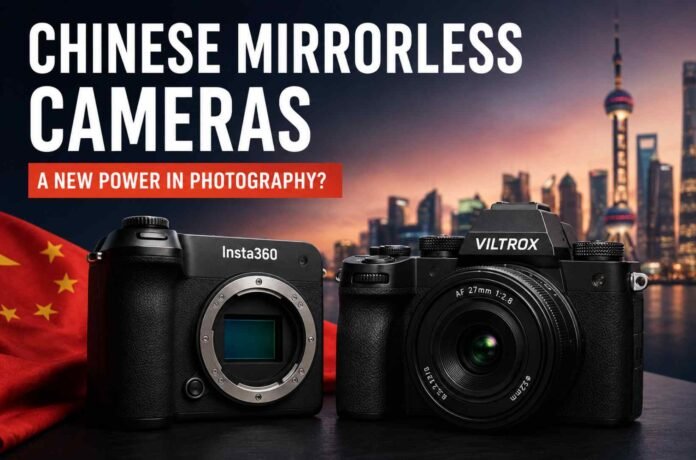
- Chinese brands are moving closer to the traditional mirrorless camera market.
- Insta360 could challenge conventional camera design with new and unusual form factors.
- Viltrox could make mirrorless photography more affordable by combining lower priced bodies with its growing lens expertise.
- More competition could force Canon, Sony, Nikon and others to improve value, innovation and accessibility.
For decades, buying a serious camera has usually meant choosing a familiar name from Japan. Canon, Sony, Nikon, Fujifilm and Panasonic have shaped the mirrorless market, setting the pace for everything from autofocus and sensor technology to lens design and video features.
That dominance may soon face a serious new challenge.
Chinese companies have already transformed other areas of the camera industry. DJI has become a major force in drones and compact cameras, while Insta360 has built a powerful position in action and 360 degree imaging. Viltrox, meanwhile, has earned a reputation for producing increasingly capable lenses at prices that often undercut the established brands.
Now, the next logical step could be the camera body itself.
Reports suggest that Insta360 is preparing to enter the mirrorless camera market with two new models, while speculation continues to grow around whether Viltrox could eventually follow with a system of its own. Neither development guarantees an immediate revolution, but the possibility alone is exciting because the traditional mirrorless market has become expensive, predictable and increasingly difficult for newcomers to enter.
Insta360 could bring a completely different approach
Insta360 is not approaching photography with decades of attachment to conventional camera design. That could be its biggest advantage.
The company has built its reputation by experimenting with formats that established camera makers often ignored. Its 360 cameras, tiny modular cameras and action cameras have shown a willingness to rethink how cameras are carried and used.
That matters if its reported mirrorless ambitions become reality.
Insta360 CEO Jingkang Liu has spoken publicly about the company developing two mirrorless cameras, with one reportedly featuring a form unlike anything photographers currently expect. Alongside leaked suggestions of a more conventional Micro Four Thirds camera, that creates an intriguing possibility: Insta360 may be preparing both a traditional entry point and something far more radical.
The most interesting camera innovations are not always about adding more megapixels or another video resolution. Sometimes they come from changing the way a device fits into everyday life.
Mirrorless cameras have become technically brilliant, but many of them look and operate remarkably similarly. A Chinese manufacturer without years of legacy design could be more willing to question the assumptions behind grips, screens, viewfinders and controls.
That could produce something genuinely useful rather than simply another specification battle.
Viltrox could attack the biggest problem: price
If Insta360 has the potential to challenge camera design, Viltrox could be even more disruptive in another area: affordability.
For many aspiring photographers, the cost of entering a mirrorless system has become difficult to justify. Buying a camera body is only the beginning. Add two or three good lenses, batteries, memory cards and accessories, and the price quickly climbs.
Viltrox already understands this problem from the lens side.
The company has steadily built a large catalogue of autofocus lenses for Sony, Nikon, Fujifilm and other systems. Its strongest products have demonstrated that third party manufacturers can deliver impressive optical quality without matching the prices charged by proprietary brands.
If Viltrox can apply the same philosophy to a camera body, it could become a serious threat in the beginner and enthusiast markets.
The company would also start with an important advantage: lenses. Building a successful camera system is incredibly difficult because buyers need confidence that they will have enough optics to choose from. Viltrox has already developed experience designing lenses across multiple sensor formats and mounts.
That means a future Viltrox camera would not necessarily begin with an empty ecosystem.
An affordable camera market needs more competition
The timing could also be right for a major disruption.
The camera industry has recovered from some of its previous decline, but the market is now concentrated among a relatively small number of powerful companies. Canon and Sony remain dominant, while Nikon and Fujifilm continue to compete for their share of photographers and creators.
Competition has undoubtedly produced better cameras, but it has not always produced cheaper ones.
Flagship technology eventually reaches more affordable models, yet the entry level camera market has become thinner than it once was. Many manufacturers appear more interested in selling expensive full frame bodies and premium lenses than creating genuinely affordable systems for people buying their first serious camera.
That creates an opportunity.
A Chinese manufacturer capable of offering strong autofocus, reliable image quality and a good selection of affordable lenses could attract an enormous number of users who currently feel priced out of interchangeable lens photography.
The established brands would have little choice but to respond.
And that would be good for everyone.
More competition could mean better value, faster innovation and a renewed focus on photographers who do not want to spend a small fortune on their first camera.
The real disruption could be bigger than specifications
There is also a danger in assuming that Chinese mirrorless cameras will simply copy the existing formula at a lower price.
The most successful newcomers may not compete directly on specifications at all.
DJI did not become influential by making traditional cameras that happened to be cheaper. Insta360 did not dominate 360 imaging by following the conventional camera playbook. Both companies found opportunities where established manufacturers were slower to move.
That same thinking could now reach mirrorless photography.
Perhaps the next major camera will combine the flexibility of interchangeable lenses with a radically different form factor. Perhaps it will make shooting and sharing easier without turning photography into another smartphone experience. Or perhaps the biggest breakthrough will simply be making a genuinely capable system affordable enough for a new generation of photographers.
Whatever happens, the arrival of serious Chinese competition would make the camera industry more interesting.
The established Japanese brands have decades of expertise, extraordinary engineering resources and loyal users. They are not going anywhere. But industries rarely benefit when the same companies define the rules for too long.
Mirrorless photography needs fresh ideas, sharper pricing and manufacturers willing to take risks.
If Insta360 and eventually Viltrox can deliver that, their arrival could be one of the most important developments the camera market has seen in years.
And for photographers, that can only be a good thing.
Follow TechBSB For More Updates