
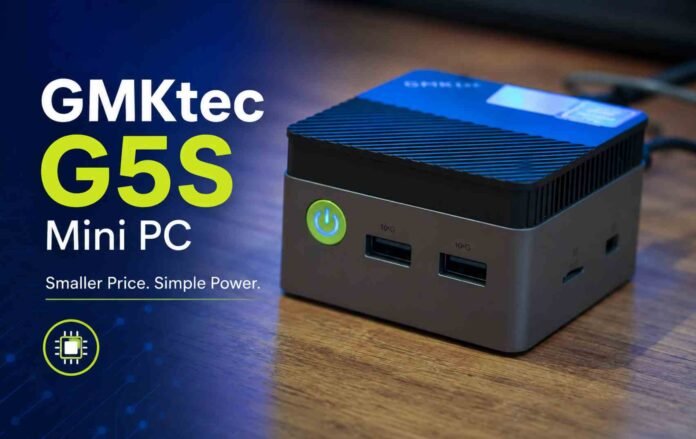
GMKtec has quietly introduced the G5S, a new version of its palm sized mini PC that takes an unexpected approach. Instead of improving on the previous generation, the company has chosen older hardware and reduced specifications to keep the price low. While this decision may disappoint buyers expecting better performance, it reflects the growing pressure hardware manufacturers face as memory prices continue to climb.
The new system replaces the earlier G5 model, which earned praise for delivering strong everyday performance in an extremely compact form factor. On paper, however, the latest G5S is clearly a less capable machine. It uses an older Intel processor, ships with less memory, and cuts storage capacity in half compared to its predecessor.
For consumers shopping for an affordable Windows mini PC, the launch raises an important question. Is lowering specifications the only way manufacturers can continue offering low cost systems?
Older Hardware Takes Center Stage
The biggest change in the GMKtec G5S is the processor. The company has replaced the Intel N97 found in the previous G5 with the older Intel N5095 chip. That decision is difficult to ignore because the N5095 delivers lower overall performance while consuming more power and producing more heat during operation.
Memory has also taken a noticeable hit. Instead of the previous model’s 12GB of DDR5 memory, the G5S arrives with just 8GB of DDR4 RAM. Besides offering less capacity, DDR4 is an older memory standard that cannot match the speed and efficiency improvements provided by DDR5.
Storage has been reduced as well. Buyers now get 128GB of internal storage on the entry level configuration instead of the 256GB included with the earlier version. While storage upgrades remain possible for some users, the smaller default capacity limits out of the box usability, especially for those planning to install multiple applications or keep larger files locally.
Despite these changes, GMKtec has retained the same ultra compact chassis that made the original model appealing. The device remains small enough to fit comfortably in the palm of an adult hand, making it attractive for office desks, home entertainment setups, digital signage, or space constrained workstations.
AI Demand Is Changing the Budget PC Market
The decision to downgrade hardware may seem unusual, but there is a broader industry trend behind it.
The rapid expansion of artificial intelligence infrastructure has dramatically increased demand for advanced memory technologies. High bandwidth memory, commonly used in AI accelerators and data center hardware, has become a major priority for memory manufacturers.
As production increasingly focuses on these premium components, supplies of traditional memory products have tightened. This has affected pricing across multiple categories, including DDR memory modules and NAND flash storage used in SSDs.
For PC makers operating in the budget segment, rising component costs create difficult choices. They can either increase retail prices or reduce hardware specifications to maintain affordable price points. GMKtec appears to have chosen the second option with the G5S.
This strategy allows the company to introduce a system starting at around $169, making it one of the more affordable Windows mini PCs in its category despite the hardware compromises.
Affordable Pricing Still Has Its Appeal
Although the specifications represent a clear downgrade, pricing remains the strongest selling point of the new model.
The base version with 128GB storage is expected to sell for approximately $169, while a higher capacity 256GB version is expected to cost around $272. The system is currently available only in China, with wider international availability expected before the Black Friday shopping season.
For users with basic computing needs, such as web browsing, document editing, online meetings, or media playback, the G5S may still provide enough performance. Buyers looking for heavier multitasking, content creation, or demanding workloads, however, will likely find the older processor and reduced memory limiting over time.
The launch also highlights how value oriented manufacturers are adapting to difficult market conditions. Instead of chasing higher benchmark numbers, companies are increasingly focused on balancing affordability with acceptable everyday performance.
The Previous G5 Set a High Standard
The earlier GMKtec G5 received positive feedback for delivering impressive capability in an exceptionally small package. It demonstrated that compact mini PCs no longer had to sacrifice usability, offering enough performance to comfortably run Windows 11 Pro for office work, administration, and light multimedia tasks.
That strong reputation makes the arrival of the G5S even more surprising. Rather than building on an already successful platform, GMKtec has introduced a version with noticeably weaker hardware in nearly every major category.
Still, the decision reflects current realities within the PC industry rather than simple cost cutting. Memory shortages, increasing AI related demand, and higher component prices continue to reshape how entry level computers are designed and priced.
Whether consumers accept these compromises will ultimately depend on how much value they place on affordability over raw performance.
Follow TechBSB For More Updates