
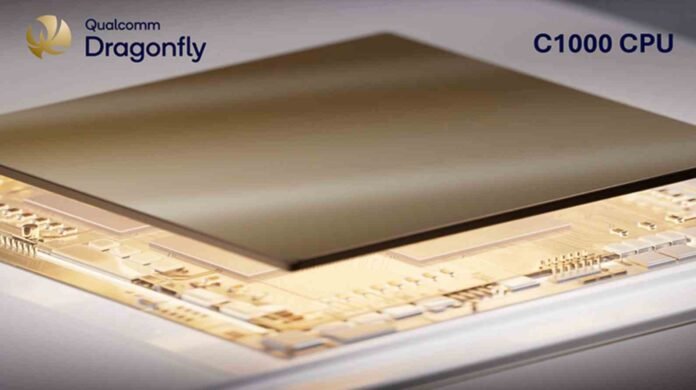
- Qualcomm introduced the Dragonfly data center portfolio featuring new CPUs, AI accelerators, memory technology, networking, and custom silicon.
- The Dragonfly C1000 CPU uses over 250 custom Oryon cores and is expected to launch commercially in 2028.
- New High Bandwidth Compute technology is designed to improve AI memory bandwidth and energy efficiency for inference workloads.
- Qualcomm also announced a multi-year CPU partnership with Meta and confirmed an annual roadmap for future AI accelerators.
Qualcomm has revealed an ambitious long-term strategy to expand beyond smartphones and edge computing with a new data center portfolio built for the growing demands of agentic AI.
Announced during the company’s Investor Day in New York, the roadmap introduces a family of products under the Qualcomm Dragonfly brand, including new CPUs, AI inference accelerators, advanced memory technology, connectivity solutions, and custom silicon offerings.
The company believes AI infrastructure is entering a new phase where inference workloads rather than training will become the dominant force inside hyperscale data centers. As AI agents continue to perform more reasoning tasks and interact with users in real time, data center operators will require systems that can deliver more tokens while consuming less power.
Qualcomm says its latest technologies are designed to improve performance per watt, increase token throughput, and reduce the overall cost of operating large AI deployments. Instead of offering isolated chips, the company is positioning Dragonfly as a complete rack scale platform that combines compute, memory, networking, and software optimized for modern AI workloads.
The announcement also confirms Qualcomm’s commitment to releasing new AI accelerators every year through a multi generation roadmap.
Dragonfly C1000 CPU and HBC technology target AI bottlenecks
At the center of Qualcomm’s new strategy is the Dragonfly C1000, a purpose built server processor aimed at AI orchestration, general purpose computing, and AI head node workloads.
The processor uses custom Qualcomm Oryon CPU cores running above 5 GHz and features a chiplet based design with more than 250 cores. According to Qualcomm, the architecture has been developed to maximize throughput while maintaining strong single core performance for demanding enterprise and AI applications.
The CPU also includes next generation PCIe Gen 7 connectivity with more than 2 TB per second of bandwidth alongside CXL support for memory expansion and accelerator connectivity. Qualcomm says the platform has been engineered to lower both capital and operating costs while supporting air cooled and liquid cooled server deployments.
Commercial availability of the Dragonfly C1000 is expected in 2028.
Alongside the CPU, Qualcomm introduced its High Bandwidth Compute technology, or HBC, which is designed to address one of the biggest limitations facing modern AI systems. Instead of relying solely on traditional high bandwidth memory, HBC combines compute and memory in a tightly integrated 3D stacked architecture to reduce data movement and improve efficiency.
The first generation of HBC is expected to deliver as much as 133 TB per second of effective memory bandwidth through the upcoming AI250 accelerator. Qualcomm claims the second generation, planned for AI300, will deliver another significant leap in performance while offering better bandwidth per watt and higher memory capacity efficiency than competing technologies.
Sampling for HBC Gen 1 is expected during the middle of 2027.
AI300 accelerator and custom silicon expand Qualcomm’s ambitions
Qualcomm also introduced the Dragonfly AI300, its third generation AI inference accelerator following the previously announced AI200 and AI250 platforms.
Designed specifically for large language models, multimodal AI, and increasingly complex agentic AI workloads, the AI300 incorporates second generation HBC technology to provide greater memory capacity and substantially higher effective bandwidth.
The accelerator supports both air cooled and direct liquid cooled deployments and is built for rack scale inference environments. Qualcomm expects the AI300 to offer between four and eight times better performance per watt compared with existing GPU based systems when measuring memory bandwidth efficiency.
The company is also investing in custom silicon solutions that allow cloud providers and enterprise customers to develop application specific processors optimized for their own AI infrastructure. Qualcomm says its experience in chip design, packaging, software, and manufacturing allows it to deliver tailored solutions with faster deployment timelines and lower execution risk.
Networking is another major part of the strategy. Qualcomm’s connectivity portfolio includes die to die communication, copper and optical networking, plus support for 800G and 1.6T data center links. These technologies are intended to reduce networking bottlenecks as AI workloads become increasingly distributed across larger clusters.
Meta partnership strengthens Qualcomm’s data center push
One of the biggest announcements accompanying the new roadmap is Qualcomm’s multi year agreement with Meta.
Under the partnership, Qualcomm will supply Dragonfly C1000 data center CPUs for Meta’s future server infrastructure, marking a significant step in Qualcomm’s return to the server processor market. The collaboration signals growing confidence in Qualcomm’s ability to deliver energy efficient processors capable of handling hyperscale AI deployments.
The company also highlighted support from more than 35 technology partners spanning memory manufacturers, networking companies, system builders, cloud providers, and semiconductor suppliers. This broad ecosystem is expected to help accelerate adoption as Qualcomm prepares future product launches over the next several years.
Rather than competing only in AI accelerators, Qualcomm is positioning itself as a full stack infrastructure provider. With CPUs, AI inference chips, advanced memory technology, networking, and custom silicon all forming part of the Dragonfly portfolio, the company is targeting a much larger role in the evolving AI data center market.
Although many of the announced products remain several years away from commercial availability, Qualcomm’s roadmap provides a clear signal that it intends to compete directly in one of the fastest growing segments of enterprise computing. As demand for agentic AI continues to rise, efficient inference infrastructure could become one of the industry’s most valuable competitive advantages.
Follow TechBSB For More Updates

