
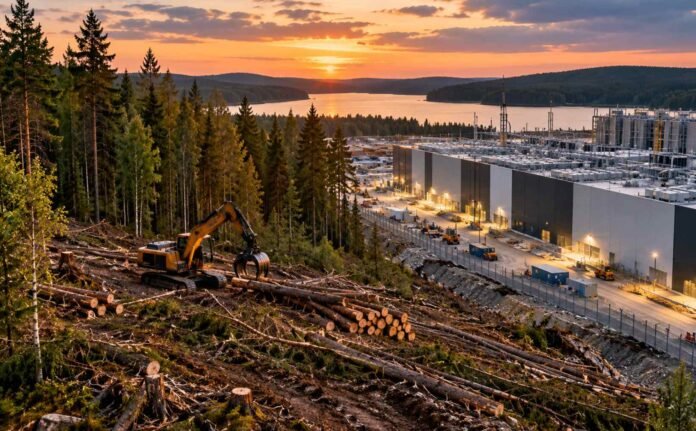
The rapid expansion of AI infrastructure is facing a growing environmental debate, with technology companies coming under pressure over the land, energy and natural resources required to build the data centers powering the artificial intelligence boom.
Google has been accused of clearing around 300 hectares of Finnish forest to make way for an AI data center, while Microsoft is facing criticism over plans to use wetlands, gardens and other nature inspired features around some of its facilities. Supporters of these projects point to investment, infrastructure and environmental mitigation efforts, but critics argue that such measures do not address the wider impact of building large data centers.
The controversy highlights a difficult question for the technology industry. Can companies substantially increase computing capacity for AI while also reducing the environmental cost of the infrastructure required to run it?
Google faces scrutiny over Finnish forest clearing
One of the latest disputes is centered on Finland, where Google is developing a major data center project. Environmental campaigners have raised concerns about the extent of forest clearing connected to the development.
Hanna Halmeenpää, chair of the Finnish Association for Nature Conservation, told AFP that satellite imagery appeared to show that areas considered important for nature conservation had also been logged.
The campaigners’ concerns are particularly focused on the timing of the work. The criticism is that forest clearing took place before the environmental impact assessment process had been completed.
The area involved is substantial. Around 300 hectares of forest have reportedly been cleared, an area roughly comparable to hundreds of football fields.
For Google, the Finnish project is part of a much larger push to expand the computing infrastructure needed to support AI services. The company has repeatedly highlighted its environmental initiatives and investments in renewable energy, water management and other sustainability measures.
That has created an increasingly complicated picture. A company can invest heavily in sustainability while simultaneously building infrastructure that requires significant amounts of land, electricity, construction materials and water.
Microsoft’s nature inspired approach draws criticism
Microsoft is facing a different kind of environmental criticism.
The company has been exploring ways to make some data center developments fit more naturally into their surroundings. Plans involving wetlands, native gardens and landscaping are intended to reduce the visual impact of large facilities and integrate them into local environments.
Critics, however, argue that attractive landscaping cannot compensate for the broader environmental consequences of data center construction and operation.
Adrian Shelley, Texas director at Public Citizen, described Microsoft’s approach as “basically lipstick on a pig.” He also questioned whether landscaping and biomimicry can meaningfully change the impact of facilities that depend on nearby gas powered electricity generation.
The criticism becomes more significant as AI data centers grow larger and require increasingly powerful energy infrastructure.
Microsoft has acknowledged that its emissions increased in 2025. The company attributed much of that increase to the expansion of its data center infrastructure.
That admission illustrates one of the central challenges facing the industry. Improvements in efficiency can be outweighed by rapid growth in the total amount of computing capacity being deployed.
Communities are pushing back against data center growth
The debate is no longer limited to environmental organizations. Residents in several parts of the United States and elsewhere are increasingly challenging proposed data center developments.
Concerns vary from one community to another. Some residents are worried about the loss of open land and natural habitats. Others have raised concerns about noise, water consumption, electricity demand, pollution and the changing character of their communities.
In Texas, for example, residents have opposed plans for a proposed data center development near Taylor. One local resident has argued that a deed from 1999 reserved the land for use as parkland.
Similar disputes are emerging as technology companies and data center operators look for increasingly large sites capable of supporting new AI infrastructure.
The scale of the AI boom is putting additional pressure on local governments. Data centers can bring investment, construction jobs, tax revenue and new infrastructure, but communities are also being asked to accommodate facilities that can consume enormous quantities of electricity and require substantial physical space.
That has made the question of who benefits, and who bears the environmental costs, increasingly important.
The sustainability challenge is getting harder
The growing backlash does not necessarily mean that AI data center construction will slow down. Demand for computing capacity continues to rise, and technology companies are investing heavily to keep up with the development and deployment of AI systems.
But the disputes in Finland, Texas and other locations show that sustainability claims are likely to face closer scrutiny.
For technology companies, planting gardens or restoring wetlands can provide environmental benefits, but critics argue that these measures should be considered alongside the full impact of a project rather than treated as a substitute for it.
The bigger challenge is therefore much more fundamental. Companies need to consider where data centers are built, how much land they consume, what energy sources power them, how much water they use and what happens to the surrounding environment.
Follow TechBSB For More Updates