
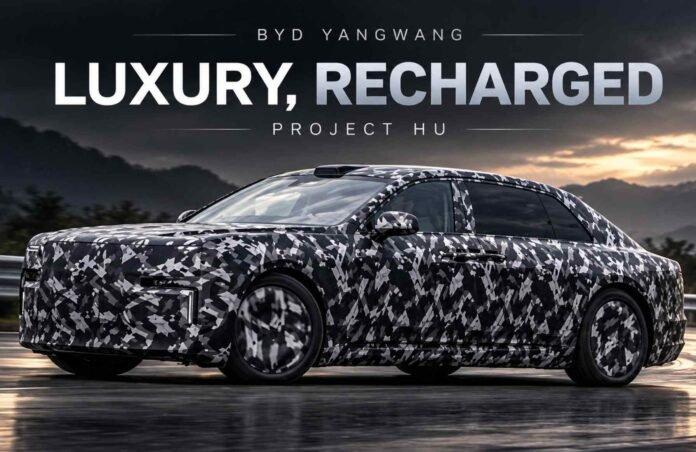
BYD is preparing to take its luxury car ambitions to another level with Project Hu, a high end electric sedan that could put some of the world’s most established premium carmakers on notice. Developed under the Chinese manufacturer’s Yangwang brand, the upcoming flagship is expected to compete with Rolls Royce, Mercedes Maybach and BMW in a segment where craftsmanship, comfort and technology matter as much as performance.
Although the vehicle remains heavily camouflaged, recent teaser images suggest that development is approaching its final stages. Yangwang general manager Hu Xiaoqing has shared photographs of the car, while footage circulating online reportedly shows it undergoing testing.
The model is expected to make its debut in Dubai in November 2026. The choice of location would make sense for a vehicle aimed at buyers who expect exceptional levels of luxury, advanced technology and exclusivity. The Middle East is already an important market for premium vehicles, giving BYD an opportunity to introduce its flagship to an audience familiar with expensive and prestigious cars.
Project Hu is not simply another electric sedan. It represents BYD’s attempt to establish Yangwang as a serious contender in the ultra luxury market, where established European brands have traditionally enjoyed a considerable advantage.
A limousine sized design with an emphasis on luxury
Size is likely to be one of Project Hu’s defining characteristics. Reports suggest that the sedan could measure approximately 5.5 metres in length, putting it in the same broad category as the Mercedes Maybach S Class and the Maextro S800, a luxury model developed by Huawei and JAC.
That substantial footprint should give BYD plenty of room to prioritise rear passenger comfort. In this market, generous legroom, a quiet cabin and premium materials are essential, particularly for customers who prefer to be driven rather than take the wheel themselves.
One of the most distinctive features tipped for the car is a set of rear hinged coach doors. Similar arrangements are associated with some of the most exclusive vehicles on the market, offering a more dramatic entrance and easier access to the rear seats.
However, the details remain unconfirmed. BYD has not yet released a complete specification or provided a full look at the cabin. The final design, interior equipment and range of personalisation options will be important in determining how convincingly Project Hu can compete with established luxury marques.
For Yangwang, the challenge will be to deliver more than imposing proportions and eye catching features. Buyers spending this much on a vehicle will also expect meticulous finishing, outstanding comfort and a sense of exclusivity that extends beyond the technology.
Solid state batteries could be the biggest talking point
The most intriguing possibility surrounding Project Hu is its potential use of solid state battery technology. The car has been tipped to become one of BYD’s first production models to adopt the technology, although the company has not confirmed that it will feature in the finished vehicle.
Solid state batteries replace the conventional liquid or gel electrolyte found in many lithium ion batteries with a solid material. Depending on the chemistry and how the battery is engineered, this approach could offer improvements in energy density, safety and charging performance.
For a large luxury electric sedan, those benefits could be particularly valuable. Higher energy density could help deliver a longer driving range without requiring an even larger battery pack. Faster charging could also make long distance journeys more convenient, while improvements in battery design could create additional opportunities for packaging and cabin space.
There are, however, significant challenges to overcome before solid state batteries can be produced at scale. Manufacturing costs, production yields, durability and performance across different temperatures all need to be addressed. The technology’s potential is substantial, but its practical benefits depend on the battery that eventually reaches customers.
BYD executive vice president Stella Li has reportedly said that the company’s first vehicle equipped with solid state batteries will arrive in 2027. That timeline has fuelled speculation that Project Hu could be the model in question, particularly if it reaches the market around the same period.
Still, a possible connection should not be mistaken for confirmation. Until BYD reveals the battery chemistry, charging figures, driving range and production plans, claims about the car being the world’s first production vehicle with solid state batteries should be treated cautiously.
Quad motors, active suspension and rapid charging
Battery technology is only one part of the Project Hu story. Speculation also points to a quad motor setup, potentially giving the sedan independent electric motors at each wheel. Such an arrangement could allow sophisticated torque distribution, helping manage traction and stability while delivering the smooth, effortless acceleration expected of a powerful luxury EV.
The car could also use Yangwang’s DiSus active suspension system. Designed to manage body movements and improve vehicle control, the system could play an important role in balancing ride comfort with confident handling.
That balance is especially important in a long, heavy electric sedan. Buyers expect the vehicle to glide over uneven roads without feeling disconnected or unsettled, while drivers still need predictable responses when changing direction or travelling at higher speeds.
Teaser material has also placed the vehicle alongside BYD’s Flash Charging technology. This has prompted suggestions that charging stops could be reduced to just a few minutes under suitable conditions. However, the images alone do not establish which charging system the production car will use, nor do they confirm its peak charging rate.
Charging performance depends on several factors, including the battery’s design, its temperature, the charger’s output and the vehicle’s charging curve. BYD will need to publish verified figures before comparisons with existing ultra fast charging electric cars can be made.
If the expected hardware comes together, Project Hu could combine strong performance with a comfortable ride and shorter charging stops. That would give it a more complete proposition than a luxury car that relies solely on size, styling or acceleration.
A reported $300,000 price puts European luxury brands in the crosshairs
Project Hu is rumoured to start at around two million yuan, equivalent to approximately $300,000, £225,000 or AU$430,000 based on the estimates in the original reports. These figures are indicative rather than confirmed retail prices, and the eventual cost could vary significantly between markets.
At that level, BYD would be entering a world where brand reputation carries enormous weight. Rolls Royce and Bentley have spent decades building identities around craftsmanship, heritage and personalisation. Mercedes Maybach and BMW offer their own established interpretations of modern luxury.
Yangwang will need to convince buyers that its approach to technology and comfort can stand alongside those traditions. Advanced batteries and sophisticated suspension could make a compelling case, but the quality of the interior, ownership experience and aftersales support will also matter.
The brand already has a foothold in the Middle East through the Yangwang U8, a large luxury SUV reported to be priced at around 659,900 UAE dirhams. That is approximately $180,000, £134,860 or AU$256,420 according to the cited estimates. The U8’s positioning suggests that Yangwang is prepared to challenge established luxury SUVs with a different combination of technology, size and pricing.
Project Hu would take that ambition into the flagship sedan category, where competition is especially demanding. A successful launch could strengthen BYD’s reputation beyond its better known mass market electric vehicles and give Yangwang a clearer identity among affluent buyers.
For now, the most important details remain under wraps. The expected November unveiling should provide a clearer picture of the design and equipment, while the reported 2027 solid state battery milestone may reveal whether the technology will feature in this particular model.
If BYD can turn the speculation into a production car with genuinely competitive range, charging speed, ride quality and cabin refinement, Project Hu could become a significant test of how far Chinese electric vehicle makers can move into the traditional luxury market. Until the specifications are confirmed, however, its most ambitious claims remain possibilities rather than established facts.
Follow TechBSB For More Updates