
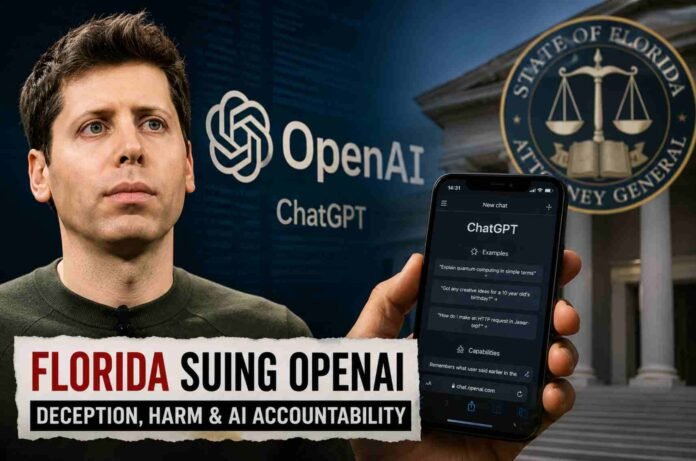
- Florida Attorney General James Uthmeier has filed a civil lawsuit against OpenAI and CEO Sam Altman over alleged deception and consumer harm.
- The lawsuit claims ChatGPT contributed to harmful outcomes, including misinformation, mental health risks, and misuse by bad actors.
- Critics argue OpenAI moved too quickly and failed to adequately warn users about AI’s limitations and risks.
- Holding one company responsible for every negative consequence of AI may oversimplify a much broader technological and societal challenge.
Florida’s Case Against OpenAI Raises Big Questions About AI Accountability
OpenAI and its chief executive Sam Altman are facing growing legal pressure in Florida, where Attorney General James Uthmeier has expanded his challenge against the company with a civil lawsuit that paints a troubling picture of ChatGPT‘s rise. The complaint alleges that OpenAI misled consumers about the capabilities and risks of its technology while releasing powerful AI tools into the public without sufficient safeguards.
According to the filing, OpenAI’s success was built on what the state describes as a pattern of deception that allowed the company to rapidly gain users while downplaying potential dangers. The lawsuit goes further by seeking to hold Altman personally responsible for alleged harm suffered by Florida residents, arguing that company leadership ignored serious risks associated with the widespread deployment of generative AI.
The accusations are serious, but they also raise an important question: how much responsibility should an AI company bear for every negative outcome connected to its technology?
The Challenge of Blaming AI for Human Consequences
The Florida lawsuit links ChatGPT to a wide range of societal concerns, from mental health struggles and misinformation to criminal misuse and declining critical thinking skills. These concerns are not entirely new. Since generative AI entered the mainstream, experts, educators, policymakers, and users have debated its impact on society.
There is little doubt that early AI systems had significant flaws. Initial versions of ChatGPT frequently produced inaccurate information while presenting it with remarkable confidence. The technology often lacked contextual understanding and sometimes reinforced harmful ideas or misconceptions. Many users interpreted fluent responses as reliable answers, creating situations where misinformation could spread easily.
However, attributing every harmful outcome to OpenAI presents a far more complicated challenge. Technologies are often adopted faster than society can understand or regulate them. Social media platforms, smartphones, search engines, and even the internet itself followed similar paths. Each introduced enormous benefits while also creating new risks that became apparent only after widespread adoption.
AI appears to be following that same pattern.
OpenAI’s Safety Evolution Since ChatGPT’s Launch
One of the strongest arguments against the lawsuit’s broader claims is that today’s AI landscape looks very different from the one that existed when ChatGPT first arrived. OpenAI and its competitors have invested heavily in safety systems, content moderation, behavioral guardrails, and risk testing.
Modern AI models are designed to identify dangerous requests, reject harmful instructions, and respond more carefully to sensitive topics. Companies have also expanded transparency efforts and introduced safety evaluations aimed at reducing misuse.
That does not mean the systems are perfect. Hallucinations still occur. Harmful outputs occasionally slip through protections. Bias and reliability concerns remain active areas of research. Yet the industry has clearly moved beyond the early days when conversational AI was largely an experiment unfolding in public.
Critics may argue that those safeguards should have existed from the start. Supporters counter that many lessons could only be learned after real world deployment revealed how people would actually use the technology.
Innovation, Responsibility, and the Cost of Progress
The broader issue extends beyond OpenAI. If courts determine that AI developers can be held liable for every misuse, misunderstanding, or unintended consequence of their products, the legal standard could affect the entire technology sector.
History offers useful comparisons. The arrival of automobiles transformed transportation but also introduced accidents, injuries, and entirely new public safety challenges. Roads, traffic laws, licensing requirements, and safety standards evolved gradually as society adapted. The technology advanced first, while regulation and public understanding struggled to keep pace.
Artificial intelligence may be experiencing a similar moment. Businesses are racing to adopt AI. Consumers increasingly rely on it for information and productivity. Governments are still determining how to regulate it effectively.
That reality does not absolve technology companies of responsibility. Firms developing powerful AI systems should be transparent about risks, invest in safety, and respond quickly when problems emerge. At the same time, assigning blame for every harmful outcome to a single company may overlook the broader societal adjustments that accompany transformative technologies.
The Florida lawsuit will likely intensify the ongoing debate over AI regulation and corporate responsibility. Whether the state can prove its allegations remains to be seen. What is already clear is that the case highlights a growing tension between innovation and accountability, one that will shape the future of artificial intelligence for years to come.
Follow TechBSB For More Updates