
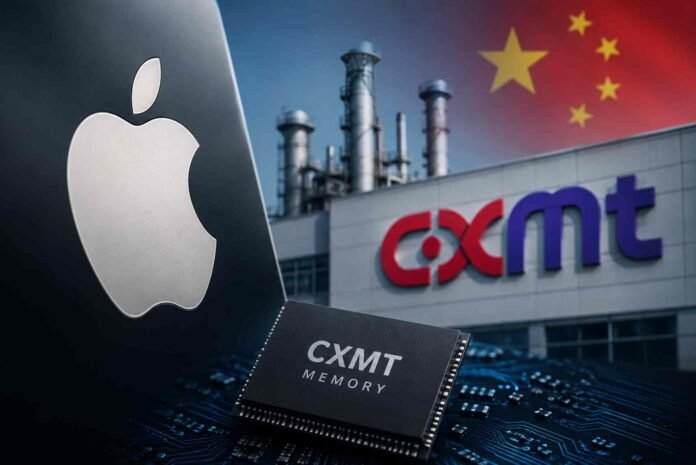
- Apple is testing memory chips from Chinese semiconductor maker CXMT for products including iPhones and MacBooks.
- Early discussions reportedly focus on using CXMT components in devices sold in China.
- The potential partnership could face scrutiny from US policymakers because of CXMT’s position in China’s semiconductor industry.
- Rising AI demand is tightening the global memory supply, pushing Apple to explore additional sources.
Apple is exploring a potentially sensitive new source of memory chips as the global shortage of components intensifies. The iPhone maker has been testing memory products from Chinese semiconductor company CXMT across several product lines, including iPhones and MacBooks, according to people familiar with the matter.
The move comes at a difficult time for the technology industry. Demand for memory chips has surged as artificial intelligence development drives spending on data centers, servers and advanced computing systems. That demand is putting pressure on supplies and pushing major technology companies to look for additional sources.
For Apple, however, turning to CXMT is not simply a question of finding more components. The company would also have to navigate the increasingly complicated relationship between the United States and China.
Apple tests CXMT chips
Apple has reportedly tested memory chips supplied by CXMT in different products as it evaluates whether the Chinese manufacturer could become part of its supply chain.
The testing does not necessarily mean Apple has committed to purchasing large volumes from CXMT. The company is understood to be in the early stages of discussions with the Chinese chipmaker, with the initial focus on potentially using its components in products sold within China.
That distinction is important. Apple operates one of the world’s largest and most complex hardware supply chains, and components normally go through extensive testing before they can be approved for mass production.
Memory is also a critical part of modern devices. Smartphones and computers depend on memory chips for storing and accessing data, while newer AI workloads are creating enormous demand for increasingly sophisticated memory products.
If CXMT can meet Apple’s technical and manufacturing requirements, the relationship could give Apple another option at a time when memory supplies are under pressure.
The political problem behind the deal
The biggest obstacle may not be technical.
CXMT is a Chinese semiconductor manufacturer that has attracted attention from US policymakers. Some officials and policymakers are concerned that partnerships between Chinese chip companies and American technology businesses could provide access to expertise or technology developed in the United States.
That makes any potential Apple deal politically sensitive.
Apple has spent years trying to balance its enormous business in China with increasing pressure from Washington. The company relies heavily on China for manufacturing and also has a large customer base there. At the same time, US restrictions on advanced semiconductor technology have made relationships between American companies and Chinese chipmakers more complicated.
People familiar with Apple’s discussions say the company hopes to obtain approval from the White House to work with CXMT.
Such approval would be significant because it could determine whether Apple’s plans move beyond testing and early discussions.
AI boom makes memory more valuable
The timing of Apple’s move reflects a much broader change in the semiconductor industry.
The rapid expansion of artificial intelligence has created enormous demand for computing hardware. AI systems require large quantities of memory, particularly for high performance data centers. Major technology companies are competing for limited supplies, putting memory manufacturers under pressure to increase production.
That competition can eventually affect consumer electronics manufacturers.
Apple sells hundreds of millions of devices across its product categories, meaning even a relatively small change in component availability can have a major impact on its supply chain.
Finding additional suppliers could therefore help Apple reduce its exposure to shortages and keep production costs and schedules under control.
However, switching suppliers is not straightforward. Memory components need to meet strict requirements for reliability, performance, power consumption and consistency. Apple also has to ensure that any supplier it works with can produce components at the required scale.
What this means for Apple’s supply chain
If Apple eventually receives approval to use CXMT memory chips, the relationship could mark an important development in the company’s approach to component sourcing.
It could also highlight how geopolitical tensions are increasingly influencing the technology supply chain.
For Apple, the attraction is clear. A Chinese memory supplier could provide another source of components at a time when global demand is rising sharply. The company could also potentially use those components in devices intended specifically for the Chinese market.
But the political risks are equally clear.
Any formal relationship with CXMT would likely receive close attention in Washington, particularly as the US continues to tighten controls around advanced semiconductor technology and China’s domestic chip industry.
For now, Apple’s work with CXMT appears to remain at the testing and discussion stage. Whether those tests eventually turn into a commercial agreement will depend not only on the quality and availability of the chips, but also on whether Apple can secure the necessary political approval.
The situation shows just how difficult it has become for global technology companies to separate business decisions from geopolitics. Apple’s search for additional memory supplies is being driven by a straightforward problem: there are not enough chips to comfortably meet growing demand.
The solution, however, may require navigating one of the world’s most complicated technology relationships.
Follow TechBSB For More Updates