
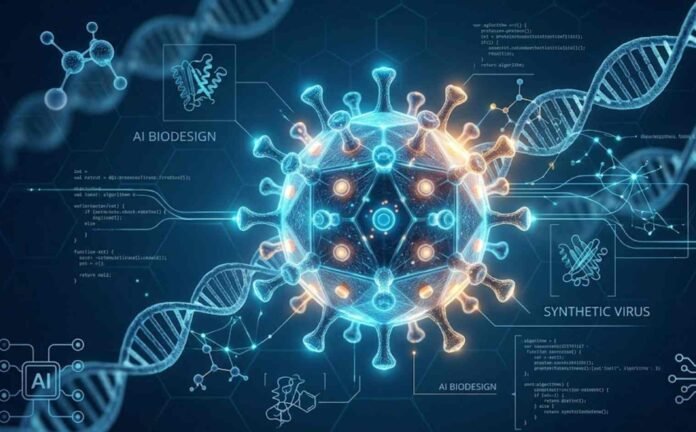
Artificial intelligence has taken another remarkable step into the world of biology. Researchers at Stanford University have used generative AI to design completely new viruses that were later shown to function in laboratory experiments.
The viruses were bacteriophages, often called phages, which are viruses that infect bacteria rather than humans. The researchers created 16 previously unknown phages that were capable of attacking and killing E. coli bacteria.
The achievement is significant because the AI did not simply modify an existing biological sequence. Instead, it was used to generate complete viral genomes. Scientists then produced selected designs in the laboratory to find out whether the computer generated sequences could actually work.
That distinction matters. Designing a useful biological molecule is one thing. Creating an entire genome that can operate inside a living cell is considerably more complicated.
Brian Hie, an assistant professor at Stanford University involved in the research, described the work as new territory for his team. The researchers believe it represents an important step towards using generative AI to design biological systems rather than simply analyse biological data.
The work also highlights a difficult question facing the technology industry and the scientific community. If AI can create new biological systems for beneficial purposes, what safeguards are needed to make sure the same capabilities cannot be turned towards harmful applications?
AI learns the language of biology
The technology behind the research follows an idea that will sound familiar to anyone who has used a modern generative AI system.
Large language models learn patterns in written language and use those patterns to predict what should come next. The researchers applied a similar principle to genetic information.
The models, known as Evo1 and Evo2, were trained using large collections of genetic sequences from organisms including viruses, bacteria, plants and humans. Instead of predicting words or sentences, the systems learned patterns found in DNA.
The researchers then adapted the models for bacteriophages. They generated hundreds of potential viral genomes and selected 302 designs that appeared promising enough to test experimentally.
Those designs were synthesised and examined in the laboratory. Sixteen successfully produced phages that could infect and kill E. coli.
For the researchers, seeing the computer generated designs work in the real world was a major moment. The team placed the phages against bacterial cultures and watched for clear areas where the bacteria had been destroyed.
The successful results demonstrate something important about generative biology. AI is beginning to move beyond predicting what biological sequences might do and towards proposing entirely new sequences that can perform a function.
That does not mean computers can currently create any virus they want. The experiment involved a relatively simple class of viruses with a narrow target, and the researchers deliberately designed the project around safety restrictions.
The medical potential is considerable
One of the most promising applications is the treatment of bacterial infections that no longer respond well to antibiotics.
Antibiotic resistance is already a major medical problem. As some bacteria become resistant to commonly used drugs, researchers are looking for alternative ways to destroy harmful bacteria.
Phage therapy is one potential approach. Because bacteriophages naturally attack bacteria, scientists have been investigating whether they can be used as targeted treatments.
AI could make that process much faster by helping researchers explore biological designs that would be difficult or extremely time consuming to develop manually.
The Stanford work suggests that AI could eventually help create phages designed to target particular bacterial strains. Such systems could potentially complement existing antibiotics or provide another option when conventional treatments fail.
The wider possibilities extend beyond phages. Researchers working in synthetic biology are also interested in using AI to develop new enzymes, therapeutic proteins, antibodies and other biological tools.
However, there is an important limitation to keep in mind. A successful computer generated phage is still a long way from designing a complex living organism.
The phage genomes used in the research were around 5,400 DNA base pairs long. By comparison, the genome of even one of the smallest known cellular organisms is vastly larger, while the human genome contains roughly three billion base pairs.
That difference illustrates how much further the technology would need to advance before AI could independently design complex life.
Safety concerns are growing alongside the technology
The scientific achievement also comes with serious questions about biosafety and biosecurity.
The same basic capability that can be used to create a useful phage could, in a different context, raise concerns about the design of viruses capable of causing disease.
Experts commenting on the research have argued that these questions need to be addressed now rather than after the technology becomes more powerful.
The Stanford researchers took several precautions. They focused on bacteriophages rather than viruses that infect humans and excluded viruses capable of infecting complex organisms from the training data used for the project. The work was also conducted in a controlled laboratory environment.
These restrictions were intended to keep the research focused on beneficial applications while limiting potential risks.
The researchers say safeguards will become increasingly important as AI systems become better at biological design. The challenge will be finding a balance that allows scientists to use the technology for medicine and research without making dangerous biological engineering easier.
The latest research therefore represents both an opportunity and a warning.
AI has demonstrated that it can move from understanding biological information to proposing new genetic designs that work in the laboratory. That could eventually transform areas such as drug discovery, infectious disease treatment and biotechnology.
At the same time, it shows why responsible development needs to keep pace with technical progress.
For now, the Stanford experiment is focused on viruses that attack bacteria, not people. But its broader message is much bigger. Generative AI is beginning to enter a new phase where computers are not simply helping scientists understand biology. They are starting to help write it.
Follow TechBSB For More Updates