
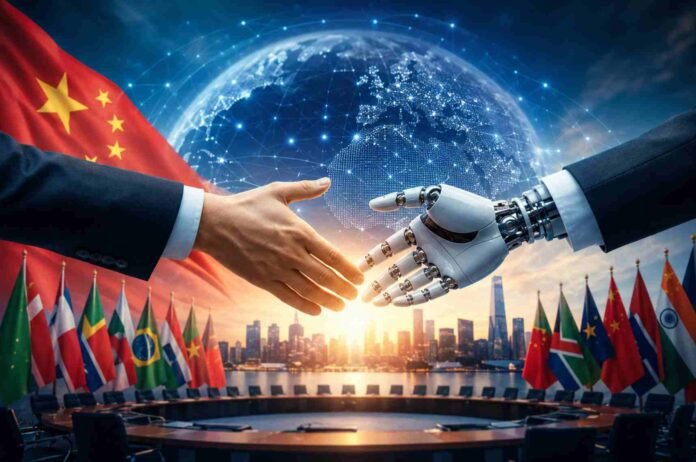
- China has officially launched WAICO with 29 founding member countries to promote international AI cooperation and governance.
- Xi Jinping called for open, responsible, and human centered AI development while opposing technology restrictions.
- WAICO strengthens China’s effort to influence global AI regulations as competition with the United States continues.
- The new alliance reflects China’s broader strategy to shape future international AI policies through cooperation with Global South nations.
Artificial intelligence is no longer just about building smarter software or faster chips. It has become a major geopolitical battleground, with countries competing not only in technology but also in setting the rules that will govern its future.
China has now taken another significant step in that race by launching the World Artificial Intelligence Cooperation Organisation, or WAICO, during the World Artificial Intelligence Conference in Shanghai.
Chinese President Xi Jinping used the global gathering to present a vision of AI that focuses on international cooperation, open source development, and shared governance. While the message emphasized collaboration, analysts believe the initiative is also a strategic move to strengthen China’s influence over global AI standards at a time when competition with the United States continues to intensify.
Xi Jinping Calls for Global Cooperation on AI
Speaking at the conference in Shanghai, Xi Jinping urged countries to work together instead of treating artificial intelligence as a technology controlled by a handful of powerful nations. According to Xi, AI should benefit all countries, especially developing economies that may otherwise struggle to keep pace with rapid technological change.
He argued that AI development should be built on international cooperation rather than competition. Xi also warned against expanding national security restrictions in ways that prevent technological progress or limit access for other nations.
Another major theme of his speech was responsible AI development. Xi stressed that artificial intelligence should always remain under human oversight. He highlighted the importance of regulatory safeguards, technical monitoring, early warning systems, and emergency response mechanisms to reduce the risks associated with increasingly capable AI systems.
China also reiterated its commitment to supporting AI development in Africa, Asia, and Latin America through technology cooperation and capacity building. This message reinforces Beijing’s growing focus on strengthening ties with developing nations.
What Is WAICO and Why Was It Created?
The World Artificial Intelligence Cooperation Organisation officially began operations on July 16 with 29 founding member countries. Headquartered in Shanghai, the organization aims to encourage international AI cooperation while helping member countries develop policies that promote safe and beneficial use of artificial intelligence.
The founding members include several influential Global South nations such as Brazil, Indonesia, Malaysia, Pakistan, Senegal, South Africa, and Russia.
Although China first introduced the idea of a global AI alliance in 2025, WAICO now provides a formal platform through which member countries can coordinate AI policies and governance.
Its stated mission focuses on creating international standards, encouraging collaboration in AI research, and ensuring that artificial intelligence remains accessible to a wider group of nations instead of being dominated by a few technology leaders.
Many policy experts believe WAICO could eventually become an important voice in future United Nations discussions about AI governance.
AI Has Become the Center of the US China Technology Rivalry
The launch of WAICO comes as competition between China and the United States continues to grow across several technology sectors.
Artificial intelligence depends heavily on advanced semiconductors, massive computing infrastructure, and enormous amounts of electricity. While the United States maintains an advantage in cutting edge chip design, China has invested heavily in expanding domestic semiconductor manufacturing and building one of the world’s largest AI infrastructure networks.
China also benefits from a strong supply of critical minerals needed for semiconductor production and operates extensive data centers supported by significant electricity generation capacity. These advantages help power large scale AI training even as Chinese companies continue to face restrictions on acquiring the most advanced American chips.
The United States has tightened export controls on high performance semiconductors destined for Chinese firms, citing national security concerns. China has responded by restricting exports of certain critical minerals and dual use technologies.
As this technology competition intensifies, AI governance has become another area where both countries hope to shape the future international order.
Why WAICO Could Influence Global AI Rules
For China, WAICO is about more than technological cooperation. It is also an opportunity to influence how artificial intelligence is regulated around the world.
Countries have struggled to establish international rules that keep pace with AI’s rapid development. Questions surrounding military applications, cybersecurity, privacy, misinformation, and ethical use remain unresolved.
Analysts believe China sees an opportunity to play a leading role while many international governance efforts remain fragmented. By bringing together a coalition of developing and middle income countries, Beijing could build support for its preferred approach to AI regulation in future global forums.
Experts also suggest that China’s strategy reflects a broader effort to expand its influence in international technology institutions. Instead of simply exporting AI infrastructure, Beijing now appears focused on helping shape the global policies that will govern artificial intelligence for years to come.
Follow TechBSB For More Updates

