
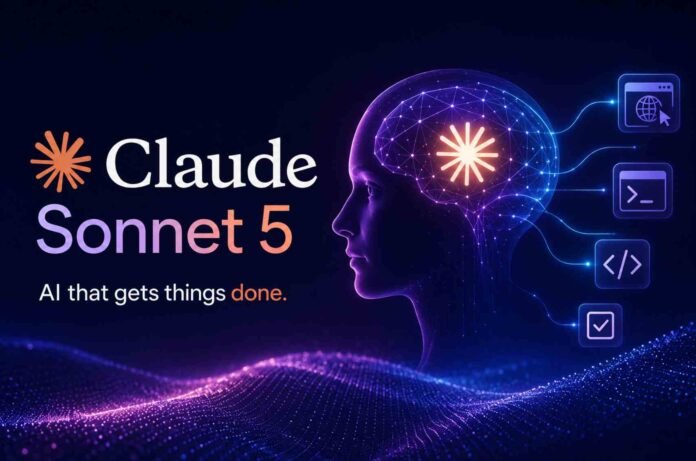
Anthropic has introduced Claude Sonnet 5, its latest AI model that places a stronger emphasis on autonomous task execution rather than simple conversations. The company describes it as its most capable Sonnet model so far, highlighting significant improvements in planning, tool usage, coding, and independent problem solving. While AI companies have spent the past few years competing over which chatbot can provide the most natural responses, the latest release suggests that the competition is entering a very different stage.
Instead of focusing only on answering prompts, Claude Sonnet 5 is built to take on larger and more practical assignments. It can create plans, use tools such as web browsers and terminal environments, and complete multi step workflows with much less user guidance. Anthropic believes these improvements bring advanced AI capabilities to a wider audience without requiring access to larger or more expensive models.
Perhaps the biggest surprise is that Sonnet 5 is not reserved for premium subscribers. Anthropic has made it available across all Claude plans, including Free and Pro users, while Team, Max, Enterprise customers, and Claude Code developers also gain access from day one.
AI is moving from conversation to action
The release of Claude Sonnet 5 reflects a much larger transformation taking place across the artificial intelligence industry. For years, AI companies measured progress by how well their chatbots could answer questions, summarize information, or generate content. That benchmark is rapidly changing.
Modern AI systems are increasingly expected to function as digital assistants capable of carrying out meaningful work. Rather than stopping after providing instructions, these systems are being designed to execute tasks themselves. This includes researching information, writing and debugging software, navigating websites, organizing projects, and handling workflows with minimal supervision.
Anthropic says Claude Sonnet 5 represents another step toward that vision. According to the company, the model can plan tasks more effectively, decide which tools to use, and complete assignments that previously required significantly larger AI models.
This growing focus on agentic AI is quickly becoming the industry’s next major battleground. Instead of competing solely on conversational intelligence, developers are racing to build assistants that can independently solve real world problems from beginning to end.
Stronger coding performance takes center stage
One of the biggest improvements in Claude Sonnet 5 comes in software development. Anthropic positions the model as a powerful coding assistant capable of handling complex programming tasks with greater accuracy and efficiency than earlier versions.
The company reports that Sonnet 5 achieved an 80.5 percent score on the Agentic Coding Terminal bench 2.1 benchmark. By comparison, Claude Sonnet 4.6 scored 67 percent on the same evaluation. While benchmark scores never tell the complete story of real world performance, the results suggest meaningful gains in handling coding workflows that involve planning, debugging, and interacting with development tools.
These improvements also extend beyond programming. The model is designed to support professional work across research, content creation, technical documentation, and other productivity focused tasks where multiple steps and tool interactions are required.
Making these capabilities available even to free users also reflects Anthropic’s confidence in the model’s efficiency and scalability. Instead of limiting advanced features behind expensive subscriptions, the company is using Sonnet 5 as its default experience across most of the Claude ecosystem.
The AI race is becoming an agent race
Claude Sonnet 5 arrives at a time when nearly every major AI company is shifting toward autonomous assistants. The industry’s focus is no longer limited to creating chatbots that sound more human. The goal now is to build AI systems that can independently manage increasingly complex responsibilities.
Recent product announcements across the industry highlight this trend. Companies are investing heavily in AI systems that can browse the web, analyze information, interact with software, write code, and complete tasks from start to finish. The conversation is gradually moving away from who has the smartest chatbot toward who can build the most reliable digital worker.
Anthropic’s latest launch reinforces that direction. By combining stronger reasoning with better planning and tool usage, Claude Sonnet 5 aims to reduce the amount of manual guidance users need to provide. Instead of repeatedly prompting the model through every stage of a project, users can assign broader objectives and expect the AI to determine the necessary steps on its own.
Follow TechBSB For More Updates