
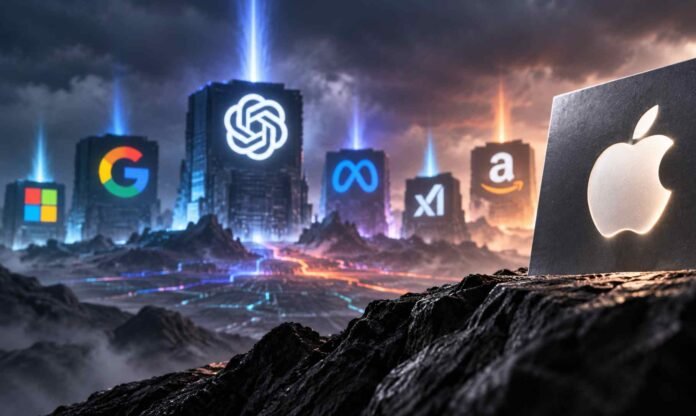
- Tech companies are spending unprecedented amounts on AI infrastructure and advanced models.
- Apple is investing in AI but is avoiding the aggressive spending race followed by its rivals.
- Apple’s strength lies in its massive device ecosystem, distribution and ability to integrate technology for mainstream users.
- The risk is that Apple could wait too long and allow another company to control the future AI platform.
The AI race has become the biggest and most expensive technology battle of the modern era. OpenAI, Google, Anthropic, Meta, xAI, Microsoft and Amazon are pouring extraordinary amounts of money into data centres, chips and advanced AI models.
The competition is so intense that some have started calling it the AI Third World War. The phrase may sound dramatic, but it captures the scale of what is happening. This is no longer just about building a better chatbot. The companies involved are competing for influence over the next major computing platform.
And while the rest of Silicon Valley appears to be racing at full speed, Apple is taking a noticeably different route.
That could prove to be a mistake. Or it could be one of the smartest strategic decisions in technology.
Everyone is spending, and the numbers are getting bigger
The scale of investment in artificial intelligence is difficult to ignore.
OpenAI and its infrastructure partners have outlined massive plans for expanding computing capacity. Google is investing heavily in servers and data centres. Meta continues to build AI infrastructure at an enormous pace, while Amazon and Microsoft are also committing vast sums to the computing systems needed to support the next generation of AI.
Then there are companies such as Anthropic and xAI, which are also making aggressive moves to secure access to the chips and computing power needed to compete.
This is what makes the current AI race different from earlier technology battles.
The winners will not necessarily be the companies with the cleverest software alone. They will need access to powerful chips, reliable electricity, enormous data centres, talented researchers and enough money to keep spending when the returns are still uncertain.
The logic is straightforward. More computing power can help create more capable AI models. Better products can attract more users. More users can bring in more revenue and strengthen a company’s position. That revenue can then fund even more infrastructure.
It is an expensive cycle, and once a company falls behind, catching up could become increasingly difficult.
Apple is playing a completely different game
Apple is hardly ignoring artificial intelligence.
The company has continued to invest heavily in research, development and AI infrastructure, while Apple Intelligence and Siri remain central to its plans for the future.
But Apple is not behaving like a company determined to win the frontier model race at any cost.
Instead of attempting to outspend everyone, Apple appears to be taking a more selective approach. It is developing its own capabilities while also working with outside partners where that makes strategic sense.
That distinction matters.
Apple has rarely been obsessed with being first. Its biggest successes have often come from taking an existing idea and turning it into something that works better for mainstream consumers.
The iPod did not invent digital music players. The iPhone was not the first smartphone. The iPad did not create the tablet computer.
What Apple did was combine technology, software, hardware and design into products that felt more complete and easier to use.
AI may be the next test of that philosophy.
Why fight the war when others are doing the expensive part?
There is a strong argument that Apple is letting its competitors take the biggest risks.
Right now, companies across the AI industry are spending huge amounts to answer questions that nobody can fully answer yet.
Which AI models will dominate? Will consumers pay for premium AI services? Will AI agents become the main way people use computers? How valuable will enormous frontier models actually become?
OpenAI, Google, Anthropic, Meta and others are effectively testing these questions in public and at enormous cost.
Apple can observe the results.
If a small number of AI platforms emerge as clear winners, Apple could potentially integrate the strongest technology into its own ecosystem rather than spending hundreds of billions trying to predict the future before everyone else.
That approach gives Apple something valuable: flexibility.
The company already controls the devices, operating systems and custom chips used by a huge global customer base. It also has one of the strongest distribution networks in consumer technology.
If AI becomes a standard part of everyday computing, Apple does not necessarily need to own every piece of the underlying technology to benefit from it.
It simply needs to make AI useful on the devices people already own.
But waiting comes with a serious risk
Of course, strategic patience can easily become strategic delay.
Technology platforms often become powerful because they build momentum early. Developers, businesses and consumers gather around the platforms that gain traction first.
Google built enormous influence through search. Apple and Google gained control over mobile ecosystems because developers followed their users.
AI could create an even bigger shift if intelligent agents eventually become the main interface between people and software.
Imagine a future where users no longer open dozens of apps. Instead, they ask an AI agent to book travel, manage finances, shop, write documents and control devices.
The company controlling that relationship could become extraordinarily powerful.
That is the danger for Apple.
If another company becomes the default intelligence layer between users and the digital world, Apple could find itself controlling excellent hardware while someone else controls the most important part of the experience.
That would be a very different position from the one Apple enjoys today.
The biggest question is whether Apple can arrive late again
Apple has the money, the customer base, the chips and the ecosystem needed to compete if it decides the moment is right.
Its restraint therefore looks less like an inability to participate and more like a calculated decision about timing.
The company may believe that the AI market is still too chaotic to justify joining an infrastructure spending war without knowing which technologies will matter in the long term.
That strategy has worked before.
But AI may move faster than smartphones, music players or tablets ever did. The companies building the earliest AI platforms are not simply creating products. They are trying to establish habits, ecosystems and relationships that could become difficult to challenge.
Apple’s gamble is simple but significant.
Wait long enough, and competitors may spend billions discovering what works. Enter at the right moment, and Apple could use its enormous reach to bring the winning technology to the mainstream.
Wait too long, however, and the future of computing may already belong to someone else.
That is what makes Apple’s position in the AI race so interesting.
The biggest winner may not necessarily be the company that spends the most money.
It could be the company that knows exactly when to start spending.
Follow TechBSB For More Updates