
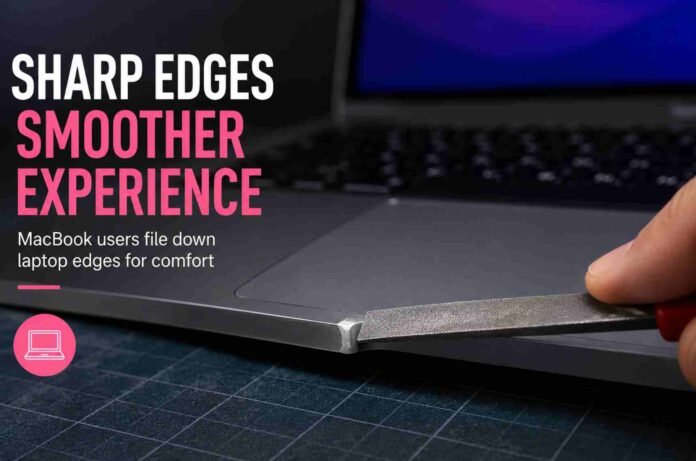
- MacBook users are sanding the front edge of their laptops to improve wrist comfort.
- Software engineer Max Bretschneider shared a detailed guide showing the modification process.
- Similar MacBook modifications have been reported for years, with examples dating back to 2010.
- The process is permanent and could affect warranty or resale value, but many users say the comfort improvement is worth it.
Apple has built its reputation on premium industrial design, with MacBooks often praised for their clean aluminum construction and minimalist appearance. However, one design choice continues to divide users. Many MacBook owners believe the front edge of the laptop is simply too sharp, especially during long typing sessions.
Instead of waiting for Apple to redesign its laptops, some users have taken an unusual route. They are physically filing and sanding the front edge of their MacBooks to make them more comfortable on their wrists. While the modification sounds extreme, it has gained attention after several users shared their experiences online, claiming the result significantly improves day to day usability.
The trend has sparked discussions across the tech community, with many saying the sharp edge has been a long standing complaint that Apple has never fully addressed.
Software engineer documents the entire modification process
One of the latest examples comes from software engineer Max Bretschneider, who detailed the entire process on his personal blog. According to him, the motivation was straightforward. Since laptops are regularly used on desks as well as on the lap, the wrists naturally rest against the front edge for extended periods. On MacBooks, that edge can create noticeable discomfort during long work sessions.
To soften the edge, Bretschneider used a standard metal file followed by progressively finer grades of sandpaper. Before starting, he carefully protected sensitive parts of the laptop by covering the keyboard and trackpad with tape. The MacBook was also clamped securely in place to prevent unwanted movement during the filing process.
Although he admitted the first few minutes were intimidating because of the permanent nature of the modification, he explained that the task became much easier once he got started. With patience and steady work, he managed to create a smooth and even finish without affecting the laptop’s functionality.
His conclusion was simple. The modified edge made the MacBook much more comfortable to use, allowing it to better serve its primary purpose as a work tool rather than just a beautifully designed device.
This is not the first time MacBook owners have done it
While the latest blog has attracted widespread attention, the idea itself is far from new. Similar modifications have appeared online for years.
Designer Kent Walters shared a comparable project earlier in 2026, showing how he rounded the sharp edge of his own MacBook. Looking even further back, discussions about sanding MacBook edges date back to at least 2010. That history suggests this is not a passing internet trend but an issue some users have quietly addressed for well over a decade.
The discussion also resurfaced on Hacker News, where multiple users agreed that the sharp aluminum edge has been an annoyance since Apple’s unibody MacBook design first appeared. Others pointed specifically to the newer M series MacBook Pro models, saying the front lip remains one of their biggest ergonomic complaints despite improvements in performance, battery life and display quality.
Not everyone would be comfortable modifying an expensive laptop in this way, but the growing number of examples shows that some users value comfort over preserving the factory finish.
Apple fans continue to push hardware beyond its original design
The MacBook edge modification joins a long list of creative hardware projects carried out by Apple enthusiasts. Over the years, users have upgraded older iPhones with USB C ports long before Apple officially adopted the standard. Others have created custom mechanical keyboards that retain Touch ID support or installed modern Mac mini hardware inside vintage iMac shells.
Storage upgrades, custom repairs and hardware conversions have also become increasingly common as experienced users look for ways to extend the usefulness of Apple products beyond their original specifications.
The latest sanding trend follows that same philosophy. Rather than accepting a design compromise, some owners are willing to make permanent physical changes if they believe it results in a better everyday experience.
Of course, modifying a MacBook in this way carries clear risks. Filing the aluminum body is irreversible and could affect resale value. It may also have warranty implications if the laptop later requires service. Anyone considering such a modification would need to work carefully, protect internal components from metal dust and accept full responsibility for the outcome.
For most users, leaving the laptop untouched remains the safest option. However, the growing number of successful examples highlights an interesting reality. Even products celebrated for their design are not immune from criticism, and for some MacBook owners, a smoother front edge is worth more than maintaining a flawless factory finish.
Follow TechBSB For More Updates