
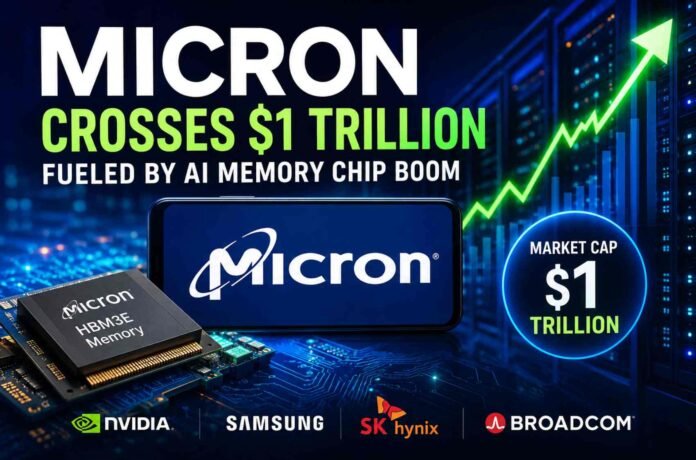
- Micron crossed a $1 trillion market valuation after shares jumped 18% in one day.
- AI driven demand for high speed memory chips is fueling the company’s explosive growth.
- Major hedge funds including Appaloosa and Bridgewater are aggressively increasing investments in Micron.
- Investors are now watching Micron’s upcoming earnings report for signs that AI demand remains strong.
Micron Technology has officially entered one of Wall Street’s most exclusive clubs. The semiconductor giant crossed a staggering $1 trillion market valuation on Tuesday after its stock surged 18% in a single trading session, powered by growing investor confidence in the future of AI infrastructure.
The rally followed a dramatic bullish call from UBS analysts, who raised their target price on Micron shares to $1,625. The new forecast instantly became the highest target among all major Wall Street firms covering the company and suggested that Micron could still have significant room to grow over the next year.
The sudden rise highlights a major shift in how investors view memory chipmakers. For years, companies in the memory business were treated as cyclical and highly vulnerable to downturns. Today, AI has completely changed that narrative.
Why Micron Has Become Essential To The AI Boom
The artificial intelligence race is no longer just about powerful processors. Memory has become equally critical.
Micron manufactures high speed memory chips used inside AI servers and data centers. These chips work alongside processors from companies like Nvidia, feeding them massive amounts of data in real time. Without advanced memory systems, even the most powerful AI processors cannot operate efficiently.
That demand has transformed Micron from a traditional semiconductor manufacturer into one of the most strategically important companies in the AI ecosystem.
Modern AI models require enormous memory capacity to train and run complex workloads. As businesses continue expanding AI infrastructure, demand for high bandwidth memory chips has exploded across the industry.
Micron CEO Sanjay Mehrotra recently revealed that the company’s entire 2026 supply of high bandwidth memory chips has already been sold out. That announcement reinforced concerns that supply may remain tight for years, further supporting higher prices and stronger margins.
The company is also benefiting from its position in a highly concentrated market. Only three companies globally can produce advanced AI memory chips at scale. Alongside Micron, the list includes Samsung and SK Hynix.
Unlike some competitors that focus mainly on long term storage chips, Micron has aggressively expanded into active memory products designed specifically for AI workloads. That strategic positioning is now paying off in a massive way.
Wall Street Is Rapidly Increasing Its Bet On Micron
Investor enthusiasm around Micron has accelerated sharply in recent months.
The company’s stock has climbed 177% since the start of the year and has gained more than 800% over the past twelve months. That makes it one of the strongest performers in the S&P 500 during the AI driven market rally.
Large hedge funds and institutional investors are also increasing their exposure.
David Tepper’s Appaloosa Management boosted its Micron position by 11% this year, making the stock one of the fund’s largest holdings. Meanwhile, Ray Dalio’s Bridgewater Associates significantly expanded its stake, increasing its position by nearly 66% in its latest filing.
Bridgewater also reduced exposure to enterprise software companies including Salesforce and ServiceNow while increasing investments in semiconductor leaders tied to artificial intelligence growth.
The trend reflects a broader shift happening across Wall Street. Investors are increasingly prioritizing hardware companies that directly support AI infrastructure instead of software businesses facing slower growth and rising competition.
Manufacturing Expansion Strengthens Micron’s Position
Micron is not slowing down its expansion plans.
Last week, the company announced a $2 billion expansion of its manufacturing facility in Manassas, Virginia. The move is part of a broader effort to strengthen domestic semiconductor production in the United States.
Governments and technology companies alike are pushing to reduce dependence on overseas chip manufacturing while securing long term AI supply chains. Micron stands to benefit heavily from that shift.
The company’s growing manufacturing footprint could also help it maintain tighter control over future supply as competition intensifies.
Still, challenges remain.
Samsung and SK Hynix are aggressively expanding their own AI memory production capabilities. If supply eventually catches up with demand, pricing pressure could emerge across the sector. Investors will be closely watching whether Micron can maintain its current momentum as competitors ramp up capacity.
All Eyes Turn To Micron’s Upcoming Earnings Report
Micron’s next earnings report, expected in June, could become one of the most closely watched events in the semiconductor industry this year.
Investors will focus on several critical areas including production timelines for next generation memory chips, long term customer agreements, profit margins, and future demand forecasts.
Any signs of supply weakness or slowing orders could impact sentiment quickly. However, if Micron continues delivering strong guidance and confirms sustained AI demand, the company may strengthen its position as one of the defining winners of the artificial intelligence era.
For now, Wall Street appears convinced that memory chips are no longer a background technology. They have become one of the core foundations powering the future of AI computing.
Follow TechBSB For More Updates