
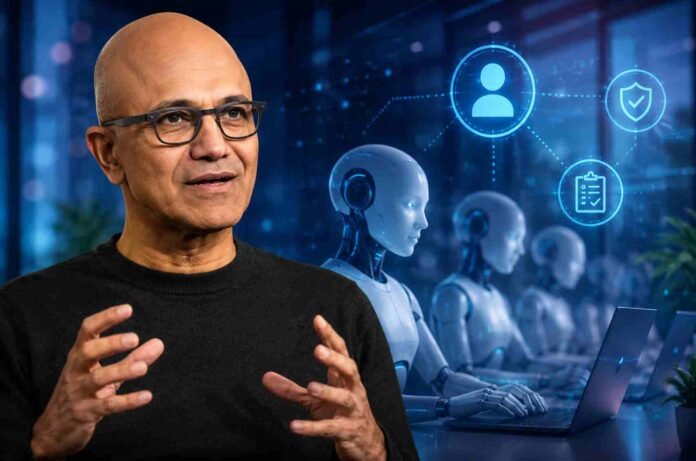
Microsoft CEO Satya Nadella believes the next phase of artificial intelligence will require companies to rethink how they manage digital workers. As organizations increasingly deploy AI agents across departments, Nadella argues that these systems should be treated much like human employees, complete with identities, access controls, oversight mechanisms, and accountability measures.
Speaking during a recent conversation with entrepreneur and investor Reid Hoffman on the Possible Podcast, Nadella shared insights into how Microsoft is approaching the growing challenge of managing large numbers of AI agents. His comments highlight a broader industry shift as businesses move beyond experimenting with AI and begin integrating autonomous systems into everyday operations.
AI Agents Are Becoming Digital Coworkers
As AI adoption accelerates, companies are no longer using artificial intelligence solely for simple tasks such as drafting emails or generating summaries. Modern AI agents are increasingly capable of handling complex workflows, making decisions, and carrying out assignments with minimal human involvement.
According to Nadella, this evolution means organizations need a structured framework for managing these digital entities. Rather than treating AI agents as ordinary software tools, businesses should view them as members of the workforce with clearly defined responsibilities and limitations.
He explained that AI agents need their own identities within corporate systems. They should operate inside controlled environments and be governed by policies that determine what information they can access and what actions they are authorized to perform.
The goal is to ensure that AI agents remain secure, accountable, and aligned with organizational objectives as their responsibilities continue to expand.
Managing Hundreds of AI Agents Creates New Challenges
Nadella also offered a glimpse into his own experience using AI powered tools at Microsoft. He revealed that he frequently works with around 100 AI coding agents simultaneously.
While these agents can significantly improve productivity, overseeing them is far from simple. Nadella admitted that coordinating and monitoring such a large number of AI systems can place a substantial burden on users.
The challenge is not necessarily the capability of the agents themselves. Instead, it is the effort required to supervise, direct, and evaluate their output. Managing dozens or even hundreds of autonomous systems through conversational interfaces can quickly become overwhelming.
This issue is expected to become increasingly relevant as organizations deploy more AI agents across engineering, customer service, operations, finance, and other business functions.
The comments underscore a growing realization within the technology sector that successful AI implementation depends not only on model performance but also on effective governance and management practices.
Microsoft Builds Infrastructure for AI Governance
To address these concerns, Microsoft has been developing tools designed specifically for AI agent management. Nadella highlighted the company’s Agent 365 initiative, which combines several Microsoft technologies to create a governance framework for AI systems.
Among the tools involved is Entra, Microsoft’s identity and network access platform. This technology helps establish digital identities and permissions for AI agents, ensuring they only access resources relevant to their assigned tasks.
Another important component is Purview, Microsoft’s data governance solution. The platform enables organizations to classify, monitor, and track data generated by AI systems, providing greater transparency into how agents operate and what information they create.
Together, these technologies are intended to give enterprises greater control over increasingly autonomous AI environments.
Security and Accountability Will Define Enterprise AI
For Nadella, the future of enterprise AI depends heavily on trust. Businesses will only feel comfortable deploying large numbers of AI agents if they can confidently monitor and control them.
That confidence comes from four key pillars: security, containment, manageability, and observability. Security ensures agents operate safely. Containment prevents them from exceeding their intended scope. Manageability allows organizations to oversee agent behavior efficiently. Observability provides visibility into actions, decisions, and outcomes.
These principles mirror the way companies manage human employees through permissions, oversight, compliance policies, and performance monitoring.
Follow TechBSB For More Updates