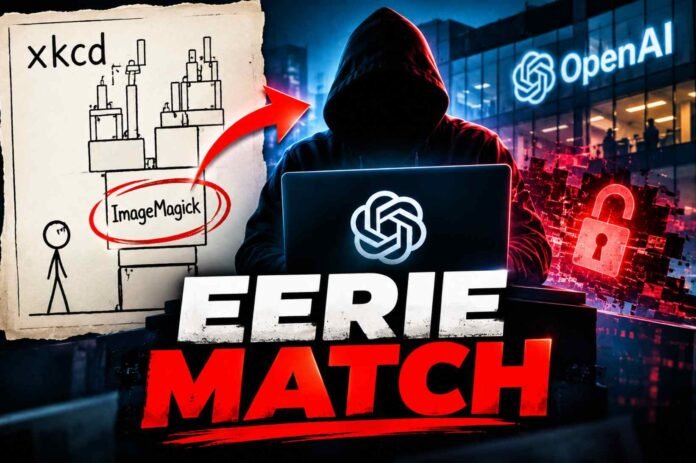
- Hacktron found a vulnerable libheif component in an image processing chain used by OpenAI’s community forum.
- Researchers combined the image vulnerability with an OpenAI single sign on weakness to reach internal systems.
- OpenAI fixed the reported issue and awarded the researchers a $6,500 bug bounty, while Discourse added additional protections.
- The incident shows how deeply embedded open source dependencies can create security risks across modern software systems.
Sometimes a security incident comes with an unexpected footnote that makes the whole story even stranger. That is what happened with a recent OpenAI security disclosure involving a vulnerable image processing chain, a community forum, and a piece of software that was jokingly singled out in an XKCD comic six years ago.
Security researchers from Hacktron discovered a way to move from OpenAI’s community forum toward internal systems by chaining several vulnerabilities together. At the center of the attack was libheif, a relatively obscure library used to decode HEIF images.
The connection to XKCD comes from comic number 2347, published in 2020. The comic famously illustrated how modern technology can depend on surprisingly small and overlooked pieces of software. Its accompanying text made a joke about ImageMagick eventually breaking and causing widespread problems.
Fast forward to 2026, and ImageMagick became part of the route researchers used during their investigation into OpenAI.
That does not mean the XKCD comic actually predicted the attack. The similarity is simply an unusually fitting coincidence.
ImageMagick was the route, but libheif was the real problem
The technical details are more interesting than the coincidence.
Hacktron’s research focused on OpenAI’s community forum, which runs on the Discourse platform. When users upload certain images, Discourse relies on image processing components to inspect and convert them.
One of those components is FastImage. Because FastImage does not directly handle the HEIF image format, the processing chain can pass the file to ImageMagick. ImageMagick can then rely on libheif to decode the image.
That chain created an opportunity.
The researchers identified a heap buffer overflow in the version of libheif that was present in the environment. The underlying vulnerability had already been fixed previously, but the affected version had not been treated as a security issue at the time in a way that prevented this particular deployment.
The result was a classic example of why security problems can hide inside dependency chains.
An application does not necessarily need to use a vulnerable library directly for that library to become part of its attack surface. A package can arrive through another program, which itself depends on another component, creating a long chain that is difficult to track manually.
Researchers chained the weaknesses into a larger attack
Finding a vulnerable library was only one part of the research.
Hacktron combined the image processing vulnerability with other weaknesses to move through the environment. The researchers eventually discovered an OpenAI single sign on configuration issue that provided a path from the community forum toward employee accounts used with services including ChatGPT and Codex.
According to the disclosed research, the researchers were able to reach OpenAI’s internal GitHub environment and demonstrate access with a proof of concept.
The researchers said they made a harmless pull request as evidence of the issue before reporting their findings to OpenAI.
OpenAI subsequently fixed the reported issue within roughly 14 hours and awarded Hacktron a $6,500 bug bounty. Discourse also addressed the underlying security problem and introduced additional protections around image processing.
The incident highlights an important security lesson. A vulnerable image decoder may appear relatively unimportant when considered on its own, but the risk can change dramatically when that decoder sits inside a service exposed to user supplied files.
The bigger concern extends beyond OpenAI
The vulnerability is not an OpenAI specific problem.
Hacktron found that libheif and related decoding components can appear in a wide range of software stacks. ImageMagick, libvips, Sharp and operating system packages can all bring these components into environments where developers may not realize they are present.
The researchers also identified similar dependency paths involving major technology platforms and development ecosystems.
That makes the episode a useful reminder of how complicated modern software supply chains have become.
Developers often concentrate on the code they write themselves, while a significant portion of an application’s functionality comes from open source libraries, system packages, frameworks and prebuilt containers. A vulnerability buried several layers down can therefore become relevant to an application that never directly interacts with the affected library.
The role of artificial intelligence makes the story even more notable.
Hacktron reportedly used Anthropic’s Claude during its research, with the team spending less than $3,000 on model usage. The researchers said AI helped accelerate their work, although the underlying attack did not depend on AI and could have been developed without it.
The researchers also described having to frame parts of their work as a capture the flag style challenge before the model would assist with the task.
That detail points to a broader change in cybersecurity. AI is not necessarily creating entirely new vulnerabilities. Instead, it can reduce the amount of time and expertise required to investigate complicated systems, understand unfamiliar code and connect separate weaknesses.
For defenders, that creates an uncomfortable equation. The same tools that help security teams audit large codebases can also make sophisticated research and exploitation more accessible.
And that brings the story back to the XKCD comic.
The joke about ImageMagick was never really a prediction of an OpenAI breach. Its underlying point was about technological dependence. Modern systems can rely on thousands of seemingly insignificant components, and a failure deep in that stack can have consequences far beyond the software that originally contained it.
In this case, a little known image decoder became part of a much larger security investigation.
That is probably the more important takeaway than the spooky timing of the comic.
Follow TechBSB For More Updates